Search This Blog

Showing posts sorted by date for query john sanders row. Sort by relevance Show all posts

Wednesday, August 23, 2017

Dr. John Samuel Apperson

Dr. John Samuel Apperson (courtesy of Ellen Apperson Brown)

     "February 2, 1859. This morning was one of uncommon interest to me. I arose early and prepared myself to leave, for where, I hardly know" [1]. So begins the diary of 21-year-old John Samuel Apperson, a remarkable document written by a man confident that an adventuresome and successful future lay ahead of him. Future events would justify his optimism.

Malinda and Alfred Apperson (Jack Apperson, Ancestry)

     Born into humble circumstances in Orange County on August 21, 1837, John achieved a great deal in his lifetime. He was a man of many resources, and utilized his native talents to become successful in the fields of both medicine and business. He married twice and was the father of eleven children, some of whom became successful in their own right.
     John was the oldest of six children born to Alfred Apperson and Malinda Jones, who were married in Orange County on September 3, 1836. As a young man, Alfred had worked as an overseer. He later bought a 170-acre farm in Orange just north of the old Turnpike (modern Route 20) near Locust Grove. In the Civil War-era map detail of Orange County shown below, "A. Epperson" can be seen at right above the double red line indicating the Turnpike. Ellwood, the home of Horace Lacy, can be seen at far right. Row's Mill, the home of Elhanon Row and his extended family, lay athwart the Turnpike at far left.

Map detail of Orange County (www.fold3.com)

     John Apperson's childhood was typical for his time and place. He worked on the family farm doing chores like cutting wood, making rails and plowing with a team of oxen. He attended a school until he was 12 years old, and afterwards supplemented his education by reading whatever books and periodicals might come to his house. By the age of 17 he was working in a country store, but was handicapped by his lack of mathematical knowledge. He remedied this problem by purchasing a copy of "Key to Davies' Arithmethic," from which he taught himself [2].
     On that February morning in 1859, when his journal begins, John packed up his worldly goods--consisting of his his clothes--and placed $12.50 in money and twenty four cents in stamps in his pockets. He took leave of his family, and then walked to his grandfather's house nearby, where he spent the night. The next day, he walked to Orange Court House, where he boarded a train bound for Charlottesville. While changing cars in Gordonsville, he encountered a friend of his, identified as "J. S. R." [3]. John told his friend that he was headed west, perhaps to Mississippi or Alabama [4].
     John arrived in Charlottesville at 2:00 that afternoon. Realizing that he did not have enough money to make the journey he originally intended, he set off on foot from the train station. His goal now was to make it as far as Lynchburg and look for work. While walking down the road, John met local resident John Dudley, who lived in the hills between Charlottesville and Scottsville. The convivial Dudley invited John to his house. John spent a few enjoyable days with his sociable host and his family, which included two comely and friendly daughters. The evenings consisted of drinking, fiddle-playing and dancing. On the morning of February 7, John bade farewell to the Dudleys and struck out for Lynchburg [5].
     John continued walking south down the road (likely the forerunner to modern Route 29) toward Lynchburg. He crossed the Rockfish River by way of a bridge that was being built, and spent the night with an agreeable farmer in Nelson County. By now John was quite footsore, and had developed large blisters on his right heel and instep. His kindly host invited him to stay with him until his feet improved, but John was anxious to reach Lynchburg. On the morning of February 8 he resumed his journey south [6].
     John at last arrived at Lynchburg and took a room at an inn. While looking for work, he met a man from Marion in Smyth County, who suggested that he go to the Seven Mile Ford there and try to get a job on the railroad. John took the train to Marion, arriving with just twenty seven cents in his pocket [7].
     After a short stint at cutting railroad ties, John met Dr. William Faris. Impressed by John's intelligence and obvious potential, Dr. Faris urged John to take up the study of medicine. John did so, and began to read with Dr. Faris and accompanied him while visiting patients. The 1860 census shows that John was living with the Faris family and his occupation was "student of medicine." He continued along this path of endeavor until the outbreak of the Civil War.

Dr. Harvey Black (Virginia Tech Imagebase)

     On April 18, 1861, John Apperson was mustered into what would become Company D of the 4th Virginia Infantry in Marion. Two months later, he was assigned duty as a hospital steward under the direction of Dr. Harvey Black, the regimental surgeon. The two served together for the remainder of the war. Dr. Black became John's lifelong friend, mentor and colleague.
     Harvey Black was born on August 27, 1827 in Blacksburg, a town founded by his family. Like John Apperson, Dr. Black took up the study of medicine as a young man. In 1847 he enlisted as an infantryman to fight in the Mexican War. After three months's service in the ranks, he was appointed hospital steward, at which duty he served until he was mustered out in 1848. He enrolled in the University of Virginia upon his return home, and earned his medical degree in 1849. On September 15, 1852, he married Mary Irby Kent, with whom he had a daughter and three sons [8].
     In the years leading up to the Civil War, Dr. Black and his family lived in Blacksburg, where he practiced medicine. The 1860 census shows that the owned one slave, a 23-year-old woman. He enlisted in the 4th Virginia Infantry on May 4, 1861. He was named regimental surgeon, a post he held until November 20, 1862, when General Thomas J. Jackson appointed him chief surgeon of the Field Hospital, 2nd Corps, Army of Northern Virginia. He brought along with him hospital steward John Apperson.

Map detail of Spotsylvania County during the Battle of Chancellorsville (www.fold3.com)

      The events during the Chancellorsville campaign made an indelible impression on John's mind. Here are excerpts from his journal during that momentous week. The first entry was written while the 2nd Corps Hospital was encamped south of Hamilton's Crossing near Fredericksburg:

"Wednesday, April 29, 1863: This morning early the sound of cannon was bursting along the shore of the Rappahannock. A courier soon came back with some orders for Dr. Black. It stated that Dr. Black should be ready to move his hospital near the field. Dr. went to wash preparing to obey orders--another came ordering the ambulance train up. By 2 p. m. the wagons were ready to move...In wandering around we discovered the old Brigade. I saw the 4th and had a cordial meeting with the boys. There was considerable fighting near Fredericksburg, which resulted in some 30 killed and wounded and a company captured from our side.
Thursday, April 30, 1863: Today spent in camp speculating what would be done...The chief opinion is that we will fall back...The enemy is only making a feint here while the main body is crossing at Kelly's and Germanna...
Friday, May 1, 1863: Orders were received this morning from Dr. [Hunter] McGuire to move...At Telegraph Road we turned to the left at Mr. Wyatt's and out to the Plank Road [modern Route 610, now called Old Plank Road] at Tabernacle Church...We moved across the Plank Road and a little up to the right of the road, going west and camped. News at the front is that the enemy is falling back before our skirmishers.
Saturday and Sunday, May 2 and 3, 1863: The troops marched up the Plank Road to "New Store" [the home of John Alrich, at the intersection of modern Old Plank and Catharpin roads]. Here was a great many wounded. The house bore the unmistakable marks of a conflict nearby. Heavy cannonading toward the Old Furnace...The ambulance train took the old Catharpin Road and went up to Todd's Tavern. I was on horseback. There we took the road known as Brock's Road and paralleled it about a mile. The troops came out from the furnace [modern Jackson Trail East], crossed Brock's Road and left it to the right...Dr. Black directed us on a left hand road [modern Jackson Trail West] by William Stephens' and Mr. Triggs'. I began to expect that the fighting would occur at the Wilderness being the best position I knew of in this section of the county...We passed the old schoolhouse where I had studied the manners of spelling and arithmetic in 1845--nearly 18 years go. My feelings were such that I could not discuss them. Dr. Black was ordered forward to establish a hospital and send the ambulances on the field. When we reached the old pike [modern Route 3] the ambulances were sent down and the loaded wagons went to the Wilderness. Our tents were pitched along a gully where I have enjoyed many merry plays at "Gully's Keeper." The wounded commenced coming in and we  went to work. It seemed that Jackson commenced upon them as soon as he came up and the enemy made tracks. Our troops fought almost recklessly. The enemy left his mules. The saddest event of the day is a wound received by Gen. Jackson...he was wounded in the left arm and amputation was necessary. Dr. McGuire operated [Dr. Harvey Black assisted him]. The wounded commenced coming. The enemy's strong works had been stormed and taken principally by Trumble's Division under command of Brig. General Colston...The loss in the 4th Regiment is almost appalling--went in with 365 and lost 162. The "Blue and Gray" lost 50. The brigade charged the enemy's works three times before it was successful. General Paxton was killed; he was a brave man. Capt. Harman in the 4th Regt. was killed. Capt. Fulton lost a leg.
Monday May 4th, 1863: Nothing outside of the usual course of stirring events happened today. I saw some of the Misses Hawkins [9] and thought I knew them. A servant ran along and informed that I was right. I sent them my card and compliments...The fighting has nearly ceased. Our army is about one-half mile in advance of Chancellorsville and the enemy between that and the road. Both armies are intrenching. It was also reported that our force at Fredericksburg has been dislodged and the heights around Marye's House captured.
Tuesay May 5th, 1863: Today we were busy. Dr. Black sent Dr. Hackett and myself over to the barn to assist Dr. Straith...Dr. Straith put me to work on some mutilated hands. I took off a number of fingers and one was taken off in the middle of the metacarpal bone. This was Martin Roan, Co. D 4th Va. Infantry. I extracted a ball from among the tarsus of the foot of a soldier...
Wednesday May 6th 1863: This morning rain began to fall and soon the whole place was one mud puddle. I saw Lt. Col. Dugan and proposed that he go to my father's for a few days, but before he got off new orders came for the wounded to be sent to Guinea's Depot. Dr. Hackett and myself went over to the barn again; nothing much to do. I went home. My father had been down and brought me some things and had gone to the battlefield. He was not at home when I arrived...At home I found nothing new. The yard around the house was beautiful--as green as could be. I sat up late and went to rest with a cheerful good night. Today I met an old servant that had served under my father.
Thursday, May 7th 1863: This morning by 8 I was up and off to my post. Arrived there before some had left their bed...Today I performed my first important operation--took off a Yankee's leg below the knee. Dr. Gilkerson stood by. I felt no embarrassment whatever. Mrs. Jones gave me a full history of Yankee vandalism. It is truly distressing. No people can prosper whose propensities for wanton destruction of property and oppressing defenseless women is so great. How the blood is made to boil at such atrocities and such acts of inhumanity" [10].

     At the conclusion of the war, Dr. Black went home to Blacksburg, and John went back to the Faris home in Marion. John saved his money for a year and then applied to the medical school at the University of Virginia. The professor of surgery at that time was Dr. James Edgar Chancellor, whose family had owned Chancellorsville [11]. John received his medical degree in 1867 and returned to Smyth County, where he made the town of Chilhowie his home. On February 20, 1868, he married Ellen Victoria Hull. They had seven children together.
     Dr. Black resumed his medical practice, and he also took an interest in the Preston and Olin Institute, a Methodist boy's school in Blacksburg. The school became insolvent in 1872, and Dr. Black helped to reorganize it as the Virginia Agricultural and Mechanical College, the forerunner of today's Virginia Tech. Black served as the first rector of the school's board of visitors. That same year Dr. Black also received the honor of being elected president of the Medical Society of Virginia.
     In 1875, Dr. Black was nominated to become superintendent of the Eastern State Lunatic Asylum. He had not lobbied for the position, and was taken by surprise by the action of the institution's board. However, after mature consideration, Dr. Black decided that he could do some good in that role. He moved his family to Williamsburg, and assumed his new position on January 1, 1876 and served until March 1882. His tenure there was characterized by his humane and compassionate treatment of his patients, and the helpful reforms he instituted [12].
     Soon after his return to Blacksburg, Dr. Black petitioned the state legislature for funding to establish a facility for the insane in southwestern Virginia. Approval was given, and he and Dr. Apperson served on the building committee for the Southwestern Lunatic Asylum, which was built in Marion and opened its doors to patients in 1888. Dr. Black was named as its first superintendent. Dr. Apperson served as assistant physician there.

Harvey Black, House of Degates, 1887 (Library of Virginia)


     Despite declining health, Dr. Harvey Black was elected to two terms in the House of Delegates, in 1885 and 1887. Dr. Black suffered from what were called "urinary calculi"--stones in his bladder. In October 1887, Dr. Black traveled to St. Luke's Hospital in Richmond, where Dr. Hunter McGuire performed surgery. The procedure was only moderately successful, and Dr. Black underwent surgery a second time on October 8, 1888. He never recovered from this second intervention. He died in Richmond on October 19, 1888. He lies buried in Westview Cemetery in Blacksburg.

Dr. John Apperson (Virginia Tech Imagebase)

      The decade of the 1880s was also a period of success and tragedy for Dr. John Apperson. He had a thriving medical practice, a position at the new asylum and had been elected vice-president of the Medical Society of Virginia in 1881, 1882 and 1885 [13]. During Dr. Black's medical crisis, death visited the Apperson home twice in 1887. His daughter, 17-year-old Pauline, died on September 2. His wife, Ellen, died on November 14.
     On February 5, 1889, John married Elizabeth "Lizzie" Arabella Black, the only daughter of Dr. Harvey Black. John and Lizzie had four children together.

John and Elizabeth Apperson and family (Virginia Tech Imagebase)

     In addition to his accomplishments as a physician, John also enjoyed success in the business and professional world. He organized the Staley's Creek Manganese and Iron Company. In 1892 he was appointed business executive commissioner of Virginia to the World's Fair held in Chicago in 1893. He was a key executive in the Marion and Rye Railway, and was in charge of its construction. He served on the board of trustees of Emory and Henry College [14]. His home gives evidence of his worldly success and prosperity:

Apperson home in Chilhowie (Anita Epperson, Ancestry)

     Dr. John Samuel Apperson died at home on August 9, 1908. He is buried in the Round Hill Cemetery in Marion.

(Virginia Tech Imagebase)


Two of Dr. Apperson's sons were well known for their public service in their own lifetimes. Harvey Black Apperson (1890-1948) served in the Virginia Senate 1933-1944. He then worked for three years as a member of the Virginia State Corporation Commission.  For the last few months of his life Harvey was Attorney General of Virginia.

John Samuel Apperson, Jr. (1878-1963) worked as an engineer for many years at General Electric. But he is best known and admired for his work as a conservationist in a lifelong effort to protect the Adirondack Forest Preserve and Lake George.

But the son of Dr. Apperson that I feel closest to is his firstborn, Alfred Hull Apperson (1869-1944).  Alfred was an electrical engineer who graduated from the Virginia Agricultural and Mechanical College in Blacksburg in 1894. He was in charge of the school's electric plant for several years after he graduated. Alfred worked in Richmond for many years as an electrical inspector for the Southeastern Underwriter's Association. In 1905 he married Sallie Duncan Williams of Lynchburg.


Duncan's parents were James Tompkins Williams (1829-1900), a merchant in both Richmond and Lynchburg, and Martha Jane Row (1828-1885), my second great aunt, who was born on our family's plantation in Spotsylvania.


Sources:

- Repairing the "March of Mars": The Civil War Diaries of John Samuel Apperson, edited by John Herbert Roper. Mercer University Press, Macon, GA: 2001.

- Diary of John Samuel Apperson of Locust Grove

- Transactions of the Thirty Ninth Annual Session of the Medical Society of Virginia, Held in Richmond, Virginia October 20-23, 1908. Capitol Printing Company, Richmond, VA: 1909. Click here for the link

- Annual Reports of Officers, Boards and Institutions of the Commonwealth of Virginia For The Year Ending September 30, 1888. J. H. O'Bannon, Superintendent of Public Printing, Richmond, VA: 1888. Click here for link

- Students of the University of Virginia 1825-1874

- Men of Mark in Virginia: Ideals of American Life. A Collection of Biographies of the Leading Men in the State. Lyon G. Tyler, L. L. P., President of William and Mary College, Editor in Chief. Volume III. Men of Mark Publishing Company, Washington, DC: 1907.  Click here for link

- Culpeper Officer's Diary Tells of Chancellorsville," The Free Lance-Star, May 6, 1963.


Notes:

[1] Diary of John Samuel Apperson of Locust Grove, 3.

[2] Men of  Mark in Virginia, 6.

[3] Most likely John Sanders Row.

[4] Diary of John Samuel Apperson of Locust Grove, 4.

[5] Ibid., 5-9.

[6] Ibid., 9-12.

[7] Ibid., 1-2.

[8] Annual Reports of Officers, 36.

[9] See my article: "During the war, the girls saw sights"

[10] "Culpeper Officer's Diary Tells of Chancellorsville." Although the title of the article is misleading, the content is correct. This section of John Apperson's diary had been transcribed by Chancellor descendant and historian George Harrison Sanford King while he was a student at Virginia Tech in the 1930s. At that time, the diary was still in the possession of the Apperson family.

[11] See my article: Dr. James Edgar Chancellor

[12] Annual Report of Officers, 37-38.

[13] Transactions of the Thirty Ninth Annual Session, 233.

[14] Men of Mark in Virginia, 8.


Friday, January 10, 2014

"You don't have to pack cotton in your bosom"

Emma Farish

     In February 1876, about six weeks after his marriage to Lizzie Houston in Rockbridge County, George Washington Estes Row wrote a letter to his fifteen year old cousin Emma Farish. His letter displays a personal warmth and a wry sense of humor that is both endearing and modern in tone. [Please note that all images in my blog may be clicked on for enlarged viewing]

George W.E. Row, 1875

     Emma Farish was born in Caroline County in August 1860 to Charles Tod Farish and his third wife, Rachel Keeling Row. A first cousin of George Row, Rachel was born in 1819, the daughter of Carlton and Lucy Row, who were murdered by their slaves in 1820. Rachel was then raised both by her grandfather Thomas Row in Orange County and by her uncle Absalom Row at Greenfield. In 1859 she became the third wife of Charles Farish, whose farm lay in northwest Caroline near Moss Neck Manor and not far from another uncle of Rachel's, Keeling Row. It so happens that Keeling also had a daughter named Rachel Keeling Row, who married a brother of Charles Farish, a fact which has proved to be a bit daunting for unwary genealogists. Charles died in 1863, leaving Rachel and Emma to rely on their own resources after his estate was settled.
     Rachel Row Farish was well loved by her friends and relatives, as is apparent from the many mentions of her name in family letters and papers. She was admired for her abilities as a quilt maker and weaver, a craft she could practice at the log weaving house at Greenfield. At least one example of her handicraft survives. In later life Rachel worked as a house mother at the Bowling Green Female Seminary, where Emma graduated with honors, receiving the gold medal for French.

Letter of George Row to Emma Farish, February 1876


                                                                Greenfield, Feb 1st 1876

Dear Em

     Your two letters were rec'd, one from Ill. and the other some time before Xmas and I have not delayed writing because I did not want to hear from you but simply I am too lazy to write when I have time and I don't like to write much, you know. Well, to commence. Abbie [1] is shaking the table now and looking over my elbow. Cousin Nan is teaching school at Cousin John's [2]. Abbie has been going to her but has been home ever since Xmas. Will return soon since he won't learn at home. I was married just before Xmas (I have forgotten what day but it don't make any difference I am married [3]) to Miss Lizzie Houston of Rockbridge Co. She lived six miles above your Uncle Zack's [4]. She is tall has dark hair and black eyes and wears pinback dresses -- (I suppose you and your Ma have lots of  pinbacks) about 21 years old and a splendid woman. Abbie loves her dearly. You must come up and look for a better description. Well Billy Kent [5]  is still single and so is Billy Trigg [6] and if you have finished your education and still desirous of forming a matrimonial alliance I think you cause their "hearts to palpitate, give up the ghost" etc.
     How comes on Cousin R [7]?. I suppose she is the spriest widow in town and cutting you out of the beaux. Well you must give back to her as she is the oldest and may not have as many chances as you. I heard Nellie Farish was to be married to a young Woolfolk. Hear it come off? No marriages in this county now. Mr. Lucius Estes [8] has bought Marvin's place and moved to it. They moved since Xmas. Tom Dick Pulliam was murdered up in Texas by Tom Sutherland a week or two ago. They were on a drunk. Sutherland has not been caught -- and if you see him catch him as the Governor has offered one hundred dollars reward. Give me half, won't you?
     Abbie says give my love to Em and Rach & tell them I have a calf. Quite a freak of nature for a boy to have a calf. Don't you think so? Em I suppose you are a grown lady ere this and don't have to pack cotton in your bosom and wearing dresses buttoned in front and pinback behind with a pile of rags on top and striped stockings and all sich. If this should shock your duplicity you must overlook as I think I am writing to a child yet. Give our kindest and best love to dear Cousin R and believe me as ever your
                                                       Cousin George

N.B. All the neighbors are well.


Wedding announcement of Emma Farish

     
     Emma married a cousin, Keeling Herndon Sisson, in 1889. They settled in Richmond, where Keeling was employed by the merchandising firm of T.B. Murphy & Company. Their son, also named Keeling, was born in July 1891. Rachel's husband died just three months later, apparently from the complications of diabetes.

Keeling Herndon Sisson

     Emma lived in Richmond with her son, and later with him and his family, for the rest of her life. Emma died in 1940 and is buried in Hollywood Cemetery in Richmond.

[Photos of Rachel and Keeling appear courtesy of Wesley Higgins]


[1] Abbie Row was George Row's son with his first wife, Annie Daniel (1848-1871). Abbie's youngest son served as official White House photographer for 25 years.

[2] John Sanders Row of Orange County.

[3] Of course, George is being coyly ironic here. His epic courtship of Mary Elizabeth Houston was the focus of his life for more than a year.

[4] Zachary Herndon Rawlings was married to George's sister Bettie.

[5] Two years after this letter was written, 26 year old William Franklin Kent married Lottie Conley. A daughter of theirs, Fannie, married George Row's youngest son Horace. Horace and Fannie's youngest daughter was my mother.

[6] John William Trigg, whose family's farm Poplar Neck lay next to Greenfield, married Alice Hart in 1885.

[7] Emma's mother, Rachel Row Farish.

[8] Lucius Estes farmed at Greenfield off and on for years. He was a devoted friend of the Rows. He, his wife and his adopted son Patrick were living in one of the log buildings at Greenfield when the just married George and Lizzie Row returned late from Rockbridge on December 14, 1875. Lizzie remembered that Patrick and Abbie were engaged in a whittling match at the main house at Greenfield, and George's sister Nan was sweeping the shavings from the hearth into the fire.


Monday, October 28, 2013

Captain John Row

John Sanders Row, at right

     Earlier this year I submitted an article to the Orange County Historical Society about my cousin John Row. I have always been fond of old John and I included in my piece everything I could find about him, including the proverbial kitchen sink. I was politely informed that my piece was a trifle too long for publication and as the months passed I had almost forgotten about it. You can understand my surprise when in today's post there came to hand the current number of The Record, which included my story of John's life.
     In the photograph above, John is sitting next to his brother, Dr. Elhanon Winchester Row, who would become regimental surgeon for the 14th Virginia Cavalry. At far left is James Roach, who was quite an interesting fellow in his own right. This photograph was made in 1862 when they all served in Company I of the Sixth Virginia Cavalry.
     Here is the article in its entirety [All images in my blog may be clicked on for enlarged viewing]:


Wednesday, August 21, 2013

"The horses are actually starving to death"

George Washington Estes Row, about 1870

     Among my family's papers are many documents that shed light on the issues and events of the time, including slavery, war and reconstruction. Today's offering is of particular interest: a letter written by George Washington Estes Row to his sister Nan in January 1865. In this letter, my great-grandfather mentioned one of the last successful forays of the Confederate cavalry of Virginia: the raid on Beverly.
     By the time 21 year old George Row wrote this letter, he had been fighting as a trooper with the Confederate cavalry for almost four years. He joined the Ninth Virginia Cavalry at age 17 immediately after Virginia's succession and transferred  to Company I, Sixth Virginia Cavalry in 1862. Commanding Company I at that time was his cousin, Captain John Row.
     This letter traces the movements of Private Row during the month of January 1865. Although he had been denied a furlough, he had spent some time away from his regiment, traveling through Spotsylvania, Orange and Louisa counties.
     Of special interest is his mention of the Beverly Raid, which had occurred on January 11. It is apparent that Private Row was not part of that expedition, but a number of his comrades from the Sixth Cavalry did participate. Because of his reference to this raid and to General Rosser, my great grandfather's letter was cited in Michael Musick's classic history of the Sixth Virginia Cavalry.
     The Confederates had learned that a substantial store of desperately needed provisions could be found at Beverly in Randolph County, West Virginia. These supplies were being guarded by the 8th Ohio Cavalry and the 34th Ohio Infantry. General Rosser conceived a high risk plan to lead a group of mounted troopers across the mountains and launch a surprise attack on Beverly. He assembled a force of about 300 volunteers from the 5th, 6th, 7th, 8th, 11th and 12th Cavalries. One of those troopers, Cornelius Baldwin Hite of the Sixth Cavalry, wrote about this battle and much of what follows is based on his published account.
     Rosser and his men began their foray on January 9, setting out on the Staunton and Parkersburg Turnpike via Monterey. Although there was snow on the ground, the weather was mild. When they camped for the night they became inundated by a torrential rain that continued until dawn. The men were still thoroughly soaked when they resumed their march on the 10th. That afternoon they were beset by a punishing north wind and over the next several hours the temperature plummeted to near zero.
     These half-frozen men camped briefly for a second night and started out again very early. The troopers' wet overcoats and capes were now frozen stiff and rattled like boards as they rode in the darkness. The men suffered intensely from the cold as they arrived at Beverly about an hour before daybreak. According to Musick, many of the men were "so stiff with the cold that they had to be taken from their horses, their pistols removed from the holster and placed with the cock drawn in their hands."
     The Federal garrison was taken completely by surprise. Which was a good thing, since they outnumbered their Confederate attackers three to one. With few casualties suffered by either side, Rosser's men were able to gather up about 580 prisoners and a large quantity of supplies. They successfully recrossed the mountains and made camp near the Natural Bridge in Rockbridge County.

George Row to Nan Row, page 1

George Row to Nan Row, page 2


                                                                                                   Camp 6th Va Cav Jan 29th 65
Dear Sister [1],

     Doubtless you have given me out, for I expected to have gotten my furlough in a few days. But when I applied Gen Lee [2] disapproved it and ordered me back to my company. I went to Spot[sylvania] to spend a few days, but was caught up in that bad weather at Uncle Nathan's [3] and had to stay with him for five days. I then spent one night with Uncle Elhanon [4] and took the cars at Louisa C.H. the next day. Left my mare with cousin John [5]. I expected to find my company near Staunton, but when I got there found out it was here. We are three miles from the Natural Bridge on the Lexington Road. The times are very hard. The boys can't buy anything for their horses and they are actually starving to death. All they get they have to steal. I am glad I have left mine in Louisa. A great many of my company were frosted on this Beverly Raid of Rosser's [6] among them Elhanon Sisson [7]. Rosser has ruined our Brigade. We have not over a hundred men in my regiment. I hired Uncle Limus [8] to Mr. Childs for $200 and the plantation on the same terms as last year.
     I will try to get home soon. Give my best to Mother [9]. When Limus got home he found our sow dead and has never been able to find any of the pigs. I will be home before you can write.

                                                                                                  Your Bro  George

Miss Nannie E. Row
Hadensville, Va
From Geo. W.E. Row
Nat Bridge
Rockbridge, Va

Mrs. Nancy Row
Wilderness
Spot., Va.

Miss Nannie E. Row
Hadensville
Goochland Co., Va.

Because he had left his horse in Louisa County with his cousin, John Row, George was obliged to buy another one from General Lunsford Lomax after he returned to camp. Shown below is the receipt for that horse, signed in Millboro, Virginia by James M. Culton of the 43rd Tennessee Cavalry on behalf of General Lomax.

General Lomax's receipt to George W. E. Row for a horse


Notes:

[1] Nannie Row (1831-1889). She, her mother and her sister Bettie Row Rawlings' family spent much of 1864-65 living as refugees in Hadensville. Nannie Row's life story can be read here and here.

Nannie Row


[2] Major General Fitzhugh Lee, son of Robert E. Lee.

[3] Jonathan Johnson (1802-1873), husband of George Row's aunt Frances Estes. Johnson owned Walnut Grove plantation in southern Spotsylvania. A very wealthy and influential man in his day, you can go here to read more about him. Jonathan Johnson's home was attacked by Union cavalry in 1864--here is where you can find that story.

[4] Elhanon Row (1798-1873) of Orange County was a colonel of the local militia and had been the first elected sheriff of Orange.

[5] John Sanders Row (1831-1892) was a son of Elhanon Row and had served as sheriff and deputy sheriff of Orange County. In 1862 he was Captain of Company I, Sixth Virginia Cavalry. By 1864 he had moved his family to Louisa County to protect them from the depredations of marauding Union cavalry. The Rows returned to Orange in 1869. John Row's biography can be read here.

Captain John Sanders Row

[6] Thomas Lafayette Rosser (1836-1910) started the Civil War as a lieutenant colonel of artillery and finished it as a major general of cavalry. George Row joined Rosser and other die hard elements of the Confederate cavalry in their breakout from the Union encirclement at Appomattox in 1865. They remained at large for several weeks before surrendering to Union authorities. After Beverly, Rosser became highly unpopular among many of his men, including George Row. Ironically, George Row's oldest son married a cousin of General Rosser in 1893.

General Thomas Rosser

[7] Elhanon Benjamin Sisson (1845-1915), a grandson of Elhanon Row. Sisson spent much of his time in Confederate hospitals, but recuperated in time to volunteer for the Beverly Raid. His photograph appears here courtesy of Wesley Higgins.

Elhanon Benjamin Sisson
[8] A slave belonging to the Row family.

[9] Nancy Estes Row (1798-1873). Nancy's father Richard Estes bought Greenfield plantation in 1795 and Nancy lived there virtually her entire life. She was quite a woman. More can be learned by going here and here.

Nancy Estes Row

Thursday, June 13, 2013

Jonathan Taylor Mann

Jonathan Taylor Mann

     A few years ago I became intrigued by the story of Jonathan Taylor Mann and had the good fortune to be able to contact his great great grandson, Jim Mann, who shared photographs and transcriptions of Mann family letters. Today's post is due largely to his research and his generosity and I am truly grateful to him. [Please note that all images can be clicked on for larger viewing]
     Born June 21, 1821 in Danbury, New Hampshire, Jonathan T. Mann's father was a  Scottish immigrant who arrived on our shores in 1811. By the mid 1840s Jonathan had begun traveling to Virginia, buying horses for resale in New Hampshire. It was likely during one of these trips that he met Sarah Joseph Spencer of Fluvanna County. He married her in 1849 and they had two sons together--James Joseph (born 1850) and Edgar Jonathan (born 1856).

Sarah and James Joseph Mann

     Jonathan's fourteen year old brother Dana joined him in 1851 and was a member of the household for the next nineteen years. Jonathan Mann worked as a farmer and as a repairer of watches and clocks, skills also acquired by Dana. The Manns were friends and neighbors of my Row ancestors in Orange County. In the map detail shown below, the Row(e) property is seen at the upper center of the image, on both sides of the Old Turnpike (modern Rt. 20) at Mine Run. The Mann property is located just southwest of there, near Grasty's gold mine.

Map detail of Orange County, 1863

     During the turbulent years leading up to the Civil War, J.T. Mann became increasingly sympathetic to the political views of his adopted state. He became a slave owner, shown to be the owner of a ten year old girl in 1860. The raid of John Brown on Harper's Ferry in 1859 exercised a powerful effect on Jonathan, as it did on most southerners. He viewed the North-South conflict through the prism of his father's experiences in the old world. The North and the federal government came to represent to Jonathan imperial England subjugating the rights of Scotsmen (i.e., southerners). His brother Dana came to share these opinions and both took up arms against the United States, which had been the source of refuge for their father.

Captain John Sanders Row

     On April 1, 1862 J.T. Mann enlisted in Company I of the Sixth Virginia Cavalry. He was signed up by his friend Captain John Row, whose brother Dr. Elhanon Row and cousin (and my great grandfather) George Washington Estes Row also fought with the Sixth. At age forty one, Mann was old enough to be the father of many of his fellow troopers. His brother Dana joined the Second Virginia Artillery, which later became the Twenty Second Virginia Infantry Battalion.
     About the time he enlisted Jonathan moved his wife and sons to her mother's home in Fluvanna for their safety. John Row also moved his family there for a time in order to escape the ever present threat of violence in Orange. Two of Captain Row's young sons died in Fluvanna in August 1862.
     Mann and the Sixth Cavalry fought with Stonewall Jackson during the Valley Campaign. A letter he sent to Sarah on May 27, 1862 describes in cinematic detail the battle of Front Royal and its aftermath. The excerpt quoted here is one of the most dramatic depictions of a cavalry battle I have ever encountered in a private letter:

     ...After they were routed at Front Royal by the infantry and the artillery they ran up the turnpike about four or five miles and made a stand on a hill. Planted their cannon on the road, their infantry behind some houses and stone fences. Our cavalry were ordered to make a charge upon them. Our regiment which only had about 300 men in it then. The balance of them on picket, some dodging, some sick with crippled horses and about that time General Jackson rode up through the lines with his hat off at full speed or nearly so. Everyone gave him a cheer and our regiment rushed at full speed four miles to where the enemy had made a stand as before described and made a desperate charge. Ours was the fourth company from the front. We were ordered to their right in a field. They fired a volley at us as we charged up and then broke. We charged upon them at full speed about the time they broke, generally their balls went over our heads. Not a man in our company was hurt. The first in the charge were cut all to pieces. They had nine men killed and ten or twelve wounded. The captain of another company was killed. His name was Baxter [Captain George A. Baxter, Company K]. A braver man never lived. We took all the prisoners we took there and sent them off. Then charged up the turnpike towards Winchester eight miles as fast as we could get our horses along. We cut off all their wagons and took nearly all of them. A part or most of their cavalry got off. We took their artillery and arms...The pike was filled with wagons, horses, arms and munitions of war. For several miles knapsacks and everything that you could imagine belongs to war. Blankets and overcoats were strewed promiscuously in every direction. I galloped over dead bodies so covered in dirt that you could hardly tell that they were human. Dead horses scattered all along the road...The next morning we started again to attack their wagons that were said to be on their way from Strasburg to Winchester. We were formed in a line and our company were placed in advance and six of us, myself among the number, were detached as advance guard...We came in sight of new town saw down the pike towards Winchester a big smoke or dust from wagons. We halted until the regiment came up. Then we were ordered to charge upon them which we did as fast as the horses could go. Myself and three others put out. We got up to their infantry several hundred yards ahead of the others. The whole regiment charged with a tremendous yell. The enemy took fright and threw off their knapsacks and run for life. I rode up to a stone fence. There were seven blue coats hid behind the fence. I presented my pistol to them and ordered them over the fence. To my great relief they soon hopped over. I marched them back to headquarters and remained with them until the balance came up...
 
  On August 8 Jonathan T. Mann was himself captured during the Cedar Mountain campaign. The records show that as of August 15 he was on a list of prisoners "confined by Major William E. Doster." (Doster fought with the 4th Pennsylvania Cavalry early in the war. Amazingly, he earned his law degree from Harvard University in 1863 and then became provost marshal of Washington, D.C. In 1865 Doster was appointed attorney for James Powell, one of the conspirators in the plot to murder Lincoln and Secretary of State Seward.) Mann was exchanged in September and rejoined his regiment.
     J.T. Mann was promoted to Lieutenant in December 1862, most likely to replace James Roach, who had resigned in order to begin his term as sheriff of Orange County. That same month Jonathan wrote a letter to Sarah, in which he mentioned John Row's wife and father and sister: I saw Mrs. Rowe. They are well. Mrs [Reynolds], Col. Rowe's daughter, is very sick. They think she cannot live but a short time. After Elizabeth Keeling Row Reynolds died, her father Elhanon raised her children.
     As a lieutenant, Jonathan T. Mann was now earning ninety dollars a month. Military life seemed to agree with him. He remained healthy and enjoyed the adventure of campaigning. In fact he gained weight and reported to his wife that he weighed 167 pounds. He wrote that his patrols were rounding up fifty Union deserters a day between Mount Jackson and Warrenton. These prisoners told him that their army was demoralized and that "they were tired of fighting for the negroes. May God send peace. No one would rejoice more than I would."
     In his last letter to Sarah, dated May 23, 1863, Jonathan described a raid into Maryland and Pennsylvania to within eight miles of Ohio, "a journey of six or seven hundred miles." Seven hundred prisoners were taken, bridges were destroyed and other mischief accomplished. Most spectacular, however was the destruction of twenty five oil wells and barges loaded with oil on the Kanawha River.
     Two weeks later Lieutenant Mann and the Sixth Cavalry were in Culpeper where they participated in the two grand cavalry reviews staged by General Jeb Stuart. They were resting from that endeavor on the morning of June 9 when troops commanded by General Alfred Pleasonton came splashing across the Rappahannock River, catching the Confederate cavalry completely by surprise. So much so, in fact, that troopers of the Sixth Cavalry had little or no time to prepare for battle, many jumping barefoot on their unsaddled mounts and then racing to the sound of gunfire. Clad only in his longjohns, Mann attacked Union forces threatening rebel artillery positions near Beverly's Ford. He was one of that morning's first casualties, shot in the face.
     Not long after the battle of Brandy Station Sarah Mann came to the battlefield and found her husband's body. It was not possible to transport him to either Fluvanna or Orange, so she buried him on the farm of a friend at the foot of Clark's Mountain. In later years attempts were made by the Manns to locate his grave, but without success. J.T. Mann's name appears, together with those other Confederates who lost their lives during the war, on the memorial on the lawn of the Orange County Court House.

Orange County Confederate memorial

     In the years following Mann's death John Row did what he could to help Sarah Mann and her boys. A number of letters written by John Row to Sarah were found in the archives of the Central Rappahannock Heritage Center and were quoted from in my piece on John Row. They give a good account of the stresses of life in Orange County during the war and its aftermath and are worth a click to here.
     Sarah Mann and her sons returned to their home in Orange in late 1865. She described what she found in a letter to her mother dated December 27:

     ...it is torn to pieces but not as much as some of my neighbors' homes. What a destruction the soldiers of both armies made in this country. Things will never be replaced as before in my time or my children's. I fear we are bound to be poor people. No help for it the whole country is ruined...Several pieces of shell went through the dwelling house but not injuring it a great deal. Broke one of my bedsteads all to pieces, but my furniture was stolen by someone I do not know who.

     Dana Mann came back to Orange and helped his sister in law get back on her feet. He finally returned to New Hampshire in 1870. Sarah Spencer Mann died on December 3, 1897 and is buried in the Rhoadesville Cemetery in Orange.

Sarah Spencer Mann

Monday, April 30, 2012

Colonel Elhanon Row

Appointment of Elhanon Row to colonel of militia, 1862

     Elhanon Row (1798-1874) of Orange County was the youngest child of my great great great grandparents, Thomas Row and Rachel Keeling Row. Among his more notable achievements, Elhanon was the first elected sheriff of Orange County, winning that seat in 1852. Previously the office of high sheriff was an appointed position, one to which Thomas Row had been twice named before his death in 1840. Elhanon's son John Sanders Row was the second elected sheriff of the county (1854).
     Last week while noodling around the Orange County Historical Society's reading room I happened upon the document shown above. I had no previous inkling that this artifact existed, so when I found it I was happily surprised. In May 1862 Lieutenant Governor Daniel A. Wilson appointed Elhanon Row colonel of the third regiment of the first brigade of the second division of Virginia militia.
     The following day I found this entry in the minute book at Orange Court House: [1803] "Thomas Row qualified Lieutenant Colonel of the third regiment in the first brigade and second division of the militia of Virginia taking the several oaths required by law."
     Of course, by the time Thomas Row's son assumed the colonelcy of his old regiment, it was part of the Confederate militia. Had he still been alive, I wonder what would have been the opinion of Thomas regarding that change of allegiance. Thomas had served in the 5th Virginia Infantry during the Revolution to help secure the nation that his son and many like him willingly rent asunder.

Monday, November 28, 2011

Sarah Jane Daniel, Part 1

Robinson's Tavern, 1940s. Courtesy National Park Service, Fredericksburg
     Thomas Robinson (1791-1848) of Orange County was a son of John Robinson, who in 1791 purchased 168 acres from Brigadier General Alexander Spotswood. This tract was located on the north side of what was called the Orange Turnpike in the nineteenth century and is known today as Route 20. On the Civil War era map shown below, this road is shown running east-west in the middle of the image. The tavern was located about where the words "Locust Grove" are printed. The farm of my Row(e) ancestors was just west of Locust Grove.

Detail of Orange County, c. 1863

Robinson's Tavern sign, Route 20

     The tavern that bore his name was built by Thomas Robinson about 1815. During his lifetime the tavern was a stagecoach stop on the old turnpike. In November 1863 it was briefly used as the headquarters of Union General George Meade during the Mine Run campaign and was also utilized as a hospital during that action and the battle of the Wilderness the following year. Here Thomas Robinson raised eight children by two wives.
     Several of Thomas' children played important roles in the lives of my Row ancestors and I will mention them briefly here. Thomas' oldest daughter, Mary Anne, was born of his first wife Nancy Roach in about 1815. Mary Anne married John F. Almond and it was they who inherited Robinson's Tavern. One of their sons, Thomas Jefferson Almond, served in Company I of the Sixth Virginia Cavalry with my great grandfather, George Washington Estes Row. After the Civil War John F. Almond ran a post office at the tavern.
      James L. Robinson, a son of Thomas and Nancy, served as Sheriff of Orange County during the Civil War. His friend and neighbor, John Sanders Row (who was also first cousin to George W.E. Row) was his deputy. In 1862 John Row was Captain of Company I of the Sixth Virginia Cavalry. James petitioned the Confederate Secretary of War to allow John to resign and return to his duties as deputy sheriff. If you would like to read more of this episode, click here. By 1870 James was working as assistant deputy postmaster in Orange. Several years later he became county treasurer. By 1884 James had begun to fail mentally and physically and got into some hot water with state authorities for failure to pay taxes he had collected that were due the state of Virginia.
     After Nancy's death Thomas Robinson married Elizabeth Tutt Sanders on November 26, 1827. Their youngest daughter Anne married physician Vivian Quisenberry, who served as assistant surgeon in the 59th Virginia Infantry. After the Civil War he and Anne moved to Butler in Freestone County, Texas where he practiced medicine and ran a drug store. George W.E. Row lived with them for six months in 1871 while attempting to put together a land deal there. George worked in Dr. Quisenberry's drug store and learned how to compound drugs and fill prescriptions. The apothecary scales he used are shown below. To read more about my great grandfather's adventures in Texas, click here.

Scales of George W.E. Row

     But it was the oldest daughter of Thomas and Elizabeth Robinson who would have the closest and most enduring relationship with the Rows. Sarah Jane Robinson was born at Robinson's Tavern on February 15, 1829. At the age of 18 she married Samuel Alpheus Daniel of Culpeper County. Shown below is Thomas Robinson's permission given to Samuel A. Daniel to obtain a license to marry his daughter. It is witnessed by two of Sarah Jane's brothers, James and Richard. Next is the marriage bond signed by Samuel Daniel and Sarah Jane's brother Richard.

Robinson's permission to marry his daughter

Marriage bond of Samuel A. Daniel

     Once they were married, Samuel and Sarah Jane came back to Rose Cottage, the Daniel home in Culpeper. In this home were born their first two children. Annie Tutt Daniel arrived on March 4, 1848. Her sister Sarah "Sallie Bet" was born December 18, 1851. On the Civil War era map shown below, the location of the Daniel property can be seen south of the village of Culpeper Court House and just west of the Orange & Alexandria railroad.

Detail of Culpeper, 1860s

     Rose Cottage was destroyed by fire and in 1856 Samuel Daniel built a new home near the site of the original house. This place he called Forest Grove. Here were born the Daniels' two youngest children, William (1858) and Catherine "Kate" Medora (February 20, 1862). Forest Grove still stands today and is farmed by the descendants of Kate Daniel.

Forest Grove, 1930s

     Samuel Alpheus Daniel was a farmer, slave owner and southern patriot. The 1860 slave census shows that he owned twenty three slaves. The secession of Virginia from the Union focused his mind on a very uncertain future and accordingly he wrote his will on July 14, 1861. In it he made provisions for Sarah Jane's maintenance in the event of his death. He empowered her to select three or four slaves for the family's use should she become the head of the household. Whatever proceeds were realized from the estate sale he directed should be invested in "Virginia state stocks or some other safe investment." It was also his wish that his children be liberally educated "from the income of the estate, or from the principal should the income prove insufficient."

Page one of Samuel Daniel's will

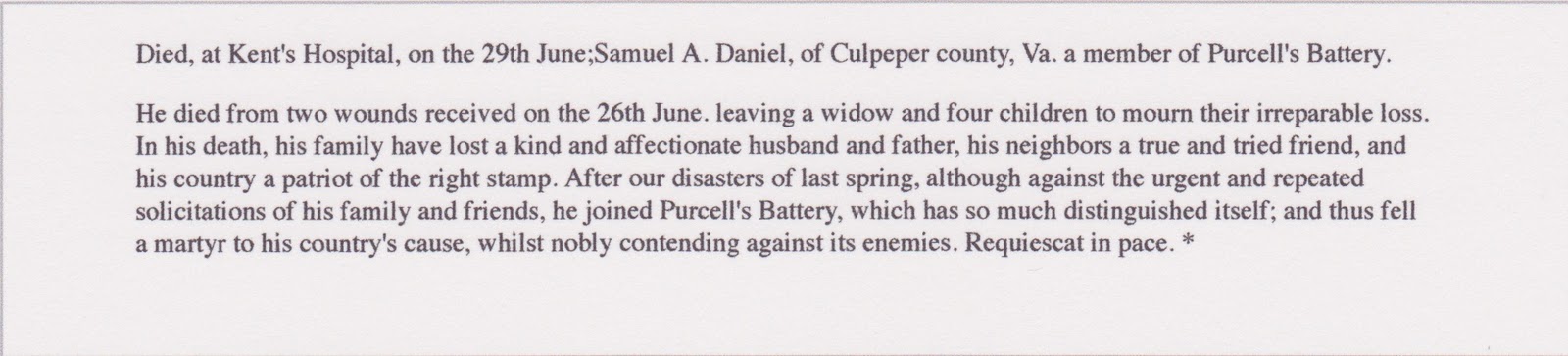
     Although Samuel could have easily afforded to pay a substitute to take his place in the ranks, his sense of honor and responsibility would not allow him to consider such a course. On February 26, 1862 he enlisted in Captain Cayce's Company of Purcell's Light Artillery. Four months later his battery found itself in the thick of the fighting at Mechanicsville during the Seven Days Battle. On June 26 he was severely wounded and was taken to Kent's Hospital in Richmond, where he died on June 29. Samuel Alpheus Daniel is buried at Oakwood Cemetery.

Samuel Daniel's obituary, Richmond Times Dispatch 4 July 1862

Transcription of Samuel Daniel's obituary

Headstone of Samuel A. Daniel, Oakwood Cemetery

     As it was for tens of thousands of other wives of Confederate soldiers, this was a shocking and devastating blow to Sarah Jane Daniel. She was now left to manage a 357 acre farm and to care for her four fatherless children. Prior to Samuel's death, Thomas Alcocke of Culpeper appears not to have been aware that he had been named executor of the Daniel estate. However, he gladly assumed this additional wartime burden and began to discharge his responsibilities as efficiently as was possible under the circumstances.
     By now Culpeper was occupied by General Pope's army and would endure long stretches of upheaval as the area changed hands several times during the war. Pope was a loudmouth and a bully and made himself especially obnoxious by giving his troops a free hand to despoil Culpeper. Farms were pillaged, outrages against women occurred frequently, churches were vandalized or burnt to the ground, civilian hostages were seized. The tragic impulsion of events left no breathing space for Sarah Jane and her children. The passivity of McClellan's army in the Peninsula and the brutal occupation of the Union army in Culpeper gave General Lee the welcome opportunity to "suppress Pope." Beginning with Stonewall Jackson's troops, Lee began to shift his forces from south of Richmond to Gordonsville and points north to confront Pope. The inevitable collision occurred on August 9, 1862 at Cedar Mountain.
     Some of the slaves of Forest Grove, including twelve year old William Yager, climbed on top of the farm's outbuildings in order to get a good view of the fighting. Neighbors from more threatened areas of the battlefield fled to Forest Grove and sought shelter in the basement. The house itself was used as a hospital by the Confederates. Among the wounded taken there were two brothers from South Carolina, whose parents later came to Forest Grove to nurse them.
     Once the fighting was over and Pope's army retreated north, burial parties laid the dead in mass graves and burned the carcasses of horses and mules. Civilians combed the field searching for food or for anything that could be of use. Among them was young William Yager. This description of his encounter with the quick and the dead comes from Daniel Sutherland's excellent Seasons of War (Free Press, 1995, page 155):

     "He discovers a prostrate Yankee too badly wounded to cry out for help. There he lies, 'the sun broiling down on his face, his arms just a goin' it.' He cannot speak, for he has been wounded in the throat. The boy has just bent down to help the stricken man drink from a canteen when, suddenly, the soldier leaps up, looks around, and without uttering a word, walks away. Yager, nearly scared to death, races from the field."

     In the wake of the battle changes came fast to Forest Grove and its inhabitants. Some of the slaves made their way to freedom within Union lines. A number of others were sold at auction in Richmond by Thomas Alcocke. That money, as well as the money realized from the estate sale in October 1862 was invested in Virginia state bonds. Sarah Jane kept for herself her favorite slaves--Millie Jackson and her children who took the name of their father, Waller Yager of nearby Mitchell's Station: Margaret, Grace, William, Calloon and Nannie. This family would remain with the Daniels throughout the war and for two or three years after. Their names and circumstances appear several times in the court papers relating to the postwar settlement of Samuel Daniel's estate.

Page from Daniel estate settlement

     Despite the death of her husband, the economic devastation caused by the war and the stress of an oppressive Federal occupation it appears that Sarah Jane Daniel remained devoted to the South's cause. These quartermaster receipts issued to her in late 1862 indicate a willingness by the widow Daniel to do her part for the Confederacy by providing pasture and forage for the army's cattle and horses.

Quartermaster receipt 19 November 1862

Quartermaster receipt 10 November 1862

     However, the "importunities and depredations" of those times referred to by Alcocke, made the conditions of daily life increasingly intolerable. For example, there was scarcely a church in that area that was not destroyed or vandalized to a point of uselessness. A lonely exception was St. Stephen's Episcopal in the village of Culpeper Court House. Its rector, John Cole, had been befriended by Robert E. Lee and Jeb Stuart during their time in the town. Still it suffered heavy damage by marauding northern troops. Forty years after the war the church received a small amount of money from the federal government as compensation. If houses of worship were not safe, it is not difficult to imagine the dangers that were routinely experienced by  the population at large.
     By the winter of 1863 Sarah Jane no longer felt safe to remain in the country and took her children and moved into town. To protect Forest Grove from complete ruin she arranged for a Unionist family named Hixon to live there free of rent as caretakers. Once settled in town she ran a boarding house patronized by Federal officers. Milly Jackson cooked meals for them and William Yager and his brother and sisters ran errands for them. They were given access to the commissary's stores and were able to thereby supplement their diet. In the 1930s it was used as a funeral home by Will Reaguer. The photo below was taken shortly before its demolition in the 1960s.

Sarah Jane's boarding house

     And so it was that Sarah Jane Daniel, her four children and Forest Grove were able to survive the war. Although Thomas Alcocke had been directed by the will of Samuel A. Daniel to sell Forest Grove, he wisely decided to defer that "to a more propitious time." Yes, Forest Grove survived the conflict but it did not emerge entirely unscathed. All of the stock, the farming implements and nearly all the fencing were gone. But the house and outbuildings still stood. Alcocke advanced $45 to Sarah Jane in order that she could buy a few cows and hogs and farm implements.
     With that $45, a sharp eye for business and a will of iron Sarah Jane Daniel rebuilt Forest Grove.