Search This Blog

Monday, January 28, 2013

The Used Cow Salesman

Horace Row


     Just to be clear, I do not for a moment believe any of this was the cow's fault.
     In fact, in all likelihood it was probably one of those misunderstandings that can arise during a transaction between parties acting in good faith. I would like to believe that there was no conscious intent to defraud or hoodoo a neighbor and fellow dairy farmer.
     That said, this whole affair could have been handled with a little more tact and subtlety by Mr. Row, about whom I had more to say here. And in that case the rupture in whatever friendly relations that existed beforehand could have been avoided.

M.W. Thorburn, 1890s. Photo courtesy of Rich Morrison

     In my last two posts I introduced Mungo William Thorburn, pictured above with a woman who was likely Mary Douglas, his second wife. Born in Scotland, Thorburn arrived in Spotsylvania by 1900 with two daughters and having lost a son and his first two wives. In 1904 he married Abbie Morrison and with her had three sons. Everything that I have read about M.W. Thorburn leaves the impression that he was a highly capable man of sterling character--hard working, pious and civic minded. He was noted for having spent fifteen years reclaiming boggy land on his farm and adding that acreage to his crop rotation. He served on the board of public roads in Spotsylvania and was a crucial player in the long term success of the Fredericksburg & Wilderness Telephone Company. Thorburn was a devoted supporter of Tabernacle Methodist Church. He was highly regarded by those who knew him.
     Because I know more about him, the portrait of my grandfather Horace Row is a bit more complicated. He was born in 1882 on Sunshine farm, the section of old Greenfield plantation that has remained in my family since 1795. Horace lived at Sunshine his entire life. His father died when Horace was nine months old, and he became the man of the house at age seventeen when his older brother Houston died in 1899. Horace Row was a successful farmer, an astute manager of his money and the father of five children.
     He also had a prickly personality and had an unfortunate talent for alienating people. And he was an undisguised foe of Prohibition.

M.W. Thorburn's first note to Horace Row

     In the summer of 1927 Mungo Thorburn wrote a note to Horace, expressing an interest in buying one of his milk cows. The tone of the letter hints at a friendly, if somewhat formal acquaintance: Mr. Rowe--Dear Friend--I will be up to look at the cows as soon as I can. I'm filling my silos today and part of tomorrow. Yours truly, M.W. Thorburn.
     By October 3 it is apparent that things have not gone according to Mr. Thorburn's expectations. Since we were not present when the cow changed hands, it is not possible to know what was said by my grandfather that day. But the letter that M.W. Thorburn next wrote to Horace leaves no doubt that he feels that he was not dealt with fairly.

M.W. Thorburn's letter to Horace Row

M.W. Thorburn's letter to Horace Row, p. 1


M.W. Thorburn's letter to Horace Row p. 2

 Mr. Rowe--
Dear Sir, 

     I am writing you about this cow. I explained to you that I wanted her for fall milk. As a honorable gentleman I trusted on you, now the cow has not proved as you said. Then you want me to hold the bag. I would not have that brand on me for the best cow I have got. I have talked with some of the best men, and they said they would not have believed that on you. Now if you love the dollar more than your honor, it is up to you?
                                                                                         M.W. Thorburn

    Horace's reply, preserved in a draft of a letter intended for Thorburn, makes his point with a minimum of neighborly diplomacy. I am sorry to say that this is the only example of my grandfather's writing as an adult that survives in the known record. And I certainly wish it depicted him in a more flattering light:

     In reply to your letter of yesterday will say that you bought the cow on your own judgment and your three sons and son in law. You all felt her good and milked her, looked her over three times. When I did not care to sell I told you the date I took her away on and by her look and actions looked for her to run in Aug., but I did not have ex ray eye of corse and you said of corse not. I have seen some good men about it and they were surprised at you not expecting such a good offer as I made you and the offer is still open beside I have bought a lot of cows and calf & horses in my life and I found that they some times do not turn out as I expected them to but I was man enough not to squeal but to take my medisson. If you will please show this letter to the men you talked to they will see that I am strait in my dealings as any man.
=you doing the exchanging 
     You deliver her to me in good shape and take the other on back at your expense.


     In October 1939 Horace and my uncle George drove the farm truck to an orchard in Sperryville. That day my grandfather died of a heart attack while picking apples. In the weeks to come my grandmother received dozens of letters of condolence from friends, relatives, schools and churches. It will probably surprise no one that there was not one from M.W. Thorburn.
     My grandmother pasted her husband's obituary in the old family Bible. Whether or not she chose this page intentionally I cannot say. It could be just coincidence and not a subtle jab from her.
     But sometimes I wonder.

Obituary of Horace Row


Monday, January 21, 2013

The Fredericksburg & Wilderness Telephone Company

The Fredericksburg & Wilderness Telephone Company, 1959

     The story of the Fredericksburg & Wilderness Telephone Company began 105 years ago in Spotsylvania with a country doctor and a Scottish immigrant.
     Dr. William Armistead Gordon lived at "Greenwood," his family's home in the Wilderness section of the county. In a desire to better serve his patients, Dr. Gordon made known his wish to have a direct emergency telephone line from his house to Fredericksburg.
     That stated desire set into motion a series of events that created the F&W, an enterprise that survived as an independent telephone company for fifty eight years. In 1908 there assembled at the law office of Judge A.T. Embrey a group of capable men to sign articles of incorporation creating the F&W. They were: Thomas Fell Morrison, G.J. Fletcher, R.A. Jennings, H.F. Etches, J.Y. Downman and Mungo William Thorburn.

M.W. Thorburn, about 1880

     Born in Scotland, M.W. Thorburn arrived in Spotsylvania by the late 1890s. I introduced him in my previous post. Thorburn lost little time in getting underway with establishing the company's  infrastructure. On September 8, 1908 he published in  The Free Lance a request for bids for the delivery of telephone poles. These poles were to be set on the roadside at regular intervals from Fredericksburg to the Wilderness. The line went first to Thorburn's house and he was the first to have a phone installed. From there the line continued to Dr. William A. Gordon.

The Free Lance 8 September 1908
     In 1910 a switchboard was installed in the home of Arthur Lynn Johnson, who lived across Catharpin Road from the Thorburn farm. Johnson's daughter Hazel began work as the switchboard operator while in her teens and continued to do so until the system was converted to dial service in 1950.

House of Arthur Lynn Johnson

Telephone lines coming into the Johnson house

Hazel Johnson Tiffany

Bill Pemberton working on the switchboard
     In 1915 a toll trunk line was established to Fredericksburg. Calls to town were ten cents each. As time went on, lines were installed down several roads in the vicinity; each road had a single line to the switchboard. Customers on each road shared the same party line, some lines having as many as twenty five parties.
     Thomas Fell Morrison served as the first president of the F&W 1908-1916, then Dr. William Armistead Gordon 1917-1924 and M.W. Thorburn 1925-1941. Thomas E. Thorburn was elected president after the death of his father and served with distinction until the company was sold in 1966.

Tom Thorburn (standing) with state auditors

Tom and Marion Thorburn

Tom Thorburn, at head of table, with Spotsylvania Board of Supervisors

     Alonzo Pemberton, Sr. became the manager of the F&W in 1911 and served in that capacity until 1945. He was then succeeded by his son Alonzo Pemberton, Jr. (known to everyone as "Bill" Pemberton). Bill was a cousin to Tom Thorburn. Bill worked as manager of the F&W for the remaining years of its existence, and then for the Continental Telephone Company.

Tom Thorburn (left) and Bill Pemberton


Bill Pemberton

Bill Pemberton (center) with Roosevelt Porter and Jake King

     Things went well for the company for many years, but in 1947 the F&W found itself unable for the first time to pay dividends to its stockholders. The F&W unsuccessfully offered itself for sale to a couple of larger local telephone companies. Bankruptcy began to look like a real possibility.
     Just when the F&W's prospects looked the bleakest, the government announced a new program that seemed tailor made to help the struggling company survive. The Rural Electrification Administration, created during the Depression to help get electrical power to farmers, was soon to be offering loans at two percent interest to local telephone companies wishing to convert to dial service.
     Even before the government could print the loan forms, F&W submitted its application for funding. According to an article written by Patricia Kent in the 9 May 2001 edition of The Free Lance-Star, "Tom Thorburn recalled that, at one point, he rode a milk truck to Washington to get REA officials to sign a document. Meeting the customary stall, he said he would sit on their office's front steps until they signed it." Thorburn got his form signed.

Marion Thorburn holding REA check


     On April 11, 1950 the Fredericksburg and Wilderness Telephone Company received a check from the REA for $55,000. Thanks to the efforts of Tom Thorburn and others, it was the first telephone company in the United States to receive a check from the REA for this new program. At the time there were 165 subscribers to the F&W when the change was made to dial service and soon the company would add 130 more. The first resident in the county to get the new dial service was Eugene Dickinson.

Eugene Dickinson

     September 20, 1950 was declared "REA Telephone Day" at the Fredericksburg Agricultural Fair. The Marine Corps Band arrived to play, speeches were given and President Truman called Mr. and Mrs. Eugene Dickinson to congratulate them.

Eugene Dickinson (just kicked by a cow) and wife

Marine Corps band at Fredericksburg Fair 1950

Crowd gathered at Fredericksburg Fair 1950

     Party lines continued to exist for many years after the four digit dial service replaced the old wall mounted crank telephones, but the number of customers on each line continued to decrease. While this was undoubtedly a boon for all (the ten cent toll charge for calls into town became a thing of the past), some people missed listening in on their friends' conversations, or being listened to. One housewife said she could tell who was listening in by the sound of the clocks in her friends' kitchens. After the removal of the old wall phones some homeowners were confronted with vivid patches of wallpaper that had not seen the light of day for forty years.
     In 1952 the F&W installed an experimental system developed by General Electric which made possible the transmission of phone calls by radio waves. The Alsop community in Spotsylvania was deemed too distant for the F&W to build lines to, so those people were the beneficiaries of this program. A special building equipped with a radio receiver was built at Five Mile Fork to receive calls.

F&W building and radio tower

     The four digit telephone numbers were later upgraded with the Sterling (prefix 786) and Hunter (prefix 489) exchanges. My sister still has the Sterling telephone number assigned to our parents fifty two years ago.
     By 1965 the F&W, which in the 1940s could not attract a buyer, found itself in the enviable position of being courted by the Continental Telephone Company. When the F&W sold out to Continental in 1966 it had 1,168 subscribers.


     Late on a Saturday morning in 1965, a twelve year old boy in Spotsylvania took his single shot .22 rifle down from the rack, shoved a handful of bullets into his pocket and headed out the door. The widow who lived on the farm across the road paid this boy a dollar to come over when he could and discourage blue jays, starlings and other poachers from helping themselves to the cherries in her orchard. It had not taken these crafty birds long to avoid the orchard when the boy was there and often it was not necessary for him to dig out a single bullet from his jeans pocket. This particular Saturday morning I (yes, gentle reader, I need not dissemble further--this intrepid hunter was none other than myself) was in a certain mood to plink at least one bird and after a couple of frustrating hours drowsing against the trunk of a cherry tree I sullenly began to trudge home. Then, on the telephone line above me running along Old Plank Road I spotted a bird arrogantly perched on the line above an aluminum junction box. I slipped a round into my rifle and slowly brought up the barrel, the end of which could not have been more than six feet from my intended prey. I gently squeezed off a shot. Unharmed, the startled bird flew off. It had not been a good day so far. It was about to get worse.
     When I came into the kitchen my mother had a baffled look on her face, holding the phone, repeating "Hello, hello." She had been talking to her sister Nancy and the line had suddenly gone dead. In an instant a host of emotions strove for mastery within my breast as I at once realized what I had done. With an understandable concern for the consequences, I confessed to my parents that I believed I knew what happened
     Mom called Bill Pemberton, who in due course arrived with his truck and worked for a time on the insides of the aluminum junction box. It must be admitted here that I managed to take out phone service to the county west of our house. When finished, Bill came up to the house and handed my mother the flattened .22 slug (in the kindest manner possible, given the circumstances). Mom kept that souvenir for the rest of her life as a symbolic relic of my marksmanship.


The photo of M.W. Thorburn is courtesy of Rich Morrison. All other photos are from the Colvin Collection.


Thursday, January 17, 2013

The School House on the Corner

Check for taxes paid to X.X. Chartters by Lizzie Row

     Xanthus Xuthus Chartters (1844-1893) was arguably the most exotically named man in nineteenth century Spotsylvania. For reasons that should be self evident, he was generally referred to as X.X. Chartters. He was a grandson of George Edwards Chancellor, who built the imposing house on the Orange Turnpike known to history as Chancellorsville. During the Civil War X.X. served in the Thirtieth Virginia Infantry, at times on detached duty with the quartermaster department. His war record shows that he was usually counted as present, except for his confinement to the hospital for bronchitis from December 1863 to March 1864. Together with the bedraggled remnants of the Army of Northern Virginia, X.X. was surrendered by General Lee at Appomattox in April 1865. (Each of the images in my blog can be clicked for enlarged viewing.)

Virginia Herald, 26 April 1875

     Four months after the surrender, X.X. Chartters married Evelyn Montague of Essex County. They ultimately settled on a farm in Spotsylvania located at the intersection of Old Plank and Catharpin Roads. X.X. earned his keep as a farmer and as deputy treasurer for the county. He is probably best remembered, however, for his leadership roles in the Grange, the advocacy organization representing the interests of farmers. By the mid 1870s he had organized a local chapter of the Grange in Spotsylvania, which included his friend--and my great grandfather--George Washington Estes Row. Meetings were held in a building X.X. erected near the corner of Old Plank and Catharpin. By the time X.X. Chartters died of tuberculosis in 1893, he was traveling widely as the leader of the national Grange movement. 

Mungo William Thorburn

     By 1900 the Chartters farm had been purchased by Mungo William Thorburn (1858-1940), a Scottish immigrant and widower with two young daughters. He quickly earned the friendship and respect of his new neighbors because of his industriousness and his devotion to his community and his church (specifically, Tabernacle Methodist Church, where I attended as a youngster). Thorburn served on the Spotsylvania board of public roads. In 1904 he married Abbie Morrison, with whom he had three sons--James, Thomas and George.

The Grange School

     Before the consolidation of the county school system, many local families held school in their homes or some other convenient building. William Thorburn utilized the old Grange meeting place for that purpose. Lillian Eastburn, the teacher in the 1908 picture shown above, was a niece of Abbie Morrison Thorburn. The Thorburn sisters Catherine and Isabella tower over their three year old half brother James. The Johnson children lived across Catharpin Road on the property still referred to by locals as Johnson's corner. Ralph Johnson became the owner of a grocery in Fredericksburg at 1400 Princess Anne Street. His son was Sheriff Ralph Johnson. Also seen in this photo is Hazel Johnson, who for thirty five years worked as the telephone operator for the Fredericksburg & Wilderness Telephone Company. 
     The same year this picture was taken, this very spot became the birthplace of the independent local telephone company that served the Chancellorsville area for more than fifty years. Its story will be the subject of our next episode.


Tuesday, January 15, 2013

Erasing History

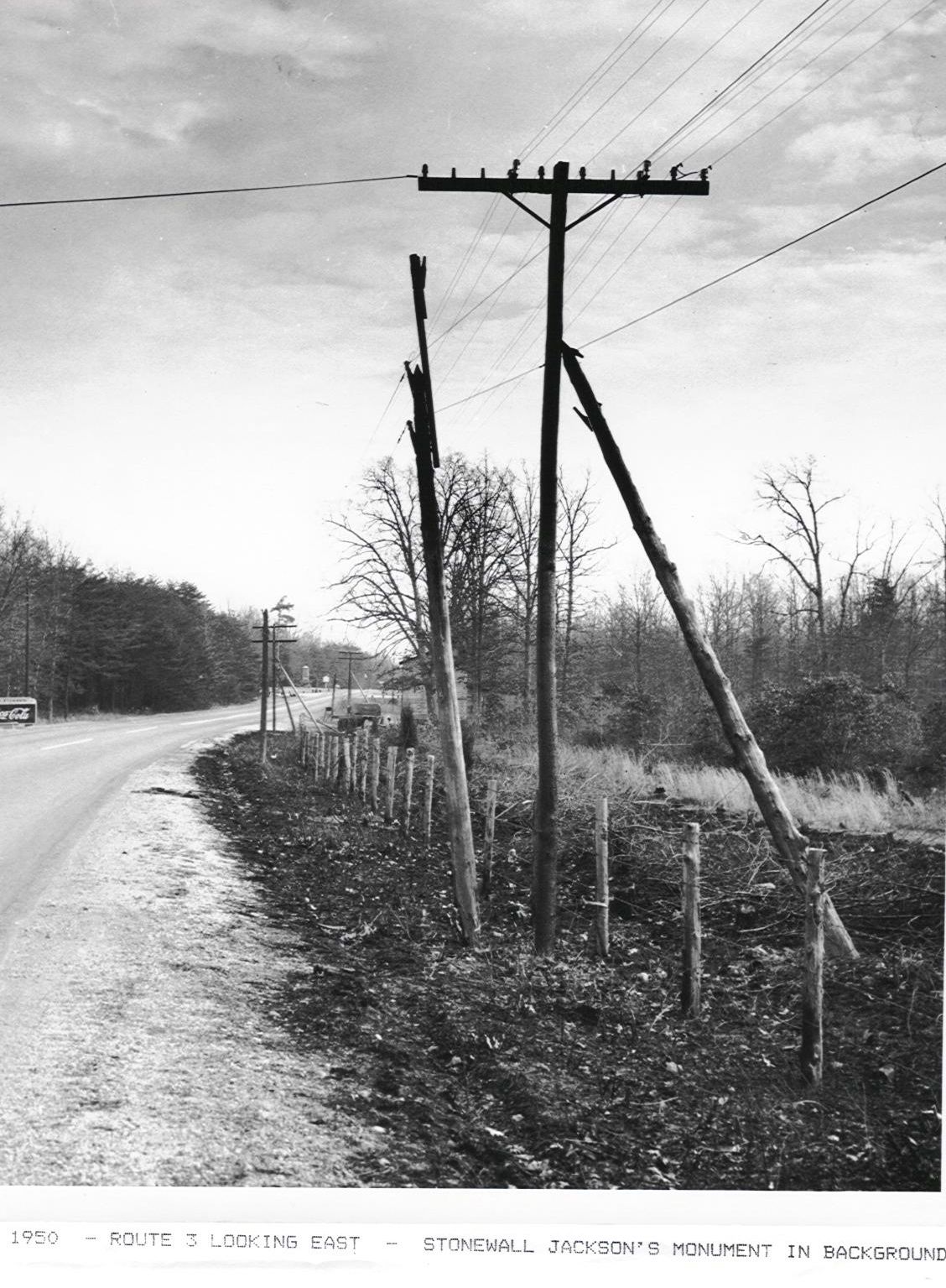
Orange Plank Road, 1954

For those of you who would prefer not to watch an old man cry virtual tears, now might be a good time to avert your eyes.

     In a piece I wrote last October  I broke with tradition and wrote about my own history instead of that of my ancestors. While acknowledging the inevitability of change, I allowed myself the indulgence of mourning the disappearance of the landscape of my boyhood, together with the history attached to it, and its replacement by the current reality in Spotsylvania. Forty years of relentless commercial development has annihilated that ancient landscape and the historical memory that informed it.
     Let the record show that I am not one who would chain himself to a tree or an old farm house in an effort to thwart the tide of progress. I am a firm believer in property rights and the free enterprise system.
     That said, what has happened to Spotsylvania during the course of my lifetieme is not altogether a cause for celebration and thanksgiving.
     For my readers who have never visited Spotsylvania, or have come there after these changes have taken place, the images I am presenting today will probably not mean much.
     To those of you who, like me, grew up there and whose families have lived there for generations these photographs will have special significance.
     These pictures were taken in the early 1950s as part of an effort to document the Fredericksburg & Wilderness Telephone Company's upgrading to dial service. All of today's images are courtesy of the Colvin Collection. Click on each photo to see the enlarged image.
     Once history is erased, can we ever get it back?

Brock Road with Goshen Church in the distance

Spotsylvania, 1950

Spotsylvania, 1950

Rt. 3 looking east, Jackson Monument in the distance

Brock Road near the intersection with Orange Plank Road

Rt. 3 at Five Mile Fork, looking east

Fredericksburg & Wilderness building at Five Mile Fork

Old Plank Road looking east toward McLaws Drive


Sunday, December 23, 2012

"It sure looks like starvation"

Nan Row

     Kate Kale was born in Fredericksburg in April 1830. She was the seventh of eight children born to Anthony Kale, a Swiss-born candy maker and grocer, and Catherine Estes, a daughter of my third great grandfather Richard Estes of Greenfield in Spotsylvania (for the truly curious, my post on the Kale family can be read here). Just prior to the Civil War Kate was living in Fredericksburg with her sister Mary. Kate never married. In her later years she lived in Stafford with her sister Mary's family. Like all the Kales, Kate was well to do. She inherited her father's properties on Princess Anne and Caroline Streets in town. After her death in 1904 these properties were sold at public auction, including 706 Caroline Street, today home of the Fredericksburg Visitor Center. (All images in my blogs are clickable for larger viewing).

Southwestern Spotsylvania in 1863
     During the summer of 1864 Kate was staying at Walnut Grove, the stately home of her uncle Jonathan "Nathan" Johnson. Southwestern Spotsylvania had thus far escaped most of the war's violence and destruction, being somewhat removed from the battlefields of Chancellorsville and the Wilderness. This interlude of relative tranquility ended when elements of Sheridan's cavalry invaded Spotsylvania from the south, briefly making camp at Walnut Grove. Afterwards Kate wrote a letter to her cousin Nan Row-my great grand aunt-describing in vivid detail what she had experienced during the brief occupation of her uncle's home. At that time Nan Row and other family members were living as refugees in Hadensville in Goochland County.

Roger Mansfield to Mabel Wakeman, August 1961

     Kate's letter to Nan remained in the possession of my family for ninety seven years. During the 1950s and 1960s Spotsylvania historian Roger Mansfield and my great aunt Mabel Row Wakeman exchanged many letters regarding their shared ancestry and his interest in Greenfield, the home of the Estes and Row families from 1795-1905. In 1961 Mabel gave to Roger the original of Kate's letter to Nan. Roger acknowledged this gift and thanked Mabel for the letter in his note to her. The original letter, or a photocopy of it, supposedly exists in the archive Roger Mansfield donated to the Virginia Historical Society, but I was unable to find it when I visited there several years ago. Fortunately the current owners of Walnut Grove have a copy of Roger's transcription, which they generously shared with me. Today I am presenting the text of Kate Kale's letter in its entirety, followed by my notes.

Sarah Estes Johnson (Courtesy of Kerry Sears)


                                                                                                               Walnut Grove
                                                                                                                July 13th, 1864

Dear Nan, 

      Supposing that you would like to hear how we fared at the hands of the hirelings of the best government in the world, I will try to give some of the particulars though it now seems more like the impressions of a bad dream than a reality.
     On the morning of the 10th, we heard that Mr. Boggs' [1] man came up to Mr. Sorrells with the news that the Yankees were at Waller's Tavern on their way up. So Uncle Nathan [2] rode down to hear the truth of it, and he soon came back and sent off the horses by John [3] and Jack [3], and the mules by Paul [3] and secured a few valuables about the house, but did not feel that they were coming. In a few minutes and in dashes too--they wanted meal--we had very little. They took that, inquired about corn and bacon but did not take any--seemed to be in great haste--said that the column was going up by Twyman's [4]. I thought then that they were pickets and had stole in to get something to eat as they did before and no more would come--vain delusion. In the least while the meat house was cleaned out--the first party took all but three pieces, the next ones took that--the corn was taken in a twinkling of an eye.
     The next news was John. Jack and the horses were all gone. Up to that time the cellar only had been searched, but in a short time a number of men came and told Uncle Nathan that one of his boys told them that there was corn and meat upstairs in the house. Before that, while they were in the cellar, I believed that they would go up stairs before they were done with it, so I hid nine pieces of bacon under three beds and as good luck would have it, they did not turn those three beds up, but they did the two over the parlor. Well, upstairs they went, and down came the corn and bacon. They found about a hundred lbs. of sugar in the closet and that saved the bacon, I reckon. They took all the sugar. Uncle Nathan was with them, and I was with another set over the sitting room. They wanted clothing, they said. I told them I had nothing but my own. I opened one drawer and they were satisfied--did not put their hands in. Two slipped in our room and broke open my trunk and Miss Jones's chest. I saw him just as he had opened my trunk and told him there was nothing in there that belonged to him, to come out, and he dropped the top and came out. In a little while I saw another one there. I ordered him out in the same way, and he walked out. Did not know until afterwards that they had gone in Miss Jones's chest. She had $7 in gold, her best pin and her bonds laying on the top ready to take out whenever the Yankees came, and she forgot it entirely. They got it slick enough. I did not dream of her having anything valuable in there. A Yankee wanted to break open her trunk in the room where I was, and I told him that I knew there was nothing in there but her clothes, and he left it. 
     Sunday, after they were here Friday, we heard that the infantry were coming, so we took nearly all the bacon that was saved in the house and flour and corn, and sat it out, and nearly everything was found by them--not the infantry, but the same party that went up Friday. You can imagine my feelings better than I can describe them when I saw a body of men ride in and take up camp. They had the house guarded, but we did not know it until later in the day. If we had, it would have saved a great deal of uneasiness, but they went into every hole and corner, and found everything that was above the ground. Uncle Nathan put a great many things at the old barn, in a mighty good place, as he thought. Amongst them was a book with eight hundred or a thousand dollars in it, and they got that. The State money that he had to pay off his wards was hid out, and he heard them say that they were going to see what was there. He told them they could go and see for themselves, and he walked off feeling miserable enough, and did not know until Tuesday morning that it was all safe. He says that you must write to George [5] to come and get it just as soon as possible. He spent one miserable day and night about it. He also says that you all must come over to see us. I did want to go over to see you this summer, but the jig is up now. 
     Uncle Nathan has bought one horse for himself and one for Aunt S [6]. The Yankees took two from her, and some milk and butter--only a few went there. They took some corn from Tod and a mule from John and some clothing. That Perry, a deserter, I reckon you have heard of him, last week he stole some of Aunt S's wheat out of the field. Buck and one of the Pendleton boys were tracking it and came right upon them in the woods beating it on a sheet--two men and a woman--they ran. Buck stayed and Pendleton went out and sent the Negroes with the cart and took the wheat home. The Saturday afterwards they set her fence afire. That is they do not know who did it but they could not help thinking that it was them, and burnt 71 panels. Uncle Nathan and I were down there Sunday. I feel very sorry for her. One of her sheep was stolen not long since and two from John Johnson [7] and some of Tod's wheat has been taken. Those two men went to Aunt S's and passed themselves as Yankees, and searched her house all over looking for brandy, one stayed out to watch while the other one was searching. He took a love ring and a little breast pin out of Nannie's [8] trunk. Dina was in there with her, he shut the door and told her if she did no tell him where the brandy was he would kill her. Aunt S got an axe that was in the house and told him to open the door or she would split it down and he opened it. Buck was off with the horses and the Yankees had broken the guns before, but no Yankees were out that night. What a pity it was that he had not been shot. What a life to live. The Conscript officers are after them but I am afraid that they will not get them. They took John Dobyns [9] last Sunday. The Yankees took every thing Mr. Dobyns [10] had to eat, killed his cattle and sheep. I heard that the girls drove 10 of the sheep to the house and saved them. They took both of his carriages and one Negro man went with them. They took everything from Mr. Kube [11] that he had to eat and his clothes and some of hers, so I hear. I could not hear the particulars from Mrs. Todd [12] but expect that they took what she had. Neither could I hear the particulars from Greenfield, but expect--all fared alike. I did not  hear of any of Mr. Kube's Negroes going off. Oh, I forgot to tell that Walker [3] went off bag and baggage after the Yankees had stolen the hat off his head the first day. He had been in the cabin at least two months blind and seemed to be distressed that he could not be in the cornfield and talked to his master about it and Uncle Nathan told him that if he did go blind entirely that he would take care of him as long as he had anything about him to do it. I never thought of his going. In fact when the Yankees came I never thought of the Negroes once not even of Jack until he was gone, only I said to Uncle Nathan he could not have sent a worse hand with the horses. I was sorry than John went but I don't care a thing for Jack. 
     When they came back Jack took his wife off in Ben Graves's [13] buggy. I heard--indeed saw-- her with a Yankee in the buggy and Jack riding a horse. An officer was on Uncle Nathan's gray horse. The Yankees did not get the mules until Tuesday morning. Paul was with the Chewnings and some others and one Yankee frightened all off. He only took the mules. The others went back and got the horses where they left them. They killed 25 of Uncle Nathan's sheep but did not take any of his cattle. Thirteen of Miss Polly T's Negroes went off and every one of Mr. Dickenson's started. Three men and two little children that had no mother came back. He had a great deal of corn and bacon and lost all--he was so selfish with it that people do not feel as sorry for him as they would have done if he had been willing to share with others that had none before. 
     I received a letter from John [14] written the 25 of May and sent by one of his old company he was well. He and R. [15] are both in the same co[mpany]. John is in the commissary department. He says that the State is full of refugees and everything high. Sugar is not to be had at any price. I haven't heard from Mary [16] or Julia [17] for a long time. Jane [18] got better and has relapsed. She is well now and working out. Says she can't stand the fire and can't draw the water. She has been out two or three weeks. I would think she could stand the fire as well as the sun, especially as we have so little to cook, but she ain't going to trust herself anywhere. I believe if the Yanks come again, that there won't any be left, and it seems to be the impression of everybody. A Yankee struck my Jane and she struck him back with some onions that she had. He said he did it because she would not open the cellar door--cussed her and told her she was the very Devil. They did not curse me nor say anything to make me mad though I spoke to them briefly and indignantly but I certainly dread their coming again. They did great worse some places than they did here. I saw one that pretended to sympathize that they had taken everything we had to eat, but the sweetest morsel was still left and they could never take, and that was faith in our cause and General Lee. I did not lose anything here but my knife, scissors, needles and comb and towel. I bought a box of tobacco $9--they got that at Joe Johnson's [19].
     You must write soon. I hope you are getting along very well. Everything is burnt up, and if it does not rain in a few days there will not be any corn made, and the horses and cows will starve as well as the people. Jane lost her baby about two weeks ago. It seemed to decline after she got sick and seemed to have the croup when she died. She sends love to Kitty and Dorky and the children and love to Chris. All are well as usual. 
     We saved 2 1/2 [bushels] of corn and flour and bacon. Uncle Nathan will make only 80 bu. of wheat--is getting ready to thresh it out now. Very few in the neighborhood has any wheat. It sure looks like starvation but I hope the Lord will provide. Have you heard from cousin Rachel [20]? I wrote to her for the receipt. She sent it and said that the Yankees had not injured her so far, but I don't reckon she can say that now, but I hope she may have escaped. How is Martha [21] getting along. I reckon it is very agreeable in R[ichmond] this summer. All join me in love, hope Aunt Nancy [22] has her health. Tell her she and you must pick up and come over to see us. It is well for her so far that she is is over there. I hope the Yankees may not get there. With love to all,
                                                                                                Your Cousin, 
                                                                                                            Kate

I hope you may be able to read this scrawl.
Mr. Pool lost every Negro and everything else he had.


[1] Lewis Boggs (1811-1880), neighbor of Jonathan Johnson who lived near Waller's Tavern.

[2] Jonathan Johnson (1803-1873), owner of Walnut Grove.

[3] Slave of Jonathan Johnson.

[4] General store and post office near Walnut Grove.

[5] George Washington Estes Row (1843-1883), nephew of Jonathan Johnson and my great grandfather. Johnson acted as George's guardian, representing his interest in the estate of Richard Estes of Missouri, who left $566 to George.

[6] Sarah Estes Johnson (1804-1869), widow of Jonathan's brother Marshall Johnson.

[7] Probably John Castle Johnson (1828-1886), a son of Jonathan's brother Aquilla Johnson.

[8] Sarah Ann "Nannie" Johnson (1844-1907), a daughter of Sarah and Marshall Johnson. Sarah married Robert Henry Jerrell in 1865. They were the grandparents of Roger Mansfield.

[9] John H. Dobyns (1840-1905), a nephew of Leroy W. Dobyns. Deserted from the 55th Virginia Infantry in 1863. Seized by conscription officers and imprisoned at Castle Thunder in Richmond. Pardoned by Jefferson Davis in 1864 when he joined Winder's Legion. Married Jane Kent, an aunt of my grandmother, in 1890.  Jane had her own heart stopping encounter with marauding Yankees, which can be read here.

[10] Leroy W. Dobyns (1811-1871), owner of Oakley plantation. His daughter Maria also wrote a letter to Nan Row, describing the depredations of Union soldiers at Oakley during the battle of the Wilderness, which can be read here.

[11] Bernhard Kube , a German immigrant who was a friend and neighbor of the Rows. He traveled extensively around the country as a gold miner before the war. Brought home a parrot from one of these trips and gave it as a gift to Nan Row.

[12] Caroline Matilda Todd (1804-1885), widow of Charles M. Todd (1797-c.1850), who owned Todd's Tavern.

[13] Benjamin F. Graves, a neighbor of Jonathan Johnson.

[14] John Peter Kale (1824-1886), brother of Kate who moved to Texas in the 1840s and was an early settler in the town of Livingston. John served in the 5th Texas Infantry, Hood's Division, before being wounded at the battle of Second Manassas.

[15] Richard Estes Kale (1821-1872), brother of Kate who moved to Denton, Texas before the war. Richard served for a time in the 15th Texas Cavalry.

[16] Mary Kale Harding (1826-1898), sister of Kate. Married Enoch Harding of Stafford in 1861 and lived near Tackett's Mill.

[17] Julia Kale Alexander  (1833-1887), sister of Kate. Married in 1852 to Robert Brooke Alexander, who published the Democratic Recorder in Fredericksburg.

[18] A slave of Kate Kale.

[19] Joseph Watkins Johnson (1836-1887), a son of Sarah and Marshall Johnson. Inherited Walnut Grove after the death of his uncle Jonathan Johnson.

[20] Rachel Row Farish (1819-1892), a cousin of Kate Kale and widow of Charles Tod Farish of Caroline County. Rachel's parents, Carleton and Lucy Row, were murdered by their slaves in 1820. She was then raised by her grandfather Thomas Row in Orange County.

[21] Martha Row Williams (1828-1885), a sister of Nan Row. Martha was married to commission merchant James T. Williams, a partner in Tardy & Williams in Richmond.

[22] Nancy Estes Row (1798-1873), Nan Row's mother, and my great great grandmother.

Friday, December 7, 2012

Walnut Grove

Walnut Grove

     Built in the early 1840s, Walnut Grove remains-like Oakley-one of the few antebellum plantation houses still standing in Spotsylvania. Located on Foremost Run in the southwestern corner of the county, Walnut Grove is an excellent example of the craftsmanship of master builder William A. Jennings. Much of the information included in today's post comes from the current owners of Walnut Grove and their write-up for the National Register of Historic Homes. In the detail of J.F. Gilmer's 1863 map shown below, Walnut Grove is located at the lower left of the image where "N. Johnson" is indicated. All images in my blog are clickable for larger viewing.

Southwestern Spotsylvania, 1863

     Jonathan Johnson (called "Nathan" by his friends and relations) was a son in law of Richard Estes, my third great grandfather. Nathan married Frances Estes about 1820. Coincidentally, his brother Marshall Johnson married Frances' sister Sarah Estes. While Sarah and Marshall successfully raised six children, Nathan and Frances remained childless.
     Nathan Johnson was a man of refined tastes who enjoyed the good life and was able to amass a small fortune during his lifetime. He was well known for raising some of the finest livestock in the region. Nathan was also active in local and state Democratic politics. In 1840 he was appointed commissioner of the Andrew's Tavern voting district. On election days Democrats would assemble at Nathan's house and then march to the polls with fife and drum playing and flags and streamers flying. Nathan Johnson was also appointed a delegate to the gubernatorial convention in Petersburg in 1858.
     For decades Nathan performed many useful legal services for my ancestors. My great great grandfather Absalom Row, owner of two Virginia law books and justice of the peace in Spotsylvania for twenty years, neglected to have his name witnessed on his will. Nathan and Sanford Chancellor testified in court as to the authenticity of that signature after Absalom's death. Nathan Johnson acted as legal guardian for Absalom's son, George W.E. Row, representing his interests in the legacy left to him by Nathan's brother in law Richard Estes, who died in Missouri. And Nathan spent the last ten years of his life toiling away as administrator of the complicated estate of his sister in law Mary Estes Carter, who died at Greenfield in 1863. The image below from the inventory and appraisement of Mary Carter's estate comes from the archives of the Central Rappahannock Heritage Center.

From the estate papers of Mary Estes Carter

     A slave owner and lifelong Democrat, Nathan Johnson was an unambiguous supporter of succession and the southern cause. Most of his nephews saw action in the Confederate army. Like his neighbors Nathan did what he could to help the war effort, selling hay and grain to the quartermaster officers. He also provided the services of his slave, named Major, "as laborer on the public defenses at and near Richmond" as seen on this receipt for $32 from Captain J. B. Stanard, chief engineer for building those fortifications.

Captain Stanard receipt to Jonathan Johnson, 1863

     During the fighting that occurred at nearby Trevilian Station in 1864, elements of Sheridan's cavalry camped at Walnut Grove. As was their standard practice Union soldiers stole food hidden under the beds and confiscated valuables from the house as well as Nathan's prized livestock. These enterprising soldiers in blue also found a book in the barn in which Nathan had hidden $800-1,000.
     A niece of Nathan and Frances, Kate Kale ( about whose family I have previously written), was staying with the Johnsons during this episode. She described this incident in a letter to her first cousin-and my great great aunt-Nan Row. Kate wrote that a Union soldier struck a servant named Jane for refusing to open a cellar door. Jane hit the soldier back with some onions that happened to be handy. Despite all this unpleasantness Walnut Grove survived the war pretty much intact.

From the inventory of Jonathan Johnson's estate


     Unlike many of his neighbors, Nathan Johnson was able to remain a wealthy man until his death in 1873. The inventory and appraisement of his estate shows that he had over $30,000 in cash and coin in the house. He left his $200 gold watch to Kate Kale. The image above is courtesy of the Central Rappahannock Heritage Center.


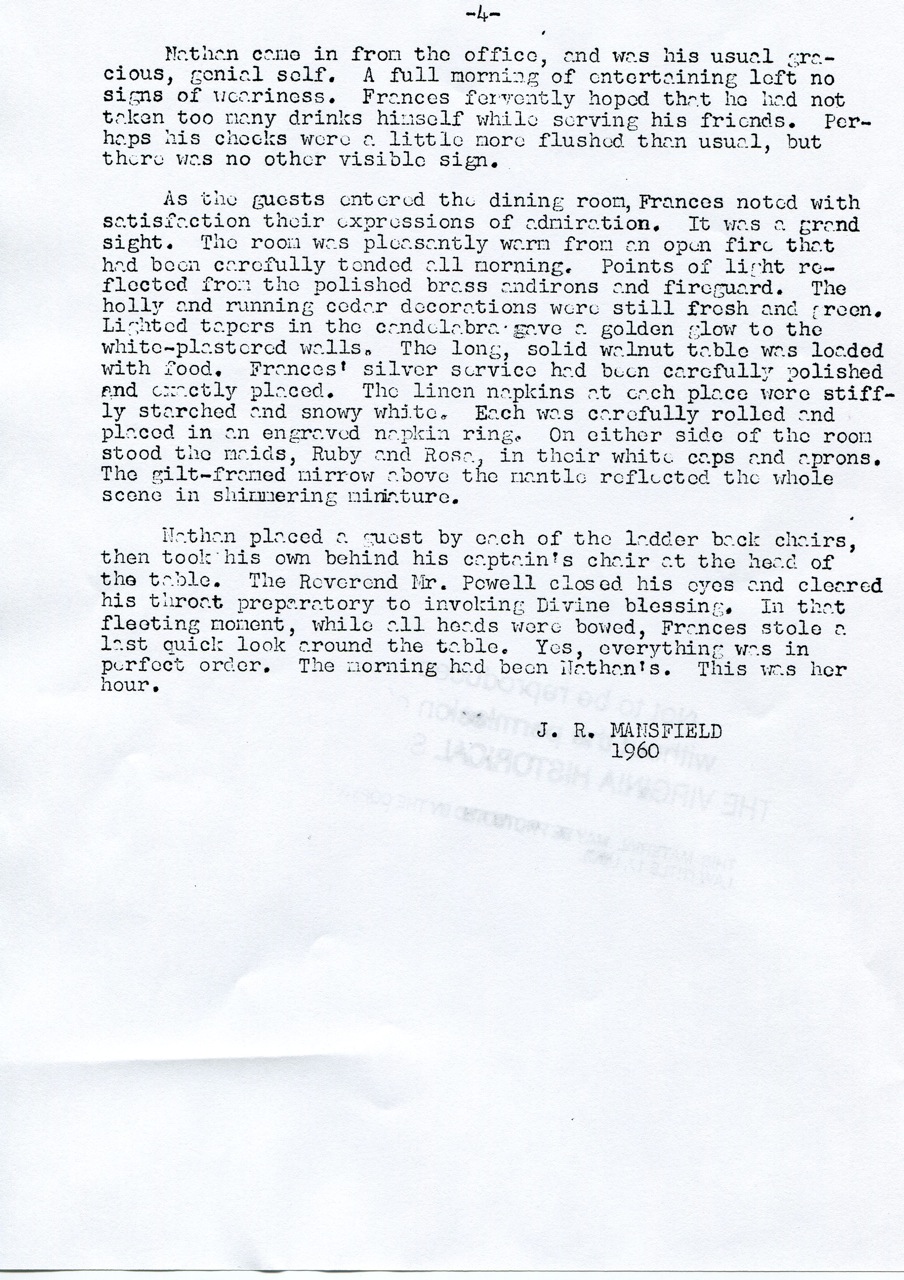
     During the 1950s and 1960s Spotsylvania historian Roger Mansfield exchanged many letters with my great aunt, Mabel Row Wakeman. They addressed each other as "Cousin" since they had discovered that Roger's great grandmother-Sarah Estes Johnson-was the sister of Mabel's grandmother Nancy Estes Row. Roger took an interest in my family's history and wrote a monograph on Greenfield in 1960. That same year Roger also wrote a piece about what life would have been like at "Walnut Hill" during Christmas time in 1860. So, in the spirit of the holidays I present Roger's semi-fictional account of the Johnsons of Walnut Grove, given to Mabel 52 years ago.