Search This Blog

Friday, May 7, 2021

The McCrackens


     For a number of reasons, not the least of which were the oppressive policies of absentee British landlords, the potato became the main source of sustenance for the rural poor in Ireland by the 1800s. When Ireland's potato crop was blighted by the Phytophthoria infestans mold in 1845, the effect on the country's people was immediate and devastating. During the next ten years, more than one million Irish starved to death, and another two million left Ireland. The engraving of the effects of the famine in Skibbeeren shown above was made by Irish artist James Mahony in 1847.

     Among those who emigrated from Ireland during this period were the McCracken family, who found their way to Spotsylvania County by the 1850s. Thomas and Emma McCracken and their four sons--Patrick, Michael, Bernard ("Barney") and Terence prospered in their adopted country and contributed a great deal the civic and economic life of Spotsylvania and Fredericksburg. Their lives would be noted for both episodes of sublime grace and madness.

     Bernard McCracken, more commonly known as Barney, was born in Ireland in 1836. At the beginning of the Civil War, some say he briefly served the Confederacy in Captain Thornton's Company of Irish Volunteers, which became part of the 19th Battalion of Virginia Heavy Artillery. But by 1863 Barney was working in a liquor shop in Washington, D.C. when he registered for the draft, as seen in the image below. Whether he ever wore a Union uniform is not known, but is doubtful as his name appears in the 1864 edition of the city directory as a "saloon keeper."


     Soon after the Civil War, Barney married Mary F. Bowling and settled in Louisa County, where they had three children together. Barney became active in Republican Party politics and for a time served as tax assessor for Louisa and Orange counties. In 1869, he was elected to the Virginia House of Delegates. The one term he served in that august body was notable for the press coverage devoted to his escapades on the floor of the House. The two articles below--the first from The Daily Dispatch of April 13, 1870 and the second from The Daily State Journal dated March 16, 1871--are examples of a colorful personality, or one that is slightly unhinged:


     Thirty-five-year-old Bernard McCracken died in Fredericksburg on December 17, 1871. He is buried in the Confederate Cemetery there.


     In 1856, Barney's father Thomas bought a 325-acre farm in western Spotsylvania County near Parker's Store, and divided it between himself and his sons Patrick and Michael. Where his youngest son Terence was at that time is not known; he may have been attending school somewhere. In the 1863 map detail of western Spotsylvania, the McCrackens' farm can be seen in the lower left of the image as "McCrackings."

     Patrick McCracken was born in Ireland on December 4, 1826. He married Elizabeth Dickey of Orange County on March 2, 1857 and they made their home at Patrick's farm.They had one son, William, who died young.

     In April 1862, troops of the United States army crossed the Rappahannock River and occupied Fredericksburg, where they remained until August. Some time in July Patrick McCracken drove a wagon load of produce into Fredericksburg to sell. His presence aroused the suspicion of overly vigilant soldiers, who arrested him and sent him to Washington, D.C. where he languished in the Old Capitol Prison for nine weeks. Patrick finally was admitted to the office of General James S. Wadsworth, who was at the time military governor of the Washington district. Wadsworth quickly decided that there was no legal basis to detain him and freed Patrick after he pledged to not support the Confederacy.


     The lives of General Wadsworth and Patrick McCracken were fated to intersect one more time two years later, during the Battle of the Wilderness. On May 6, 1864 Wadsworth was leading his men in the chaotic fighting near the intersection of Brock and Plank roads when he was shot in the back of his head. While his wound was mortal, death was not instantaneous. He was taken to a Confederate field hospital set up on the Pulliam farm. Below is a photograph taken in 1866, showing the place were General Wadsworth was wounded:


     News of Wadsworth's wounding and his presence at the temporary hospital at the Pulliam farm reached Patrick McCracken. Patrick packed up some food and took a bucket of milk with to go to Wadsworth and do what he could for him. Once he got there, he learned from Dr. Zabdiel Adams, who was also a wounded prisoner who had tried to help Wadsworth, that the General was unconscious and unable to eat or drink. Patrick said that the doctor could have the milk and food instead. The next day, Patrick returned to the Pulliam farm with some sweet milk, which he used to moisten Wadsworth's lips. 

     Wadsworth died the following day. When Patrick showed up to care for Wadsworth, he learned that he had died and had been laid aside for burial. Patrick had the General's body transported to his farm, where he made a coffin out of some doors and boards that he painted black. Patrick dug a grave in his family's cemetery and placed Wadsworth in it and covered the coffin with a plank and then dirt. He then fashioned a grave marker and placed it at the head of the grave. 

     Several days later, Union General George Meade sent a letter to General Robert E. Lee, seeking to make arrangements to retrieve the body of General Wadsworth. On May 12, under a flag of truce, Union soldiers came  to the farm of William A. Stephens and learned from the Confederates where the General's body had been taken. An ambulance was dispatched to the McCracken farm, and the mortal remains of James S. Wadsworth began their long journey to his home town in New York.

     The day after Wadsworth died, Patrick wrote this letter to his widow, which was printed in the 1865 edition of the New York State Agricultural Society:


     Mrs. Wadsworth sent a sum of money to Patrick as a token of her appreciation for his kindness. According to McCracken family lore, Patrick and his brother Terence used that money to start their grocery business in Fredericksburg. 

     Within two months of the surrender of the Army of Northern Virginia at Appomattox, Patrick opened a grocery store in Fredericksburg on what is now known as William Street. From the June 24, 1865 edition of The Fredericksburg Ledger:

     Not long after, Patrick's brother Terence joined him as a partner in the business. After Patrick's death, Terence would have at least one other partner, but he never changed the name of the business.


     By 1870, Patrick and Elizabeth were living in Fredericksburg. The 1870 census tells us that also living in the McCracken household was Patrick's clerk, 27-year-old George Edward Chancellor. The son of Reverend Melzi Sanford Chancellor, George was a veteran of the 9th Virginia Cavalry. Within a couple of years, George opened his own store at the corner of William and Charles streets (this building still exists and serves as home to Castiglia's Italian Restaurant). Shown below is an 1866 photograph of George Chancellor (seated, wearing striped pants) with his family.
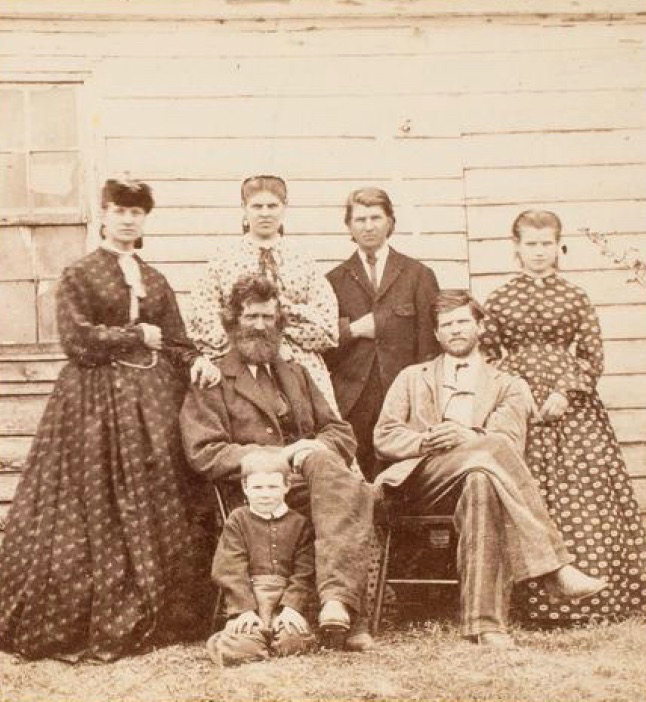

     Elizabeth Dickey McCracken died on October 21, 1873. Patrick followed her to the grave on June 18, 1875. They are both buried in the Confederate Cemetery in Fredericksburg.


     Like his brother Patrick, Michael McCracken also began his adult life as a farmer and slave owner in Spotsylvania near his parents. Also like his older brother, Michael married a woman from Orange County, Martha Jane Almond. They exchanged vows in Orange on December 23, 1856. They had two sons--Melvin, born in 1861 and Thomas, born in 1864.

     Michael enlisted in Company E of the 9th Virginia Cavalry on April 5, 1862. By September he was detailed as an ambulance driver. He remained at this duty until he was dropped from the rolls on June 1, 1863, when he was awarded a mail contract. 

     Michael and his family remained on his farm until after the 1870 census. By 1873, the McCrackens had moved to Fredericksburg, where Michael started out as a saloon keeper. A few years later he and Martha built a hotel on Commerce (modern William) Street. There was also a McCracken Spoke Factory in Fredericksburg, but to which brother or brothers this enterprise belonged is not known. Michael became active in the civic affairs of Fredericksburg. He was a member of the fire department, an officer in the Building and Loan Association, a member of the Rappahannock Boat Club, and he served as town magistrate. 

     By the mid-1880s, the behavior of Michael's son Thomas was already making the news, but not in a positive way. From the December 11, 1885 edition of The Free Lance:


     Martha Almond McCracken died on August 17, 1887. She lies buried in the Confederate Cemetery in Fredericksburg. From The Free Lance:


     Four years later, the McCracken family's name would again appear in the newspapers in a highly unfortunate, indeed tragic, event. On February 20, 1891, Thomas McCracken murdered his father on William Street. The particulars were described in February 22 edition of The Richmond Dispatch:


     In the ensuing trial, Thomas was found not guilty by the jury by reason of insanity. He was committed to the Eastern State Hospital in Williamsburg. He was furloughed for a few days the following year to visit his family at Christmas. From The Free Lance dated December 30, 1892:

     Thomas was released from the asylum in 1902. The 1910 census shows that he was single and working as a house dealer in Bruton, Virginia. In 1920, Thomas McCracken, employed as secretary-treasurer of a syrup company, was living in Richmond with his wife and children. By 1930 he was living alone in Williamsburg and working as a house painter. After that, I find no mention of him in the public record.

     The youngest of the McCracken brothers, Terence, was born in Ireland on June 21, 1844. He married Margaret Scott on December 26, 1866. By 1876, Margaret and both of their children had died. The following June he married Frances Catherine Doherty at St. Peter's Catholic Cathedral in Richmond. They had two sons, both of whom survived to adulthood. 

     In addition to owning the grocery and dry goods store with his brother Patrick, Terence was a member of the Building Association, the fire department, the grain exchange and the Chamber of Commerce. Beginning in the 1880s he served on the board of directors of the Eastern State Hospital, where his nephew Thomas would be committed in 1891. 

     Terence spent the last weeks of his life as a patient at the Laurel Sanitarium in Laurel Maryland, which treated mental illness and alcoholism. He died there on June 21, 1918. He is buried in the Confederate Cemetery in Fredericksburg. From his memorial on Findagrave:


My source for the story of Patrick McCracken and James S. Wadsworth is The Ultimate Price at the Battle of the Wilderness

Saturday, March 27, 2021

Thomas Evan Thomas


       Welsh immigrants began arriving in America in significant numbers by the end of the 17th century. Many who were attracted by William Penn's creed of religious tolerance came to Pennsylvania. By the mid-nineteenth century, Wales had become one of the world's leading coal producing regions. The burgeoning coal and steel industry in Pennsylvania lured large numbers of Welsh citizens to America. Ultimately, the Scranton area boasted the largest number of the Welsh people outside Wales itself.

      One of these immigrants was William Evan Thomas, born in Swansea, Wales on June 3, 1835. William secured second class passage aboard the sailing ship Centurion when it cast off from Liverpool, England in the summer of 1857. Centurion arrived at the Port of New York on July 23, 1857. The William E. Thomas shown on the ship manifest above was very likely the same person I mention here. 

     William made his way to western Pennsylvania, where he found work in the bustling coal mining and iron industry there. In 1863, he was working as an iron puddler, a worker who turns pig iron into wrought iron by "subjecting it to heat and frequent stirring in the presence of oxidizing substances." Shown above are puddlers at work in the 1920s.


     On March 3, 1863, the United States Congress passed the Conscription Act, which required all male citizens between the ages of 20 and 45, and those who had applied for citizenship, to register for the military draft. On June 30 of that year, the name of William E. Thomas, a puddler aged 28, was written on a list of men from Scranton who were subject to the draft. Whether he ever served in the Union army is not known, although I suspect that the decision was made somewhere that his labor in the iron works was of greater benefit to the war effort than toting a musket into battle. 

     Sometime in 1864, William married a young woman from Wales, Amelia Morgan, the daughter of a Welsh coal miner. Their first child, Thomas Evan Thomas, was born in Scranton on March 16, 1865. A daughter, Margaret, was born in 1869. Amelia died shortly after her birth. The 1870 census (in which William is now listed as a "miner") shows that William, Thomas and Margaret were living as boarders in Scranton in the household of Amelia's mother, who herself had also been recently widowed. 


     In 1875, William married another Welsh immigrant, Sarah Mills Williams, born in Cardiff in January 1839, the daughter of Jane Mills and Samuel A. Williams, a Congregationalist minister. As seen on the ship manifest above, the Williams family arrived at the Port of New York on the sailing ship Carroll of Carrolton on November 4, 1840. Sarah was not yet two years old. The Williams family settled in Bradford County, Pennsylvania. The 1870 census shows that Sarah was living with her parents and working as a "tailoress."

     William and Sarah's first child, Jane "Jennie" Williams Thomas was born on September 19, 1876. By this time, William had laid plans to move his family to Spotsylvania. By a deed dated November 27, 1877, William Evan Thomas bought a 184-acre farm in Spotsylvania from Anthony and Maria Wineschenk. Located about a half mile west of Zoan Baptist Church, the farm "lay on both sides of the old Turnpike Fredericksburg to Orange Court House" [that is, today's Route 3]. William and Sarah's youngest child, Samuel, was born there two years later, on June 5, 1879. 

     In 1884, William bought a 143-acre tract that was part of the estate of the late Reuben McGee (1798-1881). This was located on the Turnpike (today's Route 3) adjacent to the modern location of the Spotsylvania County History Museum. Today what remains of that property is owned by the Battlefield Trust.

     In December 1887, William deeded the former Reuben McGee property to his son Thomas, now 22 years old. Here Thomas would build the house he and his large family would live in for many years.

     On July 30, 1890, Thomas married 32-year-old Ida Kezia Morrison. Their wedding took place at the home of her parents, James T. and Sarah Eastburn Morrison, and was officiated by by Methodist minister Arthur R. Goodchild. Fourteen years later, Ida's younger sister Abbie married Scottish immigrant Mungo William Thorburn, who--like Thomas--would become one of Spotsylvania's leading citizens (William Thorburn is particularly remembered for being instrumental in the founding of The Fredericksburg and Wilderness Telephone Company). During the 21 years they were together, Thomas and Ida became the parents of 12 children, ten of whom survived childhood. In the family portrait above, Thomas and Ida pose with seven of their offspring. (Photo credit: Stephen Huerta on Ancestry.com)

     Thomas was a deeply religious man. He became an ordained minister in the Methodist church, and his family were devoted members of Tabernacle Methodist Church. Over the years, Reverend Thomas conducted services at a number of local churches and officiated at many weddings and funerals. He read from the Bible each morning at breakfast while holding one of his children in his lap. Shown below is Tabernacle Methodist Church as Reverend Thomas knew it.


     In addition to his clerical life, Thomas was for many years actively in the Spotsylvania Republican Party. In 1899, he was elected to the first of several terms as justice of the peace. The following year, he was appointed as one of Spotsylvania's enumerators for the 1900 census. In 1901, he was elected as a delegate to the Virginia Republican convention. 

     The dawn of the twentieth century brought with it the first of a series of tragic evens that would befall the Thomas family. On April 9, 1900, Ida Lady, the 9-month-old daughter of Thomas and Ida, died of whooping cough. She was laid to rest in the cemetery at Salem Baptist Church. 


     Two years later, on May 5, 1902, 67-year-old William Evan Thomas died of heart disease at his home. His funeral was held at his house, officiated by Methodist minister James William Heckman. William lies buried in the cemetery at Salem Baptist Church. His grave is marked by an impressive obelisk with several inscriptions on it. The first is the well-known quote from Matthew 5:8: "Blessed are the pure in heart, for they shall see God." It appears first in English, then in Welsh. This is followed by a heartfelt sentiment from his widow, Sarah, which reads in part: "Farewell my dear husband, thy days on earth are over. Thy sufferings to an end have come. Those pains thou shalt feel no more."


     Sarah Williams Thomas outlived her husband by 24 years. After the death of William, Sarah made her home with the family of her daughter, Jennie Ricker, and moved with them to Clarendon in Arlington. She died there on January 14, 1926. She is buried near her husband at Salem Baptist Church, her grave marked by an obelisk of the same design as her husband's:


     The Holiness movement in America had its roots in 19th-century Methodism. The adherents of the Holiness doctrine were Pentecostal and evangelistic. Revival camps sprang up in many places, including Spotsylvania. Methodist minister James William Heckman established the Spotsylvania Holiness Association in 1903. The Association bought a tract of land at the intersection of Brock and Piney Branch roads. By 1906, the camp consisted of "a large and well-ventilated auditorium, eight commodious cottages and a large dining room." Revival meetings would be held at this location for nearly half a century.


     Reverend Thomas was elected as the first president of the Association, and he played a key role in its success in the years to come. The captioned photograph below, taken in August 1907, is the earliest known picture of the SHA camp. Among those shown here are Reverend Thomas (18), Cora Lewis Parker, who would become Thomas's second wife (21), Thomas's daughter Abbie (34), Reverend Heckman (48), and Thomas's son, Thomas Maxwell (50).


      In addition to this image, there are three other known photographs of gatherings at the Holiness camp site which were shared with me by Barbara Faulconer. I have been told that the captions for the first two were prepared by Thomas's youngest child, the late Amy Thomas King.

     In the last photograph, Reverend Thomas can be seen standing at right with his arms folded across his chest:


     As if his activities in the religious and political realms were not enough to occupy his time, Thomas found other constructive outlets for his boundless energy. He had to make a living, of course, and he did this by farming his own land as well as a 243-acre farm he bought near Screamersville called the Appler Tract. He also owned a sawmill operation near the Jackson monument (he generously provided Thanksgiving dinner to his mill employees in 1909, a kindness noted by The Free Lance). For a time he served as school trustee and was postmaster at the general store at Screamersville 1908-1910. The store and post office also served as a stop on the Potomac, Fredericksburg and Piedmont Railroad. Below is a rare photograph of the store taken in the early 1900s (Photo credit: Vickie Neely).


     The house that Thomas had built on Route 3 had to grow as his family grew. These undated photographs show two elevations of his house (pictures courtesy of Carolyn Carmichael):


     Thomas's farm and residence were among the most modern of their era by Spotsylvania's standards. He used a hydraulic ram to pump water up two hills from a stream to his house. He had a carbide lighting system for his house and he also made use of a Delco Light Plant to furnish electric lights for the farm. It is said that his farm was the first to have electric lights before electricity in Spotsylvania was available by transmission lines. Shown below is a representation of the Delco Light Plant:


     The Thomas farm included a milk barn with a concrete vat in which the milk cans were immersed in cold water until they could be transported. There was a silo, a cow barn, woodshed, brooder house, a granary, machinery shed, corn house and a barn for the horses and mules that included a hayloft.

     All of Thomas's thirteen children who lived to be of school age received a good education. In 1911, it was reported that three of his children were attending the Hanover School in Fredericksburg. When Chancellor High School was built in 1912, the Thomas children became students there. This photograph taken about 1920 shows three of his sons standing in front of the school: Thomas Maxwell (16), Adlowe (20), and Rhys (23):


     Thomas was dealt two crushing blows in March 1911. Ida died suddenly at home on March 11. Eight days later, their four-year-old son Edward died of pneumonia after a bout with whooping cough. Mother and son are both buried at Salem Baptist Church. The sad news of their passing was noted in The Daily Star:


     Cora Lewis Parker was born in Spotsylvania County on April 28, 1885. By 1910 she was living with the family of her sister Charlotte in Staunton. Charlotte's husband, Clifton, was a teacher at the Virginia School for the Deaf and Blind. Cora also taught there. She gave up her career when she married Thomas Evan Thomas on October 14, 1913. The wedding took place in Washington, DC and was officiated by Reverend Henry B. Hosley, pastor of the Wesleyan Pentecostal Church on D Street. Hosley was closely identified with the Holiness movement and frequently preached at the Spotsylvania Holiness Association (Reverend Hosley also married my grandparents in 1917). Shown below is a likeness of Hosley from one of the Washington newspapers.


     Advocating for the rights of farmers was also part of Thomas's portfolio. In 1890, he was elected as an officer in the Spotsylvania chapter of the Farmers Alliance. He later was active in the Virginia Agricultural Council of Safety and the Virginia Farmers' Educational and Co-Operative Union.

     During World War I, Thomas was the Fredericksburg chairman of the YMCA's effort to maintain the organization's huts at all the army training camps in Virginia. During the war, the YMCA was the principal  provider of services to men in uniform to sustain their morale and to promote their spiritual and physical well-being.

     During the 1920s, Thomas was elected to two terms on the Spotsylvania Board of Supervisors. He was named chairman of this board in 1926. In late 1928, Thomas fell ill and when it appeared that he was not improving, he sought treatment at Sibley Hospital in Washington, DC. It was presumed that he was suffering from cancer of the stomach, and an exploratory surgery was performed on October 26, which revealed that his illness was too advanced to be successfully treated. He died at the hospital on November 5, 1928 at 11:00 p.m. with Cora at his side. His body was brought back to Spotsylvania. His funeral was held at Tabernacle Methodist Church and he was buried in Oak Hill Cemetery.


     Cora Thomas outlived her husband by 48 years. She remained on the farm and taught in the public schools. She was also a long-time Sunday school teacher at Tabernacle. In 1940, she boarded several lodgers at her house, including Gay Broaddus, who was the last principal at the R.E. Lee School at Spotsylvania Court House (the school burned in December 1941). Cora died at the Riverside Nursing Home in Fredericksburg on July 10, 1976. She is buried near Thomas at Oak Hill Cemetery.


My thanks to Carolyn Carmichael, a granddaughter of Thomas Evan Thomas, for her help in writing this article.


Friday, January 1, 2021

John J. Wright

                                                                           John J. Wright

     On November 18, 1863, John Julius Wright was born into slavery in Spotsylvania County at "the Blanton farm" near Massaponax. His mother was Louisa Alsop; his father's name is unknown. His step-father was Woodson Wright. As a free person after emancipation, John attended a nearby one-room school for black children on what is now Route 1. As a young student, John demonstrated intellectual promise and an aptitude for learning.


                                 Virginia Normal and Collegiate Institute (Library of Virginia)


     John attended the Virginia Normal and Collegiate Institute near Petersburg, where he graduated with honors in 1894. The Institute was established by the state legislature in 1882 to educate black scholars who wished to pursue a career in teaching. Over the years, the school's name changed as its mission evolved. In 1902 it became the Virginia Normal and Industrial Institute. In 1946 it was renamed Virginia State College. And in 1979 it became Virginia State University. 

     His education now complete, John returned to Spotsylvania County where he became a teacher at the one-room school where he had once been a pupil.

     On February 12, 1896, John married Jennie Garnett, who had also attended the Institute. Like her husband, Jennie also had taught school in Spotsylvania. She died shortly after the birth of their daughter Jeanette in November 1898. Jeanette followed in her parents' footsteps as an educator after completing her Ph.D. at the University of Chicago. 

     John next married Cora Jackson at Beulah Baptist Church on April 16, 1902. Cora had been a teacher in the Reedy School District of Caroline County. After marrying John, she assisted him in promoting black education in Spotsylvania County. They had one son, Jesse, who was born in 1903. John and Cora also adopted a boy named Randolph Thurston. 

     John J. Wright believed that the path to success for the black race required the ownership of land and a quality education. During the Jim Crow era, white-led school boards paid scant attention to the educational needs of black children. To help remedy that state of affairs, John organized a meeting of representatives of Spotsylvania's historically black churches. This meeting was held at St. Luke's Baptist Church on July 5, 1905, and the Spotsylvania Sunday School Union was established. One of the decisions made that day was to begin a fund raising effort to build a proper school for black students. 

     After several years of raising money for the new school, the SSSU had enough resources to buy a 158-acre tract in Snell for $3 per acre. A deed dated January 3, 1910 conveyed the property to John J. Wright and two other trustees of the SSSU. From 1910-1912, plans were made for the new building which were then approved by the County Board of Education. Master carpenter and contractor Alfred "Allie" Fairchild was chosen to construct the school, which was called the Snell Training School (it was also called the Spotsylvania Industrial School).

                                                                         Alfred Fairchild

     In the fall of  1913, the first classroom was completed and classes began for 47 black students in grades 1-7. The first teacher at the school was Sadie Coates Combs, who had been a student of John J. Wright and had earned her degree at the Virginia Normal and Industrial Institute at the age of 19.

                                                                    Sadie Coates Combs

     Work continued on the new school, which was completed in 1922 at a cost of $7,500. John J. Wright served as the school's first principal. The building consisted of four classrooms, twelve bedrooms and four rooms in the basement dedicated to feeding the students. Although this school was created to serve black students from throughout Spotsylvania County, no provision was made to provide bus transportation on that scale. If black students could make it to Spotsylvania Court House, the county would then bus them the three miles to the school. For that reason, the Snell Training School was, in part, a boarding school.

                                                                     Snell Training School

     In 1927, the SSSU paid off the remaining indebtedness of the school, and a cornerstone was laid during a well-attended ceremony on October 2. The cornerstone was laid by the Prospect Lodge of Lewiston, assisted by the Prince Hall Lodge of Fredericksburg. In that same year, the building and four acres were leased for 20 years to the County Board of Education.

     By 1930, there were 135 students attending the Snell Training School, with a faculty of four teachers. During the early 1930s two years of high school instruction were added and two more rooms were added to the building, as well as some other improvements. A library was added in 1934, and that same year the school was accredited by the State Department of Education.

                                                                              John J. Wright
 
     John J. Wright died of apoplexy while at home on January 2, 1931. He is buried at Beulah Baptist Church. At some time after his death the Training School was renamed John J. Wright School
 
                                                             Free Lance Star 3 January 1931


     Shortly after 9 p.m. on February 3, 1941, John J. Wright School caught fire. The conflagration apparently was started by an overheated stove in one of the students' bedrooms.


                                                            Free Lance-Star 4 February 1941

                                                            Free Lance-Star 5 February 1941


                                                            Free Lance-Star 6 February 1941

     In the immediate aftermath of the school's destruction, the decision was made to modify the surviving building that had served as an auditorium into classrooms. Over time, other temporary buildings, referred to as "tar paper shacks," were built to accommodate the students. The Spotsylvania County School Board agreed to build a new school and pay the teachers' salaries, In return, the SSSU donated to the county 20 acres of the original school site and turned over the $20,000 insurance settlement.

     A number of obstacles arose in starting construction of the new school in a timely fashion. Not the least of these was the reality of World War II, which made large projects requiring manpower and materials difficult. Delays were also caused by the insurance settlement, the lengthy negotiation  on the size of the new school, the contract bidding and so on. Ultimately, the Literary Fund of Virginia--a state-sponsored program that made available low-interest loans for school construction--provided most of the funds.


                                                             Free Lance-Star 16 October 1950 

     The groundbreaking ceremony for the construction of the new John J. Wright Consolidated School took place on October 16, 1950. The school opened its doors to black students in grades 1-12 in 1952. In April of the following year, the school was officially dedicated


                                                           Free Lance-Star 27 April 1953                              

     Desegregation of Spotsylvania's public schools began in 1963, when 7 girls ages 9-15 from John J. Wright Consolidated School began attending classes at previously all-white schools. The county's public schools were completely integrated in 1968. At that time, John J. Wright became an intermediate school, serving black and white students in grades 6 and 7. When the 8th grade was added in 1978, the school was renamed John J. Wright Middle School, which remained in operation until 2006. Today the building serves as the John J. Wright Education and Cultural Center. 


The primary sources for this article are: