Search This Blog

Wednesday, August 29, 2012

Yankee Hospitality

From the memoirs of Benjamin Rawlings

     [In my last post I began to tell the story of Benjamin Cason Rawlings, the first Virginian to join the Confederate army. Once again, I wish to acknowledge my indebtedness to Ben's biographer, Byrd Tribble, for allowing me to quote from her work. The original images of the Rawlings family papers which appear here are courtesy of Byrd Tribble.]
     In our last episode we left Captain Ben Rawlings at his parents' home in western Spotsylvania on the night of November 27-28, 1863. Ben had attracted unwanted attention earlier on the 27th by capturing two federal cavalrymen near his home. Now, that night, he found himself surrounded by a regiment of Union cavalry. He had but one reasonable alternative, and that was to surrender peaceably.

Warrenton Dudley Foster


     Together with about one hundred other unlucky southern soldiers, Ben was marched off to captivity. While being taken to the federal rear Ben met up with Warrenton Dudley Foster, a neighbor who had also been seized. While they marched along Foster managed to write a note, shown below. It reads: "You will please inform my family that I am a prisoner of war, and Capt. Benj. Rawlings also, we are on our way to Washington City this the 28th November 1863." Foster wrapped this note around a rock and threw it into the yard of Mrs. Woolfrey, who lived near the intersection of Orange Plank and Culpeper Plank Roads.

Foster's note

     "After some days we were loaded in box cars and under a heavy guard were sent to Washington and consigned to Old Carroll Prison, also known as the Old Capitol Prison," where they arrived on December 5. There the Confederate officers were segregated from the enlisted men and placed in the upper stories of the prison. During his brief stay at this facility Ben was treated well. "Our fare at this prison was very good and plenty of it." Naturally, this relatively pleasant interlude would not last long and on January 12, 1864 they were taken to the federal prison set up at Fort McHenry in Baltimore harbor.

Old Capitol Prison (Library of Congress)

     At Fort McHenry Ben got his first taste of the harsh conditions that would characterize the remaining months of his imprisonment. "Although we got enough to eat, it was dished out to us like so many pigs. A big Irishman would go through the barracks with two large camp kettles with the beef cut up in small pieces, which he would pick up with his naked hands and toss it to each of the prisoners."
     His time at Fort McHenry would also be brief. On January 23, 1864 "we were suddenly ordered to pack up without knowing our destination. We feared the change would be for the worse, and in this we were not mistaken. We were put on a side-wheel steamer and taken down the bay to Point Lookout."

Point Lookout, Maryland

     Upon his arrival at Point Lookout Ben was admitted to Hammond Hospital there with a diagnosis of "debilitas." Ben quickly learned that he would need cash and something to barter with if he wished to supplement his meager rations. With that purpose in mind (and with an apparent desire to shield his father from the fact of his current infirmity) Ben wrote to his father, James Boswell Rawlings on February 26. "Have not heard from you or any of the family since my capture...Am doing as well as can be expected. [Write to me at] Pt. Lookout Hammond Hospital. Not sick. Quarters for officers...send me by flag of truce 20 lbs of chewing tobacco...Also send some greenbacks."

Letter to James B. Rawlings, February 1864

     A week later Ben followed up with a letter to his mother, including a second plea for chewing tobacco and greenbacks. He added a serious piece of advice regarding the family's future safety: "You should be careful not to allow yourselves to become in contact with the yankee army in its next advance. Save what you can. Fall back with the negroes."

Letter to Ann Cason Rawlings, March 1864

     Ben's parents took this warning seriously. Shortly before the battle of the Wilderness the senior Rawlings, together with their oldest son Zachary and his wife Bettie and their daughter Estelle, packed up what belongings they could and fled from Spotsylvania. Joining them in their flight were my great great grandmother Nancy Estes Row and her daughter Nan. They headed for the crossroads village of Hadensville in Goochland County. The seven of them, together with the slaves who accompanied them, stayed in Hadensville for the remainder of the war.
     Once Ben was discharged from Hammond Hospital he joined his fellow prisoners in the officers' section of the camp. The officers were quartered in large Sibley tents, in the middle of which they were allowed small fires. While they were never given sufficient wood to keep warm, their lot was much better than that of their enlisted brethren. "Our rations were ever so much better than those given to the privates in the next pen, who died like flies from indifferent rations, clothing and bedding."
     It was at Point Lookout that Captain Rawlings had his first contact with the black troops of the Union army, who comprised a third of the garrison. "There were several instances where former masters recognized their quondam slaves in the sentinels posted on the parapets of the pen enclosing our quarters. These negroes were very insolent and some days would shoot down prisoners who got too near the dead line [the no man's land between the prisoners' pen and the walls enclosing the perimeter]. 'Bottom rail on top now' was their favorite expression when speaking of the changed relations to their former masters." For Ben, who had enjoyed the services of one of his father's slaves while an officer in the Thirtieth Virginia Infantry, this must have come as a rude shock, indeed.
     A number of Confederates made attempts to escape from Point Lookout; some lost their lives in doing so. Ben made his own bid for freedom while there, as described in an article appearing in the Lexington Gazette on January 25, 1911: "The late Capt. B.C. Rawlings of Rockbridge was detailed to go out of prison with other men and get wood. He had his men cover him up with brush and at night he made his escape, getting fifteen miles from prison when he was captured and taken back. His punishment was wearing a ball and chain." Ben's two days of freedom also earned him two weeks in solitary confinement.

Fort Delaware


     Ben was moved to the fourth prison of his eleven months of confinement on June 25, 1864. "We were suddenly shipped up the coast to Fort Delaware, crowded almost to suffocation in the hold of a naval vessel. This place we found to be the worst of our experience. We were both starved and maltreated generally. The long summer days seemed interminable."
     For the rest of his life Ben remained bitter about his experience at Fort Delaware. "There is no question that the government allotted full rations but allowed the prison authorities to steal it from defenseless prisoners...Remember that a great government with unlimited resources starved prisoners that they refused to exchange...O, Liberty, what atrocities are perpetrated in thy name."
     After his removal to Fort Delaware Ben's family in Hadensville lost contact with him. Ben's brother sent a letter to the Richmond Enquirer which was published on September 2, 1864: "Capt. B.C. Rawlings, Company D, 30th Virginia Regiment, was taken prisoner near Chancellorsville the last of November 1863. Last heard from him at Pt. Lookout. Any information concerning him will be thankfully received by his father and brother, at Hadensville, Goochland Co., Va. Z.H. Rawlings."
     Ben's constitution deteriorated to a dangerous point while he was confined at Fort Delaware. By October 1864 "I was in a most emaciated condition and had reached a state of mind perfectly indifferent to the future so much that I did not care to offer myself as a possibility of exchange. Some of the older men insisted that I be sent before the board, which to my surprise passed me at once. We were then taken to Fort Monroe by the steamer New York and from there up the James River by a boat of our own." Ben was exchanged on October 11, 1864.
     Captain Ben Rawlings was admitted to General Hospital No. 4 in Richmond on October 17, where he remained until furloughed on November 11. "So ended my experience in yankee prisons. That I escaped with my life can only be ascribed to a kind providence that has always taken care of me through all the dangers of an eventful and adventurous life and will, I trust, be ever merciful to the end."

Defenses at Howlett house


     Ben rejoined his regiment in the Petersburg defenses near Howlett house at the end of November. There he stayed until the Thirtieth Infantry was ordered to positions north of the James near Fort Harrison in February 1865. On April 2 the Confederate lines were breached and Lee was forced to abandon Richmond. Then began a nightmarish week long retreat by a disintegrating rebel army beset by attacks of the encircling union forces. As Ben remembered forty years later: "We took up a position at Five Forks, where after repulsing several attacks of Sheridan's cavalry, Warren broke through and rolled up our line on the left. I lost my sword at Five Forks. The next day, in protecting the wagons, we fought the Battle of Sayler's Creek, where we left the field in disorder, losing many men captured. We crossed the bridge over the Appomattox and continued the retreat. I slept while I walked over this railroad bridge.
     " We were without rations the night before the surrender, so some of the boys killed a hog and cooked it. Having no salt, we were obliged to eat it without salt. That night and the next morning were filled with rumors of the surrender of the Army of Northern Virginia. The artillery was being packed, and the infantry was stacking arms. General Lee in his new uniform was riding across the fields in front, and the whole army was in distress and mortification as the truth was forced upon us that the Army of Northern Virginia was to be surrendered. With recent memories of Yankee prisons, I and one of my men from Kentucky who knew the country concluded to escape through the lines and join General Johnston. The man, originally from Spotsylvania, was named Buchanan. So, leaving my company in the command of Lt. John Rawlings [Ben's cousin] I left with Buchanan to get through the lines, crossing the north side of the James with the intention of going through the mountains to Johnston. After crossing the river I found that Buchanan did not know the route at all so was forced to go home, which I reached about the third day. My family had refugeed in Hadensville in Goochland County. When I got to the house where my family was staying, I was disheveled, unshaven and glassy-eyed with fatigue and fever. My own little brother, James, did not recognize me and hid in fear behind my mother's skirts."
     On May 2, 1865 Benjamin and Zachary Rawlings and my great grandfather, George Washington Estes Row, rode out from Hadensville on Three Chopt Road and made their way to Richmond. Once they arrived at the capitol building they joined the throngs of other forlorn Confederates seeking paroles. Each of the three received a parole signed by the provost marshal of Richmond, Colonel David M. Evans of the Twentieth New York Cavalry. A month before, when he led his regiment into the fallen Confederate capital, Colonel Evans hoisted with his own hands the United States flag over the capitol building. Once appointed provost marshal he set up his office in the senate chamber. Below is the parole given to George W.E. Row; Ben's would have been very similar to this.

Parole of George W.E. Row

     And so, four years and four months after Ben Rawlings at age sixteen joined the Confederate army in South Carolina, his career as a soldier came to an end. But his taste for adventure remained undiminished.
     The following year Ben Rawlings set out for California to mine for gold.

Monday, August 13, 2012

First Virginian for the Confederacy

Benjamin Cason Rawlings

     At the age of fifteen, just two weeks shy of his sixteenth birthday, Benjamin Rawlings set out on an adventurous course that made him admired throughout the burgeoning Confederacy and his ardor for the cause was seen as the ideal of southern patriotism. Caught up in the secessionist fever that fired the imaginations of young men in the increasingly rebellious states, Ben became widely known as the first Virginian to enlist in the newly born Confederate army. He was also the youngest soldier to have served for the entire duration of the Civil War. Moreover, he enlisted three months before the first shots were fired upon Fort Sumter and he did not surrender to Federal authorities until three weeks after the rest of his regiment had laid down their arms at Appomattox.
     He was a most remarkable boy.


     Virtually all that I have learned of Benjamin Rawlings is due to the generosity of his biographer, Byrd Tribble. Over the years Byrd has shared with me a great deal of Rawlings family lore and anecdotes which have added to my knowledge of and respect for Ben. Byrd's book, shown above, is still widely available on the web and I highly recommend it to the history buffs among my readers. In 1904, already suffering from the heart problems that would end his life four years later, Ben dictated his story to his son James Emery Rawlings. In earlier posts, which can be read here and here, I give an overview of Ben's life and his importance in my family's history. In this post and the one to follow I will be focusing on Ben's experience as a soldier. Quotes from and references to Byrd's book, as well as images of the original documents that are part of his story, are presented here with the kind permission of my friend, Byrd Tribble.


     Benjamin Cason Rawlings was born at Green Hill, his family's farm in western Spotsylvania, on January 9, 1845. He was one of five children born to James Boswell Rawlings and Anne Cason Rawlings. Previously I have written about his brothers, Zachary Herndon Rawlings and James Richard Rawlings. The Rawlings men tended to be large, powerful fellows with long arms. Ben stood at six feet. His father, at six feet three and a half inches tall, is said to have been able to walk up the steps of the mill while carrying a barrel of flour under each arm. 
     By late 1860 Ben and many other young southerners were caught up in the turmoil gripping the nation after the election of Abraham Lincoln. All eyes turned to South Carolina, which had already exited the Union and was headed for confrontation over the Federal forts in Charleston harbor. Ben's seemingly impetuous next step had probably been turning over in his mind for some time. He had made the decision that he needed to get to Charleston so he could be there when the inevitable sparks began to fly.
     A few days after Christmas 1860 Ben was visiting his uncle Benjamin Cason at his farm, Mill Garden, located off Gordon Road near between Plank Road  in Spotsylvania. It was here that fifteen year old Ben set his plan into motion. Without giving any kind of hint of his intentions to anyone, Ben furtively borrowed one of his uncle's horses and--with about seven dollars in his pocket-- rode into Fredericksburg. He left the horse at the livery stable and took the next train to Richmond. There he bought with his remaining money a ticket to Weldon, North Carolina. Now penniless, Ben began walking to Florence, South Carolina, following the railroad tracks. When he reached Goldsboro, North Carolina he wrote home and asked his father to send money. Ben was too impatient to wait on the arrival of this money and continued on to Florence without a farthing in his pockets. Ben had convinced himself that he could rely on the kindness of strangers who were sure to help him once they learned of his noble endeavor. In this he was sadly mistaken and he spent much of his trek cold and hungry. Upon reaching Florence he at last met a local citizen who admired Ben's grit and bought him a train ticket to Charleston.
     After getting off the train Ben registered at the Charleston Hotel. In short order he met prominent Virginian John Preston. Preston was married to Wade Hampton's sister and would serve on the staff of General P.G.T. Beauregard. Ben now had to wait for his money to catch up with him from Goldsboro. In the meantime, Preston offered to pay for Ben to stay at the Pavilion Hotel. More importantly, he wrote letters of recommendation for Ben that would pave the way for him to realize his dream of joining the Confederate army. During this time Ben was also introduced to rabid Virginia secessionist Edmund Ruffin.

Maxcy Gregg

     Ben took one of his letters of recommendation to Colonel Maxcy Gregg, commander of the First Regiment of South Carolina Volunteers. Gregg was a professional lawyer, an amateur scientist and used ear trumpets to accommodate his deafness. Colonel Gregg was pleased to have this eager, strapping sixteen year old join his regiment but wisely waited until he had received written permission from Ben's father. James B. Rawlings gave his blessing to Ben's enlistment with the condition that Ben be allowed to resign in order to join a Virginia regiment when his home state joined the Confederacy. Ben was equipped with an Enfield rifle and joined the Volunteers on Morris Island. As it so often happened to the young boys in camp for the first time Ben soon fell ill and was furloughed by Colonel Gregg until his health improved.

Leave of absence granted to Ben, February 1862

     The standoff between the Federal garrison inside Fort Sumter and the southern rebels manning the guns across Charleston harbor reached a climax in early spring. On April 11 Ben was sent to Cummings Point on Morris Island, where one of the main Confederate batteries was located. Early the next morning Ben had his first whiff of the gunpowder that touched off the war that he and his countrymen had been so avid for.
     While the cannons roared Ben and his fellow infantrymen shot at Sumter with their Enfields so that they could proudly tell the folks back home that they had been in the fight. Once the sun came up the guns of Fort Sumter returned fire. Ben saw Edmund Ruffin knocked off his feet by the concussion of a near miss. This would be the only non-lethal battle of Ben Rawlings' war.
     Several days later Virginia voted for secession and soon thereafter volunteers from Ben's regiment and others were sent to Richmond, as it was now rightly supposed that the war's focus would be in the Old Dominion. By now Ben's exploits had become well known and accounts appeared in the Fredericksburg newspapers. Two examples are shown here.

Fredericksburg News 5 February 1861


Fredericksburg News 30 April 1861

     By early May 1861 the Thirtieth Virginia Infantry had been organized. Honoring the arrangement they had agreed to in Charleston, Maxcy Gregg wrote an honorable discharge for Ben on May 10, 1861. Gregg heaped praise on this impressive young soldier: "I think he well deserves a commission. Notwithstanding his youth, if I had a Lieutenancy at my disposal, I would most cheerfully offer it him." That same day Ben enlisted as a sergeant in Company D of the Thirtieth, the "Mount Pleasant Rifles," commanded by Spotsylvania native Valentine Johnson.

Ben's discharge by Maxcy Gregg, p. 1

Ben's discharge by Maxcy Gregg, p. 2


     One of Ben's duties as orderly sergeant for Captain Johnson was to keep an accurate muster roll for his company. Ben at first struggled with this new responsibility and would get things mixed up. He was teased mercilessly by the older troops he had to account for. "Often at night I would go back to my tent, lie down, and cry at night. But I stuck to it."
     Company D's first taste of war came at Aquia Creek where they had been sent to support batteries set up to defend against encroaching Federal gunboats. It was here that these newly minted Confederates drilled and learned the fundamentals of soldiering. One day the Union gunboat Pawnee, together with three or four others, shelled the gun emplacements near Ben's company. In order to prove his own mettle as well as to impart a little courage into the hearts of his men, Ben casually strolled about and picked strawberries during the bombardment. The men of Company D were awestruck by this display and were probably not inclined to tease Sergeant Rawlings thereafter.
     In July an epidemic of measles swept through the camp. Ben was stricken and was sent to a hospital set up in Fredericksburg. When his mother heard of his illness she came with the carriage and took Ben to Mill Garden, uncle Ben Cason's farm. Much to his chagrin, the rest of Ben's regiment marched off to Manassas and fought in the first major engagement of the war on July 21. "I could hear the guns of First Manassas and I was very anxious to be there." Ben rejoined the Thirtieth about three weeks later.
     The Thirtieth Virginia wintered in Fredericksburg. In the early spring of 1862 Ben received a thirty day furlough for voluntarily re-enlisting for three years or the war. His furlough was cut short, however, as troops on leave were summoned back to their camps after the passage of the Conscription Act of April 16. Soldiers were given the option of re-enlisting or face conscription. Ben, of course, had already made his choice.
     In May 1862 seventeen year old Ben Rawlings was elected lieutenant of Company D. Shortly thereafter Companies D and F were among those detailed to City Point to prevent Union troops from disembarking from gunboats. The Thirtieth was then ordered to assemble in Richmond and march to what would become known as the battle of Seven Pines (also called the battle of Fair Oaks). But things did not go quite as intended. In Ben's words: "While waiting in Richmond a large number of the men had gotten filled with whiskey before breakfast. When we got out of the city men commenced falling out, and when we went into camp, nearly half were between Richmond and camp, gloriously drunk. Most of them came up that evening, but the fighting was all over and we did not get under fire."
     It would be a very different affair a month later during the battle of Malvern Hill, the climax of the Peninsula Campaign. Ben's account of that day sums up the irony and unexpected reactions to stress that occur in any war:
      "The captain of Company D was away, so I was in command. At the right of the company was a large, reckless-looking character who was thoroughly exhausted by the heat and fatigue. He said he preferred being in hell to marching up and down that country. I was impressed by the fervor of his words.
     "We were then ordered down to a strip of woods about a mile and a half from the river and not one quarter of a mile from thirty guns that were placed on a hill. We marched by the right flank down this strip of woods to the river to keep the enemy from finding our location. We had gone but a short distance when the gunboats opened fire; they seemed to get our exact location. The shots came through the woods, and the first one exploded to the right of my company. I was at the head of the company but in front and to the left. One shot hit Wilson the man who preferred hell to marching up and down the country. The hit took his heel, part of his foot and tore flesh from his buttocks. He died that night. He got his wish very soon.
    " Now we halted and were ordered to get under cover. The gunboats kept shelling, and then the battery in front of us opened with the thirty guns. This was the worst artillery fire I ever experienced. I happened to be near a very big white oak tree and I and several others got behind it, but we seemed to be between the devil and the deep blue sea. We would get behind the tree to get away from one shell in front, when from the right flank a gunboat shell of large size would come along, so we jumped from side to side as the shells came from side to side. While I was dodging shells, I saw my second lieutenant doing the same thing, his face pale and his eyes rolling and he looked so ludicrous that I got to laughing and could not control myself, and I just laughed and roared and the more I laughed, the scareder I got. I looked up the hollow and saw Colonel Harrison of our regiment behind a tree taking a big drink out of a flask, and he looked so scared that I laughed all the more. The boys all looked at me as if they thought I had gone crazy. This fire lasted until dark, when we marched back to where we had started that afternoon."
      Once it became obvious to General Lee that McClellan had no further appetite for battle in the peninsula, he began detaching troops to Orange County to "suppress Pope," whose depredations in neighboring Culpeper invited retribution. In two battles fought in August 1862--Cedar Mountain and Second Manassas--Lee was able to accomplish just that very objective. While that was going on in northern Virginia, the Thirtieth Infantry had been left in the peninsula as part of the force to keep McClellan's army in check. Ben's regiment was then sent north to reinforce Stonewall Jackson during Lee's invasion of Maryland. Jackson was given the task of seizing Harper's Ferry, capturing the Federal arsenal there and neutralizing the Union garrison commanded by General Miles.
     During the brief siege of Harper's Ferry Ben's company was ordered to defend a Confederate battery shelling the town. As was his custom, Ben was full of curiosity and bravado and made his way down the hill to the town. By now it was apparent that the Yankees had run out of fight, thanks in part the the ineffective leadership of General Miles. Together with a dismounted rebel cavalryman from Orange County named Powell, Ben brazenly entered Harper's Ferry. He was the first Confederate to do so. Ben managed to obtain a saber, two self cocking pistols and two horses.
     The following morning Ben and the rest of Jackson's command left Harper's Ferry before sunup and hurried to the fighting at Antietam. Once there Ben's regiment took up a position at the extreme right of the Confederate line. Ben suddenly realized that he was conspicuous in his red hunting shirt and Lieutenant William Saunders of Company H, who was wearing a similar shirt, commented to Ben about how they stood out. The Thirtieth made their way through a cornfield ("The bullets made a terrible noise as they hit the corn") and passed the Dunker church. From there they charged a Union skirmish line. Ben felt uneasy about his red shirt.
     What they thought was a skirmish line turned out to be three lines of Union infantry which poured fire into the Thirtieth Virginia. A Federal battery enfiladed their flank with grape and canister. It was too much. The order was given to retreat. In the line of their retreat was a wood fence. Ben noted that the panel of fence closest to him was the most pocked by bullets so he chose a different part to climb over. Three hundred men of the Thirtieth made the attack; only seventy emerged unhurt. Lieutenant Saunders, the other red shirt wearer that day, was found dead clutching a daguerreotype of his sweetheart. Although his records do not survive in the archives, it is believed that Bens' brother Zachary of Company A was among the wounded that day. Soon after the battle of Antietam Zachary returned to civilian life in Spotsylvania.
     During the retreat from Antietam Ben helped carry his wounded men to the Potomac, where flat boats awaited to take them across. While retreating through Shepherdstown,  women came out with buckets of coffee and biscuits and dressed the injuries of the walking wounded. While foraging through the countryside Ben and his men were well cared for at a large farm house where "two lively red haired girls" soon became friendly enough to indulge in some wartime hugging with the boys in gray. The girls let Ben and the others snip off locks from their red tresses before the retreat resumed. "We all got a lock, and about the last we saw of those girls their heads looked like a crow's nest."
     Three months later the Thirtieth was positioned at Barnards' farm during the battle of Fredericksburg. Ben had a good view of the fighting that day but his sector remained relatively quiet. Ben's friend and mentor, General Maxcy Gregg, was mortally wounded at Fredericksburg and died two days later. Soon after the Yankees retreated Ben's regiment went into winter quarters. During this lull Ben was an active participant in what is now remembered as the largest snowball fight ever to occur in North America. Thousands of Confederates took part in a very serious exchange of snowballs which gradually escalated to fisticuffs. "Only not being able to get guns saved worse trouble."
     In March 1863 the Thirtieth Virginia was part of the contingent detached by Lee to forage in southern Virginia and North Carolina to acquire much needed food and supplies. Ben was present during the Confederate siege of Suffolk. While in line of battle and under fire Ben was given his examination by Major Willis of the Fifteenth Virginia Infantry and was duly promoted to Captain of Company D on March 18. He was eighteen years old. They were still there when Hooker crossed the Rapidan. Lee ordered Longstreet to collect his scattered forces and return to Spotsylvania to reinforce Lee and Jackson, but the battle of Chancellorsville was over before they could arrive.
     While the rest of Ben's division went off to the disastrous fight at Gettsyburg, Ben's regiment was left behind to protect Lee's rear by guarding the bridges over the North Anna River near Hanover Court House. Later the Thirtieth was sent to east Tennessee and western Virginia to support Longstreet during the fights at Chickamauga and Chattanooga.
     In November 1863 Ben received a furlough to visit his parents in Spotsylvania. The timing could not have been worse for Captain Rawlings, as General Meade had chosen just this time to take his army south of the Rapidan and try to surprise Lee's troops encamped in Orange County. Union cavalry was seen marauding between the Orange County line and Spotsylvania Court House.
     The ever alert and resourceful Ben Rawlings, despite the fact that he was home on leave, took the initiative to scout out where the enemy was and what his intentions might be. Taking his pistol and his father's double barreled shotgun, Ben came upon a column of Union cavalry and artillery passing west through White Hall toward Orange. Ben lay in hiding and did his best to estimate the enemy's strength. After the column had passed Ben captured two troopers lagging at the rear. After disarming them Ben took one horse for himself and put his two captives on the other mount. He took them back to his parents' house,  where he turned them over to Lieutenant Robert C. Shiver of the Second South Carolina Cavalry of Hampton's Legion. He kept the receipt for those prisoners for the rest of his life.

Prisoner receipt given to Captain Rawlings

     Ben made the unfortunate decision to spend that night at his parents' house. In the dark a regiment of Yankee cavalry surrounded the Rawlings' house. Ben's life was about to take a dramatic and unexpected turn.


Tuesday, July 3, 2012

"This heart is still true to thee"

George Washington Estes Row

Lizzie Houston

     From the beginning they were a most improbable couple.
     By mid 1874 Lizzie Houston was twenty years old and one of the most actively courted young women in Rockbridge County. Lizzie enjoyed the many advantages that came her way as the daughter of George Washington Houston and the former Annette Willson. Like the other girls of her social class Lizzie had been educated at the Ann Smith Academy in Lexington. Her life included a pleasant routine of extended stays with family members who lived nearby as well as chaperoned visits with the eligible young men of the area. My great grandmother was a pretty girl and she caught the eye of local swains such as Arthur Ott, R.C. McKinney, Will Moore and students from Washington and Lee like Will Austin. These young men, and others, competed for Lizzie's affection. They expressed their amorous feelings indirectly in letters filled with poetic whimsy and religious references. Lizzie could have had her pick of any of them but she was by no means anxious to the tie the knot just yet. Life for now was too much fun. Still, she had feelings for her suitors and would look back fondly on these times. She kept their photographs and letters for the rest of her long life.
     At this time there arrived on the scene another suitor, my great grandfather George Washington Estes Row. In 1874 George was, at age thirty one, eleven years older than Lizzie Houston. His life and experiences had been quite different from those of his younger rivals. During the late war he had served in the Confederate cavalry. He had already achieved some success in Spotsylvania as a farmer and saw mill owner. And he also suffered from bouts of melancholia that plagued him periodically.
     By 1874 George Row had a great deal to be melancholy about.
     In November 1871 George's first wife, twenty three year old Annie, died of diphtheria at Greenfield, the family farm in Spotsylvania. George's sister Nan stepped in to take care of raising his three year old son Abbie. His infant daughter Virginia Isabella went to Culpeper to live with Annie's mother Sarah Jane Daniel. Sarah renamed the child Annie to honor the memory of her late daughter. Little Annie died in July 1872. Six months later George's mother Nancy Estes Row died at Greenfield.
     The accumulation of these sorrows bore heavily on George. A restless, roving disposition manifested itself and he began to divide his time between Greenfield and Rockbridge County, now the home of his sister Bettie and brother in law Zachary Herndon Rawlings. After having worked as a contractor on the Norfolk & Western Railroad for several years Zachary had bought a grist mill and nineteen acres in northern Rockbridge County (the Osceola Mill remained active until 1969). Zachary built a fine house across the road from the mill and he and Bettie settled there with their three daughters.

The Rawlings house

     George Row was not an enthusiastic farmer and like many men during this era he sought opportunities in the railroad business. In Spotsylvania George's saw mill provided ties and fencing stock to the Fredericksburg & Gordonsville Railroad and its later incarnation, the Piedmont, Fredericksburg & Potomac. George was also interested in the trains themselves and hatched some ideas while living with Bettie and Zachary. In late 1874 he submitted a patent application for an improved car coupling and was granted a U.S. patent in January 1875. Considering that George Row's formal education ended at age seventeen when he enlisted in the Ninth Virginia Cavalry, this was no small accomplishment.

Patent granted to George W.E. Row

     George's interest in the railroad business was reinforced by Zachary's younger brother Ben Rawlings who had recently returned to Virginia after gold mining in California for several years. Ben came to Rockbridge and also got a job on the Norfolk & Western. In addition, Ben and George Row partnered in some short-lived business enterprise styled as "Rawlings & Row."
     But it was Ben's love affair with Florence Gibbs that was to have the most far reaching impact on George Row's life.
     Florence's family lived in Rockbridge very near the Rawlings' place. Her father, James E.A. Gibbs, was himself a successful inventor and did well with the manufacturing of the Wilcox & Gibbs sewing machine. In the course of meeting Florence's extended family Ben became acquainted with Lizzie's mother, a first cousin of James Gibbs. It would not be long before Ben made known to George Row that the Houstons had a pretty daughter worthy of his attention.
     George was instantly smitten and fell hopelessly in love with the much younger Lizzie. He pursued her with a passionate single mindedness that that left little doubt of his serious intentions. Lizzie, on the other hand, still enjoyed being the center of attention of the young men who were already wooing her. She did not quite know what to make of this serious older man. Of one thing she was certain--she was not willing to make a commitment just yet.
     Inevitably, then, it would not be all smooth sailing in the early months of George's courtship of Lizzie. In the first surviving letter sent by George to Lizzie, dated October 2, 1874, it is clear that the couple have already hit a rocky patch. George wrote this letter from Greenfield, which he calls "Haunted House." The pain of the passing of his wife, daughter and mother still clung to him and Lizzie had added to his despair by seeking to break off their relationship.

George to Lizzie, 2 October 1874

     "Can I not persuade you, yes beseech you, to reconsider this matter? Take more time and give it maturer reflection. I received this fatal fiat that has shaded my heart in gloom. I have but the hope, the fond, fond hope (how I cling to it) that I may yet be favored with your love and you may again smile on me...But Listen! though you may cease to look upon me as a suitor, though when we meet you may constrain me to appear as a stranger, though you may veil yourself from me as the Glorious sun when he wraps the golden tinted clouds around his brow--though we may never meet--this heart is still true to thee."

George to Lizzie, 15 October 1874

     A second letter, also written from "Haunted House," and dated October 15, 1874, consists of a poem "To Lizzie" and includes a geranium leaf and a swatch of striped gray fabric.

                    It is but this and only this--
                    that you did ask of me,
                    then take it, keep it for the sake
                    of him who gave it thee.

                    And may you remember
                    the gone by happy hours
                    For the substance, like the shadow,
                    Is simply, truly yours.

     With these blandishments George at last caused Lizzie to relent, if only slightly and with with reluctance. A letter written by my great grandfather from Fredericksburg on January 5, 1875 tells us of the conditional nature of their relationship and George's determination to ignore the obstacle Lizzie put in his path.
     "According to our arrangement we were not have any communication for six months but as I am now situated it is all important that I should know my fate earlier...I have a farm of one hundred and fifty acres [which he named "Sunshine"] that I propose to build and improve should I lead a settled life... I hope you may see the propriety of this course and approve of it for it is your welfare that I have at heart...My feelings toward you have not changed and are more ardent than ever. Please let me hear from you as soon as possible and I pray you answer me affirmatively...with my best love I am ever yours and truly, Geo. W.E. Row."
     Written two days later, Lizzie's reply--somewhat stiff and still showing signs of her ambivalence--at least gives George reason for hope. "Dear Friend, I am sorry it has not suited your business arrangements to give me the time I desired to reflect more seriously upon a matter of such importance, however, your reasons for not doing so are satisfactory and I am prepared to say your affections are reciprocated. If convenient please write me before visiting Happy Hollow [Rockbridge] as I have promised to make numerous visits and prefer being near the convent [an ironic reference to her family's home, Mount Pleasant] when 'F.C.' ['Father Confessor,' a nickname she gave to George] comes. Yours truly, Lizzie."
     A week later, on January 15, 1875 a rapturous George Row wrote from Greenfield: "Your dear letter is just to hand bringing the glad tidings that there is one in this world who loves me and is willing to share my fate with me for good or bad. Tell me Lizzie when shall I come and when you will make my heart gladdest by taking me for your protector for life. Write without reserve and tell me how to proceed in relation to asking your parents--All this I leave to your engineering--I would suggest we be as quiet as possible and surprise everybody--I have told you before that I am poor and will have to work for my living but as long as I can lift a hand you shall never be in need of the comforts of life and a warm heart will ever yield to you its choicest affections. This is all I can offer you and if you return this I will be rich indeed...And now hoping you may ever have heaven's choicest blessings--with my best love and a dozen kisses I am as ever yours affectionately, George."
     Lizzie's answer dated January 20, while still reserved in tone, shows some sign of her thawing: "Dear Friend, Your welcome letter was so much like yourself I almost imagined you were here and especially the kisses...From little remarks now and then I find Pa is a great admirer of yours, and Ma would do anything for the happiness of her unworthy daughter, so altogether I think it will be an easy matter to get their consent."
     On February 1 George finally comments on Lizzie's ongoing coquettish ways and her standoffish style in her letters to him: "I received a letter from Miss Pat speaking of what a Belle you were at the party in Fairfield. Also of your student beaux, etc. Now don't think I am jealous for I am not--I would not be so if you were to tell me yourself--I have been looking at your photograph and reading your letters for the hundredth time. But Lizzie don't you think 'Your Friend' rather cold and distant at the beginning and end of these letters. Don't take this as censure for I do not mean it as such but I am so warm hearted myself that I think everybody should be so...I will if nothing unforeseen happens be over about the 22d of this month and then we can have a long, long talk--and won't you kiss me then Lizzie! Answer me from the bottom of that precious heart."
     George made the trip to Rockbridge and I presume they had their long talk together. Despite that, Lizzie is still reluctant to make the kind of mature commitment that George expects and cannot quite let go the suitors who still visit her. This causes George some discomfiture, as he wrote on March 20, 1875: "Hope you spent a pleasant time with Mr. [Will] Moore. By the by I am rather jealous of him as it seemed you were very willing for me to leave after he came and your objections to wearing my ring in his presence also seemed as if there was an unnecessary bashfulness. Now don't think I do this to chide you but I think of these things while absent from your and it bothers very much. But I know I am wrong in doubting you so you must attribute it to my love for you..."
     After that episode no further mention is made in these letters regarding any second thoughts Lizzie may have had about George. Still, that persistent melancholy could be resurrected in George by other circumstances. On May 10 he wrote: "Often O how often do I wish I had you with me darling but the world is very dark before me now. Times are harder than I ever knew them and money is scarcer. But we are told that they who hold faithful to the end shall be saved. This is my only hope as I plod on in darkness."

George Row to George Houston 23 September 1875

     Despite his occasional despondency George survived the travails of that turbulent summer and by September he and Lizzie were prepared to announce their intentions to her parents. On September 23 in a letter enclosed with one sent to Lizzie he wrote to his prospective in laws: "With the approval of your daughter I thus address you, asking her hand. And in doing so I would state that I have not wealth to offer but promise to you should you favor our union that I shall always endeavor to be to her a kind and affectionate husband. Hoping you will take this matter into consideration and approve the step we wish to take I am Respectfully yours, Geo. W.E. Row."

George Washington Houston

George Houston to George Row 1 October 1875


     George Houston's reply of October 1 is dignified in tone but the words were all that George could hope for: "Your note to Mrs. Houston and myself in which you ask for the hand of our daughter has been rec'd. And while granting your request--with a due appreciation of the compliment and the responsibility connected therewith-- I must be permitted to say that I had rather the acquaintance had been of longer standing. Nevertheless, I am free to say that I esteemed you from my first acquaintance and was favorably impressed with your character and manners. And I am happy to say that I can heartily commend our daughter to you for her upright character and strict integrity  and may the blessing of God be with you all the days of your lives!"
     The date for the wedding was set for December 14, 1875.

New Providence Presbyterian Church

     The Houstons attended New Providence Presbyterian Church where Lizzie's father was a deacon and elder. The pastor who who would officiate at the ceremony was Reverend Ebenezer Dickey Junkin. His family was originally from Pennsylvania and they came to Rockbridge when Ebenezer's father assumed the presidency of Washington College in Lexington. Ebenezer's sister Elinor married Stonewall Jackson in the 1850s and died during the stillbirth of their first child. Once Virginia voted for secession Ebenezer's father quit his position at Washington College and returned to Pennsylvania. Reverend Junkin remained loyal to his adopted state, however, and served as a chaplain in the Confederate army.

Reverend E.D. Junkin

     Early on the morning of December 13 George left his horse and buggy at the livery in Fredericksburg and took the train to Staunton. From there the Houstons conveyed him to Lexington where he obtained the marriage license. The following day George  and Lizzie exchanged vows at New Providence and then stepped into the carriage that would take them back to the Staunton depot. George's sister Bettie later remarked that Lizzie was "a brave girl to marry George and start off among strangers." This would be Lizzie's first trip to Spotsylvania. The train from Staunton arrived in Fredericksburg late that day and once they retrieved George's horse and buggy from the livery they set off on the ten mile drive west on the Orange Turnpike toward Greenfield. It was bitter cold and the new couple were grateful that George's sister had the fire going when they arrived.

From the Row Bible

     George and Lizzie lived at Greenfield with Nan until 1880 when they, together with their first two children, moved into the house George built next door at Sunshine. Lizzie lived there until her death in 1928.


Arthur Ott

     Shortly before marrying George, Lizzie had written a letter to her former suitor, Arthur Ott, who had by that time moved from Rockbridge to California. In answer Arthur wrote on December 29, 1875: "My Dear Friend, Your postal of late came to hand and you may imagine my surprise at the information it contained. 'Going to commence life anew.' Going to be married, I take it. Well, I wish you a long life and as much happiness as usually falls to us poor mortals together with a goodly share of the responsibilities of  life and may your shadow never grow less."
     Lizzie could not bring herself to write the word "married" and she did not mention George's name.
 

Wednesday, May 30, 2012

The Rows of Caroline County-Part 2

Will of Keeling Row. Courtesy of CRHC

     In 1869 new neighbors--and Northerners at that--bought a ninety three acre farm near William and Rachel Farish. Michael Jones Smith, a veteran of the U.S. Navy, and his wife, the former Caroline Gifford, were among the many Yankees who came south after the Civil War seeking new opportunities among the economic ruins of the old Confederacy. Michael was known as "Mitchell" to his neighbors in Caroline County because that is what his wife called him. She thought "Michael" sounded "too Irishy."
     Keeling Row died on July 25, 1869. He was eighty four years old. In his will he named his son James as his executor. James was also appointed trustee of the tract of land "purchased by me [Keeling] of W.H. Farish, on which the same Farish resides, for the sole benefit of my daughter Rachel K. Farish during her life." Keeling's property was divided among his three other children. As far as I can tell, James got about 200 acres, Mary received 319 acres and Robert Beverly got 400 acres.
     On December 8, 1868 James Row married Jennie Bunbury Sanford and moved to Orange County. James and Jennie raised two boys, Carlton and Sanford Row, and apparently enjoyed prosperous lives on their farm.
Mary Row to Nan Row, September 1870
 
     The 1870 census shows that Mary and Robert Beverly Row lived at home with their mother Fannie and two black servants, thirty five year old Elsie Manuel and her ten year old son Nathaniel. In a letter to her cousin (and my great great aunt) Nan Row dated September 23, 1870 Mary wrote: "I hope your cook has not left, or if she has, that you have been able to get another. Wish you could get such a one as we have. She has been here nearly five years & will stay again & she is very obliging and good. Indeed I have many trials to contend with, but we are blessed in having good servants around."

Mary Row (Courtesy of Ashley Bradshaw)


     Mary went on to offer her unsubtle opinion of the Northerners who had settled in Caroline: "We have plenty Yankee neighbors, cousin Nan. I don't like them at all. Cannot get over my prejudice against the whole nation. Then too they are so coarse and unrefined. And those who come here are the riff-raff."
Mary Row to Nan Row, February 1873

 
Mary Row to Nan Row, February 1873

     A second letter written by Mary to Nan Row, dated February 28, 1873, survives. Mary conveys her sympathy to Nan on the death of her mother (my great great grandmother) Nancy Estes Row. Apparently Mary and her niece Catherine Row Farish had recently encountered difficulties in pursuing their teaching aspirations and she avails herself of the opportunity to again fulminate against the Northerners in her midst: "The public school near here was offered to her & me & the trustees intended locating it between here and Round Oak [Baptist Church] so she would live with us and teach alternately, but the intolerant Yankees who have been meddling with other people's affairs since the Mayflower landed on Plymouth Rock, and in this instance being the principal patrons of the school, wished to have the school at the church & they are now squabbling about it. Glad of it. They are, or seem to be pious people & a good many have joined Round Oak; but their go-a-head-a-tive-ness is too much developed for the prejudiced Virginians of my stripe."
     Caroline Gifford Smith, who insisted on calling her husband "Mitchell," died of dropsy on December 4, 1882. She was forty five years old. She and Michael had married in her hometown of Nantucket, Massachusetts in 1859. By that time Michael Smith was already an experienced seaman. Caroline and Michael had been childless.

Michael Smith (Courtesy of Ashley Bradshaw)


     Michael J. Smith joined the United States Navy on December 28, 1863. He served as acting ensign aboard the U.S. steamship Bermuda. This iron hulled ship began its existence in England, where it was built in 1861. Flying the British flag, Bermuda was used to smuggle war supplies to the South and to bring cotton back to Great Britain. In 1862 on her second voyage across the Atlantic she was seized by the Union screw ship Mercedita and her contraband cargo--consisting of cannons, ammunition and gunpowder--was captured as well. She was commissioned a U.S. warship the following year.
     After his two year stint in the Navy Michael reunited with his wife and as we have already learned they made their way south and established themselves in Caroline County by 1869. If the attitude of their new neighbors was anything like that revealed in the letters of Mary Row, then their welcome must have been a frosty one indeed.
     But times change, and people do, too.
     Mary Row was still a spinster when her mother died in 1883. Her unmarried brother Robert had probably done what he could to sustain the viability of his farm and that of his sister, but it is likely that by then inevitable decay had already taken hold. By 1884 Mary was nearly forty two years old and her prospects were not brilliant. On January 22, 1884, in a ceremony officiated by Reverend A.B. Dunaway at Round Oak Baptist Church, Mary Row became the wife of Michael Smith, one of the Yankees she once scorned.

Marriage license of Michael Smith and Mary Row

     At age forty three Mary gave birth to their daughter on July 3, 1885. The fact that Mary had become the bride of a Northern interloper was no doubt a surprise to many who knew her. The name given to their newborn daughter was perhaps even more so. The couple named her Carrie Gifford Smith, the name of Michael's deceased wife.
     Well.
     But this period of presumed domestic happiness for the Smiths would be short lived. Michael died of erysipelas--likely arising from an infected tooth-- on November 8, 1887. He was attended by Dr. R.G. Holloway, who had also treated his first wife and delivered his daughter Carrie.
     Three years later Mary Row Smith applied for a widow's pension due to her under the provisions of the Act of June 27, 1890. As Michael's widow she was entitled to ten dollars per month and Carrie would receive two dollars per month until she turned sixteen in 1901. These payments commenced November 8, 1890, exactly three years after Michael's death.
     This should have been the end of this bureaucratic episode in Mary's life. It was only the beginning.     As you might expect, one of the difficulties that arose had to do with the real name of the former acting ensign of Bermuda. Because his first wife always called him "Mitchell," no one in Caroline--including Mary--ever knew him by any other name. Mary was now required to prove that Michael J. Smith and Mitchell J. Smith were one and the same person. Mary mailed to the Pension Bureau his discharge papers, his Masonic membership and even their marriage license. Testimony was taken from her neighbors in Caroline and Michael's family and acquaintances in New England.

From the files of the Pension Bureau

From the files of the Pension Bureau

     Over the years Mary was inundated with requests for documents, verifications of wealth and income, details of her late husband's life in Maine, and on and on. The partial index of this blizzard of paperwork shown above only hints at the effort required of Mary to keep her ten dollar per month pension as well as the two dollars per month for Carrie. Her file in the National Archives consists of 163 pages of affidavits, depositions, powers of attorney and information from the Caroline County clerk of court attesting to her marriage and land ownership. She even brought her family Bible with her to one meeting to validate some point.
     One salient fact that emerges from all this turmoil is the low point to which Mary Row Smith, once the daughter of one of the most well to do men in the county, had fallen. Mary was destitute. While Mary may have been "land rich" in terms of the sheer acreage she owned, most of it had fallen into disuse and was no longer arable. She did not have a way of deriving a living income from her land. She still owned the 319 acres inherited from Keeling and another 237 1/2 acres from her brother Robert when he died in 1898 (he also left 100 acres to then thirteen year old Carrie). And she also retained a widow's right to her late husband's 93 acre farm.
     Sadly, the old Row plantation, once a prosperous and bustling enterprise supported by the labor of dozens of enslaved blacks, had fallen on hard times. The land was now of poor quality and overgrown by pines and scrub oaks. Mary received a few barrels of corn each year from the sharecroppers who farmed the land near her house. The once rich bottom land now regularly flooded and she could not afford to ditch the creek. She received the equivalent of $100 per year from "colored tenants." Michael's old farm was rented for $25 per year. Mary had some furniture, her brother Robert's old horse, a cow and a few pigs. And that was all.
     Well, perhaps not all.
     Keeling Row's daughter still had her integrity. An investigator for the Pension Bureau who met her in 1905 "found the claimant to be a perfect lady and am satisfied that she is the person she represents herself to be."
     At long last, the United States government decided to allow Mary to keep her pension.
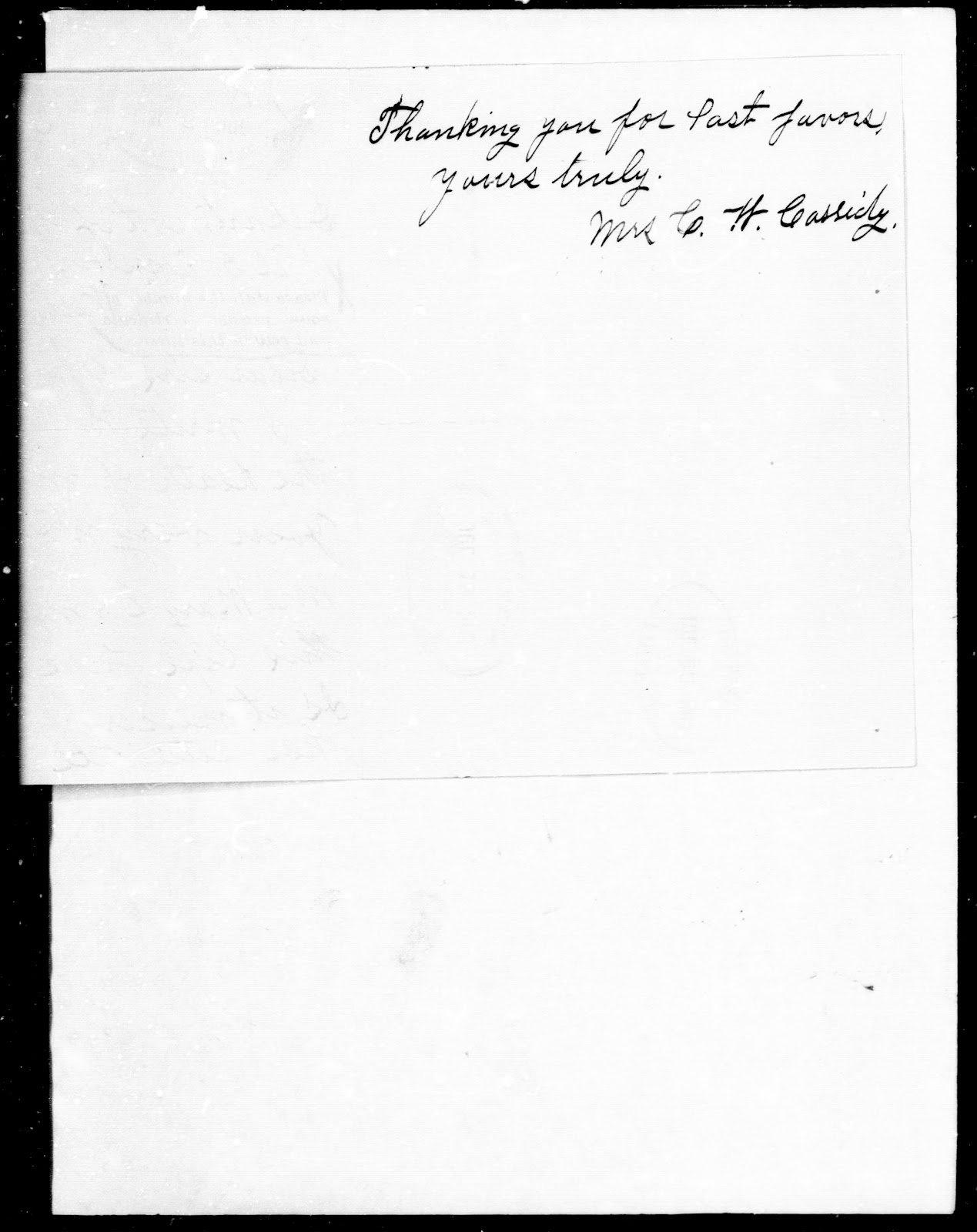
     Mary's daughter Carrie married Charles W. Cassidy, a nephew of Michael J. Smith, on February 7, 1906. They had two daughters together, Helen and Mary, and two sons, Charles and Carlton. Charles W. Cassidy died in 1914 and Carrie later married William Vernon Bradshaw (I went to school with their descendants). Carrie outlived William by thirty years and died in Fredericksburg in 1975.
     Mary Elizabeth Row Smith died on June 6, 1913 at the age of seventy one.

Carrie's letter to Pension Bureau, 1913


Carrie's letter to Pension Bureau, 1913