Search This Blog

Tuesday, April 12, 2016

Chancellor & Rawlings

M. S. Chancellor, "The Farmer's Store," 1927 (Library of Congress)

     Two young men, each born in Spotsylvania County in the mid-nineteenth century, came to Fredericksburg, where they made their mark as noteworthy civic and business leaders. They were brothers-in-law, and for almost 20 years they were business partners as well. Special thanks today to Diane Ballman of the Central Rappahannock Heritage Center (CRHC), who furnished me with two rare photos of Sanford Chancellor.

Sanford Chancellor (CRHC)

     Melzi Sanford Chancellor, Jr., who was called Sanford, was born at Dowdall's Tavern in Spotsylvania County in 1859. He was the youngest child of Reverend Melzi Sanford Chancellor and Lucy Fox Frazer. I have recently written a piece about Reverend Chancellor, which can be read here. Dowdall's Tavern stood on the south side of the Orange Turnpike (modern Route 3) just east of Wilderness Baptist Church, where the senior Chancellor served as pastor for many years.

Location of the home of Melzi Sanford Chancellor, 1863 (National Archives)

Dowdall's Tavern (Library of Congress)

     Sanford attended local schools after the Civil War and then studied at the Locust Dale Academy in Orange County. By 1879 he was working as a clerk in the store of his brother, George Edwards Chancellor. The store sold farming supplies and tools, and also carried groceries. It was located at 318 Commerce, located at the corner of modern William and Charles Streets. Today that site is the location of Castiglia's Italian Restaurant.

Invoice of George E. Chancellor, 1882

     In 1880, Sanford was still living with his parents in Spotsylvania County. By this time, Reverend Chancellor had built a new home,  called "Chancellor's Retreat," behind Wilderness Baptist Church. In the 1884 photograph shown below, this house can be seen in the far distance at right. In the foreground is the Orange Turnpike, today's Route 3.

Wilderness Baptist Church and Chancellor's Retreat, 1884 (National Park Service)

     When Sanford moved to Fredericksburg, he lived with his widowed sister, Anna Cora Chancellor King, and her sons: Chancellor, George Phillips, Jr., and Rufus. Their house was located at 822 Main (modern Caroline) Street and is still there today. Sanford, Anna and George later moved to 1108 Charles Street, where they took in boarders.
     George Phillips King, Jr.--a merchant like his uncle Sanford (he worked for James T. Lowery for many years)--married Cora Harrison in 1908. One of their sons, George Harrison Sanford King, later gained a reputation as one of Virginia's most able genealogists. Sanford Chancellor, who never married, lived with George and Cora for the rest of his life. In the photograph below, George King is shown standing at right next to Julia Mann. Sitting are Sanford's nephew, Scott Todd Stephens (a son of Lucy Monroe Chancellor) and his wife, Lillie Jennings Stephens.


     Another sister of Sanford, Leona, married James Richard Rawlings in 1877. By the 1880s the Rawlings family settled in Fredericksburg, where James began to work as a merchant.
     George Edwards Chancellor died in Fredericksburg on November 12, 1887. Acting as executors of George's estate, Sanford, his brother Vespasian and their father took steps to sell off the remaining inventory of the store and to pay the estate's debts. In July 1888, Sanford and James announced that they had bought the store on Commerce Street. They would continue in the same line of business as before under the name of Chancellor & Rawlings. For the next 17 years, they sold farming supplies, groceries, dry goods and even adding new items as opportunities arose.

The Free Lance, April 4, 1893

The Free Lance, May 28, 1894

The Free Lance, January 13, 1898

The Free Lance, April 27, 1899

     With his new-found prosperity, Sanford also began participating in the civic life of Fredericksburg. He was first elected to the city council in 1896 and won re-election several times thereafter. He was elected vice president of the Rappahannock Valley Agricultural and Manufacturing Society, which organized the fairs held in the city each year. He also joined a number of fraternal organizations, including the Independent Order of Odd Fellows, the Order of the United American Mechanics, the sons of Confederate Veterans and the Masonic Lodge Number 4.
     In a time when many of the city's leading citizens were devout members of the Baptist Church, Sanford attended Trinity Episcopalian.

Sanford Chancellor (CRHC)

     Sanford got the attention of local citizens and a reporter for The Daily Star in 1910 when he jokingly announced that he had ordered an automobile for himself:

The Daily Star, May 24, 1910
  

  In 1913, Sanford advertised his business in The Battlefield, the yearbook of the State Normal School in Fredericksburg, the forerunner of Mary Washington University:

The Battlefield, 1913 (Ancestry)

     Melzi Sanford Chancellor, Jr., died at 1108 Charles Street at 11:05 p. m. on June 19, 1925. He had been stricken with apoplexy, and two doctors were summoned to help him. Soon after their arrival, Sanford died of a cerebral hemorrhage. His funeral was conducted from the house on Charles Street by Reverend Sheerin, rector of Trinity Episcopal Church. Sanford is buried at the Chancellor family cemetery in Chancellorsville.
     In a brief and very unambiguous will, Sanford had left his entire estate to George King. George sold a half interest in the store to his brother, Chancellor King, who continued to run the business in his uncle's name for several years after Sanford's death. As late as 1953, the M. S. Chancellor store  was open for business, operated by George Harrison Sanford King and his brother, Francis Marion King. They are listed as sellers of Allis-Chalmers and New Idea Farm Equipment, General Hardware, Sales and Service. Almost 80 years after George E. Chancellor opened his doors here, the store went out of business in 1954.  In the 1955 Fredericksburg City Directory, 318 William Street is listed as "vacant."


James Richard Rawlings (Dan Janzegers)

     James Richard Rawlings was born at "Green Hill," in western Spotsylvania County on May 6, 1852. He was the youngest of five children born to James Boswell and Ann Cason Rawlings. James' father was a farmer, slave owner, justice of the peace and postmaster at Danielsville. The senior Rawlings was also a man of colorful character and expensive habits, which in 1844 landed him in the Louisa County jail for failing to pay a debt to a Jacob Roler. Mr. Rawlings wrote a letter to the sheriff of Spotsylvania County, in which he helpfully listed some of his wife's assets which could be liquidated to raise money to obtain his release from jail. The Rawlings home appears just south of Catharpin Road in the lower center of the map detail shown below.

Western Spotsylvania, 1863 (National Archives)
     James had two older brothers. Zachary Herndon Rawlings (1836-1916) was a farmer, railroad contractor, grist mill owner, store merchant and postmaster at Vesuvius in Rockbridge County. He was married to my second great aunt, Nancy Baker Row. Nearer to his own age was Benjamin Cason Rawlings (1845-1909), whose exploits during the Civil War have been topics of this blog (here and here) as well as a chapter of my book.
     Greenfield, the farm of James' in-laws, the Row family, witnessed a portion of Jackson's flank march during the Battle of Chancellorsville in May 1863. A year later, just prior to the invasion of Spotsylvania County by the army of General U. S. Grant and the Battle of the Wilderness, the Row and Rawlings families packed up their belongings and, together with a handful of slaves who had not yet run away to freedom, fled to the little crossroads village of Hadensville in Goochland County, Virginia. Here they would remain in relative safety as refugees for much of the remainder of the war.
     James' brother, Zachary, served for a time in Company A, 30th Virginia Infantry. His career as a foot soldier came to an end after being wounded at the Battle of Antietam in 1862. Benjamin, at the age of 18, became the captain of Company D of the 30th Virginia. Benjamin survived capture, imprisonment, sickness and many near misses during the war's fighting. Just before Lee surrendered his army at Appomattox in 1865, Benjamin was able to escape the Union encirclement of the remnants of the Confederate army. He made his way to Goochland County on foot and arrived at Hadensville gaunt, feverish, with matted hair and tattered clothes. James did not recognize his own brother, and was so frightened by his appearance that he hid behind his mother's skirts when he saw him.
     After the war, James continued to live and work at his parents' farm in Spotsylvania. On November 12, 1877, James married 20-year-old Leona Chancellor, a daughter of Reverend Melzi Sanford Chancellor. They had five children who survived to adulthood: James Boswell (1878-1936), Susie Estelle (1886-1957), Florence Baker (1888-1988), Lucille (1894-1958) and George Chancellor (1897-1974).
     I have not been able to find James' family in the 1880 census. By the 1880s James was working as a merchant in Fredericksburg. His name appears in the minutes of an 1886 city council meeting. After the death of Leona's brother, George, in 1887, James entered into a partnership with Sanford Chancellor to buy the store at 318 Commerce Street. The following summer, Chancellor & Rawlings arrived on Fredericksburg's mercantile scene.


The Free Lance, July 10, 1894

     James and Leona bought the house at 1112 Charles Street, and so lived just a few doors down from Sanford Chancellor and the King family. Unlike the Episcopalian Sanford, James was a devoted Baptist and served as deacon of the Fredericksburg Baptist Church for 25 years. James also served on the board of trustees for the city's public schools. 
     By the end of the 1800s, Leona's health began to decline. She died of tuberculosis at their home shortly after 2 p. m. on June 8, 1900. Her funeral was held at their house on June 10. She lies buried in the Confederate Cemetery in Fredericksburg.
     James and Sanford dissolved their partnership in the store by 1905. That year, James and his son James Boswell opened their own general merchandise store at 405 Commerce Street, just a block from Sanford Chancellor's store.


The Free Lance, April 25, 1905

     James Boswell Rawlings received his early education in the Fredericksburg public schools before attending the Locust Dale Academy and the Fredericksburg Collegiate Institute, where he graduated in 1895. During the Spanish-American War he served in Company K, the Washington Guards, and was stationed at Camp Alger in Falls Church, Virginia.
     In 1910, the Rawlingses dissolved their partnership in the store. James Boswell Rawlings accepted a sales position with the Heywood-Wakeman furniture company in Baltimore. The senior Rawlings continued to operate his store on his own. In 1913, he was appointed to the first of two 4-year terms as postmaster of Fredericksburg. His son James then returned home to take over the management of his father's store.
     On November 25, 1908, James Richard Rawlings married his second wife, Loula Williams. She was a sister of Reverend R. Aubrey Williams, who had been pastor of the Fredericksburg Baptist Church since 1904. James and Loula were married by her brother in a ceremony held at her aunt's house in Richmond. They had one child together, Mary Van Buren Rawlings, born in 1911. 
     James' other children had mostly grown up by now and had started careers of their own. Florence Baker graduated from Longwood College and became a school teacher. This was also true of her sister Lucille, who graduated from the State Normal School. Neither sister ever married.


Florence Baker Rawlings (Ancestry)


Lucille Rawlings (Ancestry)

     While Lucille was a student at the local college, James placed this advertisement in the 1913 edition of The Battlefield:


J. R. Rawlings (Ancestry)

     James and Leona's youngest child, George Chancellor Rawlings, became the executive vice president of the Lawyers Title Insurance Corporation. His son, George Chancellor Rawlings, Jr., became a controversial lawyer in Fredericksburg and served in the House of Representatives in Fredericksburg in the 1960s.


George Chancellor Rawlings, Jr. (Ancestry)

     James Richard Rawlings died of pneumonia at his home on Charles Street on Saturday morning, January 17, 1925--just five months prior to the death of Sanford Chancellor. His funeral was held at the Baptist Church and he was buried in the Confederate Cemetery in Fredericksburg.


Saturday, March 26, 2016

Three Who Rode to War

    
Vespasian Chancellor (National Park Service, with thanks to Tom Myers)

     Over a span of 21 years, Reverend Melzi Chancellor and his wife, Lucy, had 10 children together. Of their five sons, three were old enough to enlist in the Confederate service when Virginia seceded from the United States in 1861.
     Vespasian Chancellor, the oldest of the 10, was born in Spotsylvania County on November 22, 1838. In 1860, he was still living in his parents' household, working as a farmer at their home at Dowdall's Tavern on the Orange Turnpike. The following year, on April 25--just as Virginia was formally withdrawing from the Union--Vespasian was appointed postmaster at Chancellorsville. He would serve a second time as postmaster at the newly rebuilt Chancellorsville in 1877.
     On July 3, 1861, Vespasian enlisted for one year in Company C of the 30th Virginia Infantry. Much of his time was spent as a wagon driver for the quartermaster department. He was admitted to the General Hospital (where his uncle, Dr. James Edgar Chancellor, was chief surgeon) on May 12, 1862. He was furloughed five months later with a diagnosis of "Functional disease of the heart and anemia."

Vespasian Chancellor (The Photographic History of the Civil War)

     At some time after his departure from the 30th Infantry, Vespasian began to operate as a scout and spy for the Confederate cavalry, and was attached directly to the headquarters of General J. E. B. Stuart, for whom he became "one of his most successful scouts." On February 11, 1864, he officially enlisted in Company E of the 9th Virginia Cavalry and served with that regiment until at least January 20, 1865.
     After the war, Vespasian returned to Spotsylvania and lived with his parents, his three unmarried sisters and his younger brother, Melzi, Jr. As he had before the war, Vespasian continued to work as a farmer. However, because of his experiences during the Civil War, and also because of his family's unique place in Spotsylvania's history, he was able to supplement his income with much more interesting work.


     Over the years, Vespasian Chancellor was called upon by a number of veteran's groups to provide guided tours of the area's battlefields. Some of these are well documented and will be presented here. In the photograph below, taken in May 1884, Vespasian is seated at far right.

Veterans at Chancellorsville, 1884 (National Park Service, with thanks to Tom Myers)

     Standing in front of the tree at left is Warren Dudley Foster of Spotsylvania, who had been captured with Captain Benjamin Cason Rawlings during the Mine Run campaign in November 1863. Next to him is Reverend James Power Smith, who as a young lieutenant was among the first to render aid to General T. J. "Stonewall" Jackson after he was wounded on May 2, 1863. Seated at center and holding a cane is Joseph Dickinson, former adjutant of General Joseph Hooker. During the Battle of Chancellorsville, Dickinson saved the Chancellor family and other civilians by shepherding them from their burning house. Standing second from right and sporting the Dundreary whiskers he affected in his later years, is General James Longstreet.
     During the fighting on May 2, 1863, Reuben Towle Leavitt, Jr., of the 12th New Hampshire Volunteers was shot in the knee and brought into the Chancellor's house with scores of other Union wounded. The following day, the house--which was also used by General Hooker as his headquarters--came under heavy bombardment by Confederate artillery. Hooker was knocked unconscious after a solid shot hit the pillar he was standing next to. The house very shortly thereafter caught fire. Joseph Dickinson escorted the Chancellor family and other civilians there to a place of safety in Stafford County. Leavitt and other incapacitated soldiers gathered in a room were startled when a chimney collapsed from the fire and bricks came tumbling into the room. These men were saved from the burning house, but were captured by Confederate forces. Leavitt was imprisoned for six months before being paroled. He was permanently disabled by his wound. In October 1888, Leavitt and other surviving members of the 12th New Hampshire visited Chancellorsville, which was then undergoing repairs. The photo below, from Asa W. Bartlett's history of the 12th New Hampshire, shows Leavitt, at left, seated in the carriage next to Vespasian Chancellor. Damage from the battle 25 years before can still be seen in the wall facing the camera.

Reuben T. Leavitt and Vespasian Chancellor (Asa W. Bartlett)

    Vespasian also played a role in deciding where to mark the spot where a monument would be erected to commemorate the wounding of "Stonewall" Jackson. In an episode recounted in Charles Royster's book, The Destructive War, Vespasian, James Horace Lacy (owner of Ellwood and Chatham) and Lacy's son-in-law, Reverend James Power Smith, identified a likely spot on the old Chancellorsville property while giving a tour to Union veteran J. O. Kerbey. It was decided then that, because it would never be known for certain precisely where Jackson had been shot, the monument would be placed close enough to the Orange Turnpike to encourage tourists to visit it.
     In 1888, a granite marker was dedicated on the spot chosen by Chancellor, Lacy and Smith. In May 1899, Vespasian acted as tour guide for the 114th Pennsylvania Volunteers, the Collis Zouaves, who had come to Spotsylvania for the dedication of the monument which listed the names of the 38 men lost by that regiment during the Battle of Chancellorsville. The Zouaves and Vespasian also visited the Jackson monument nearby and posed for this photograph. Vespasian Chancellor is leaning against the tree at right:

114th Pennsylvania Volunteers and Vespasian Chancellor at Jackson monument (Donald Colvin)

The Free Lance, May 11, 1899

     Vespasian was a member of the Chancellorsville Battlefield Association, which bought property at the battlefield sites of Chancellorsville and Spotsylvania Court House. Although their timing was off by 30 years or so, the Association anticipated that the federal government would create a national park encompassing these locations, and that money could be made by catering to the expected influx of tourists to the area. Good intentions notwithstanding, the enterprise was a financial failure by the late 1890s.

Sue Chancellor (Rich Morrison)

     Vespasian married his first cousin, Susan Margaret Chancellor, in Washington, D.C.  on March 8, 1893. Sue Chancellor was one of the fortunate people saved by Joseph Dickinson at Chancellorsville in 1863, and her memoir of that event was published in 1921. Vespasian and Sue made their home in Fredericksburg at 300 Main (modern Caroline) Street.

300 Caroline Street, Fredericksburg (Google)

     On January 28, 1904, Vespasian took a spill on the icy pavement near his home in Fredericksburg. He fractured his right hip and was attended to by Dr. J. E. Tompkins. Vespasian died at his home on April 28, 1908. He is buried in the Chancellor family cemetery in Spotsylvania.


George Edward Chancellor*


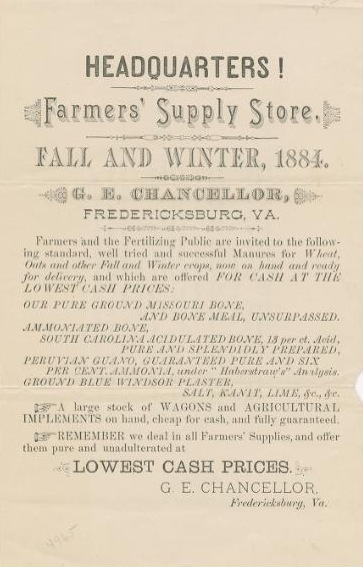
G. E. Chancellor broadside, 1884 (Library of Virginia)

     Vespasian's brother, George Edwards Chancellor, was born in Spotsylvania County about 1842. On April 25, 1861, George enlisted in Company E of the 9th Virginia Cavalry. Except for a period of time in late 1864, during which he was reported absent without leave (this occurred a month after he had been granted a furlough by General Robert E. Lee), George served for the duration of the war. His horse was killed in action at Buckland Mills in Fauquier County on October 19, 1863. Lieutenant Chancellor received eleven hundred dollars for the mount he had furnished to the Confederate service. Near the end of the war, George was wounded while fighting near besieged Petersburg. When he returned home a war's end, he brought with him the jacket he had worn as a trooper with the 9th Cavalry, which bore "a dozen or more bullet holes."

Invoice of George E. Chancellor (Author's collection)

     In 1868, George moved to Fredericksburg, and by 1870 he was living in the household of Irish-born merchant Patrick McCracken, in whose store he worked as a clerk. By 1873, George had established his own business, where he sold groceries, feed and seed, and farming implements at the corner of Commerce (modern William) and Charles Streets. He was active in the Conservative Party and was elected as a delegate to its state convention in 1870.

Receipt of George E. Chancellor (Author's collection)

     In October 1876, General Joseph Hooker (who had never fully recovered from his injury at the Battle of Chancellorsville) and his literary executor, Samuel P. Bates, visited the battlefields of Fredericksburg and Spotsylvania. Bates wrote an account of their experience at the Chancellorsville battlefield in an article he wrote for The Century Illustrated Magazine:
     "We were accompanied on our ride to the Chancellorsville field some ten or twelve miles above Fredericksburg by Major George E. Chancellor, a son of Melzi Chancellor, whose home at the time of the battle was at Dowdall's tavern, where General Howard had his headquarters. On setting out, General Hooker suggested that we should take some lunch along with us, as when he was there last, there was very little to eat in all that region. Major Chancellor thought it unnecessary, and, in fact, we feasted most sumptuously at his father's house."
     The house where they had lunch that day, "Chancellor's Retreat," stood behind Wilderness Baptist Church, as shown in the 1884 photo below. The Orange Turnpike (modern Route 3) is in the foreground.

Wilderness Church and "Chancellor's Retreat," 1884 (National Park Service)

     George Chancellor never married. In 1880 he was sharing a home on Commerce Street with merchant John J. Berrey, also a life-long bachelor.
      In 1883, a fire occurred in George's store, while it was a serious event for him, the fire did not actually threaten any other nearby buildings. However, this focused the minds of the member of city council on the fact that the city did not have a municipal water system, and not fire-fighting equipment to deal with the next unexpected blaze. Steps were then taken to remedy both situations.
     

The Free Lance, February 13, 1885

     On November 12, 1887, George died at home of "a lingering disease of the stomach and secretive organs." He is buried in the Chancellor family cemetery in Spotsylvania. His obituary appeared in the November 1887 edition of The Free Lance:


*To see the original photograph from which George's portrait was taken, please see my post The Chancellors Revealed


Thomas Frazer Chancellor (National Park Service, with thanks to Tom Myers)

     The youngest of Reverend Chancellor's sons to fight for the Confederacy was Thomas Frazer, born in 1845. He enlisted in Company E of the 9th Virginia Cavalry on March 1, 1862.
     On October 10, 1862, General J. E. B. Stuart led a force of 1,800 cavalrymen on a raid into  Pennsylvania. They cut telegraph wires, seized ammunition, clothing and other supplies, and burned the railroad depot and trains at Chambersburg. They accomplished this at the cost of a few wounded men and two unaccounted for. One of these missing troopers was Private Thomas Chancellor.
     Thomas had been taken prisoner "near Gettysburg," and spent the next two months incarcerated at Fort Delaware. He was sent to Fort Monroe in Virginia on December 15 and was exchanged on December 20, 1862. He then rejoined his regiment and served as a courier for General Stuart.
     Late in 1862, Thomas Chancellor issued an invitation to General Stuart to attend a party to be hosted by his aunt Fannie Chancellor at Chancellorsville. Although Stuart was well acquainted with Fannie and had been her guest a number of times previously, he sent her his regrets. But he allowed Major John Pelham, Colonel Heros von Borcke and some others to attend, including a couple of musicians. This party of 10 men commandeered an ambulance and set out from Fredericksburg for Chancellorsville. En route the ambulance hit a snow covered stump and wrecked violently four miles from Chancellorsville. When this battered group finally arrived, they were greeted by Thomas Chancellor. Fannie Chancellor's guests danced until midnight, ate supper, and then resumed dancing until the wee hours of the morning. (From Jerry Maxwell's book, The Perfect Lion, 241-243).
     Private Chancellor accompanied General Stuart's cavalry a second time into Pennsylvania, arriving at Gettysburg on July 2, 1863. Thomas was mortally wounded during the fighting there and died on July 15, 1863. In 1939, George Harrison Sanford King, a grandson of Thomas' sister Anna, ordered a headstone for Thomas from the Department of War and had it placed in the Chancellor family cemetery in Spotsylvania.


Sources:

Maxwell, Jerry H., The Perfect Lion: The Life and Death of Confederate Artillerist John Pelham. The University of Alabama Press, Tuscaloosa, AL: 2011.

Bartlett, Capt. A. W., History of the Twelfth Regiment New Hampshire Volunteers in the War of the Rebellion. Ira C. Evans, Concord, NH: 1897.

The Century Illustrated Monthly Magazine. May 1886, to October 1886. Volume XXXII, New Series Volume X. The Century Company, New York, NY: 1886.

Miller, Francis Trevelyan and Lanier, Robert S., editors, The Photographic History of the Civil War in Ten Volumes. New York, NY: 1911.

Royster, Charles, The Destructive War: William Tecumseh Sherman, Stonewall Jackson and the Americans. First Vintage Civil War Library Edition, January 1993.

Sunday, March 20, 2016

Dr. James Edgar Chancellor

James Edgar Chancellor (UVA Library Special Collections)

     He was the youngest child born to George and Ann Chancellor of Chancellorsville, arriving on January 26, 1826. He received every benefit a loving and well-to-do family could provide, and he made the most of those advantages.
     James attended the "classical academy" in Fredericksburg and studied medicine under Dr. George French Carmichael [1]. He then enrolled at the University of Virginia and took classes in medicine, anatomy and surgery, and chemistry and earned his degree in 1847. He then spent a year in Philadelphia, where he attended the Jefferson Medical College. He received his medical degree in 1848 and returned to Spotsylvania, where he began a successful private practice.
     Until about 1853, James lived with his half-sister, Mary Pound, and her husband, Jacob E. Appler, on their farm near Chancellorsville. In 1853, James was appointed to a one-year term as postmaster at Chancellorsville, a sinecure held by a number of his relatives over the years. That same year, on November 18, James married his sweetheart, Dorothea "Dorry" Josephine Anderson.
     Born on February 3, 1828, Dorry was the daughter of Thomas W. Anderson and Jane Porter Alsop. In 1834, Jane's father, Samuel Alsop, Jr., gave to Thomas and Jane a house and large farm in Spotsylvania called "Coventry" [2].

James E. Chancellor house (Library of Congress)

     James and Dorry Chancellor made their home at the house shown above. It was located across the road from Spotsylvania Court House [3]. The wall in the foreground enclosed the lawn of the court house at that time. The triangular wooden frame in front of the barn at left was a well built in the road. An earlier granary and stable belonging to Dr. Chancellor burned in 1857.
     Six children were born to James and Dorry: Eustathius (1854), Euodia Livingston (1855), Alexander Clarendon (1857), Thomas Sebastian (1858), Samuel Cleveland (1859) and Josephine "Josie" Anderson (1862). Euodia died in 1857. James and Dorry published the poem below dedicated to her memory. This clipping is part of the George Harrison Sanford King collection at the Central Rappahannock Heritage Center in Fredericksburg. Euodia lies buried in the gated portion of the Berea Christian Church cemetery belonging to J. E. Chancellor (his name is on the gate) at Spotsylvania Court House. Berea Church was built in 1856 under the supervision of Dorry's grandfather, Samuel Alsop, Jr.


     Soon after the Civil War began, Dr. Chancellor made his services available to the Confederacy. On September 4, 1861, James was commissioned assistant surgeon for the General Hospital at Charlottesville. The following year he was named chief surgeon of the hospital complex in Charlottesville, and remained at that post for almost the entire war.
     Since there was no such thing as a "general hospital" in Charlottesville in 1861, the wounded and sick Confederate soldiers who were brought here via the Virginia Central Railroad were quartered in the town's stores, hotels, private homes, the town hall and court house and even the Rotunda at the University of Virginia. During the Civil War, more than 22,000 men were treated at this place. Over 1,100 died there and are buried in umarked graves near the University.
     On February 23, 1862, James and Dorry Chancellor celebrated the birth of their second daughter, "Josie." Their happiness would be short lived, however. Dorry became sick just five months later and she died of "typhoid fever with pulmonary congestion." Her body was transported back to Spotsylvania, and she was buried next to Euodia at Berea Christian Church.

Richmond Times Dispatch, August 21, 1862

     After Dorry's death, James' two youngest children, Sam and Josie, were brought to the widowed Jane Alsop Anderson to care for. While it is not known how long Sam lived with his grandmother, it appears that Josie lived with her for most of her life.
     In addition to his responsibilities for thousands of patients and caretakers, James also did what he could for his extended family. After the destruction of Chancellorsville in May 1863, James made arrangements for his aunt Fannie Chancellor and her children to come to Charlottesville. He obtained for Fannie a position as matron at Midway and Delevan hospitals. Fannie, with the help of her daughters Frances and Penelope, brought fresh eggs and vegetables to the patients and provided whatever other small comforts they could. Unfortunately, James' skills as a doctor could not save Fannie's daughters once they contracted typhoid fever in August 1864. They died within days of each other.
     The year 1864 also saw Dr. Chancellor detailed on temporary duty when he was ordered to report to the Reserve Medical Corps of the Army of Northern Virginia. These surgeons assisted in the care of thousands of Confederate soldiers wounded during the battles of the Wilderness and Spotsylvania Court House. He returned to Charlottesville after the completion of this tour of duty.
     In early March 1865, Union cavalry commanded by General Philip Sheridan occupied Charlottesville for three days. Although there was a moderate amount of looting and burning, the town and outlying farms were spared the wholesale destruction these same troopers meted out in the Shenandoah Valley.
     A month later, after the capture of Richmond by Federal forces, Dr. Chancellor loaded medical supplies into an ambulance with the intention of making his way to General Joseph Johnston's army in North Carolina. However, when news of General Lee's surrender at Appomattox reached him, James returned to Charlottesville and acknowledged that the struggle for southern independence had come to an end.

Dr. James Edgar Chancellor (UVA Library Special Collections)

     James did not return to Spotsylvania after the war. Instead, he elected to remain in Charlottesville. In October 1865 he was named demonstrator of anatomy by the medical school at the University of Virginia. He also met someone who would become part of his life for the next 30 years.

Birdwood (Virginia Department of Historic Resources)

     Gabriella Garth was born about 1828 at "Birdwood" in Albemarle County, the impressive home of her wealthy and socially prominent parents, William Durrett Garth and Elizabeth Woods Martin. The beautiful young Gabriella enjoyed all the benefits of a storybook upbringing, including an education received at Mrs. Mead's School in Charlottesville. In the map detail below, I believe Birdwood is indicated as "Garth" in the left center of the image, just south of the road and east of "Randolph."

Map detail of Albemarle County, 1860s (National Archives)

     In November 1851, Gabriella married Dr. James Kirk of Hilton Head, South Carolina, in a ceremony held at Birdwood. The bride and groom then returned to Rose Hill, the Kirk home in Bluffton. A portrait of Gabriella hangs in the house today, and can be viewed by clicking on this link. Dr. Kirk and Gabriella had three children together. Dr. Kirk and their oldest child died in 1858. She remained at Rose Hill with her surviving children, Woods and Lilla, until 1861. With the threat of a Union invasion of Hilton Head now imminent, Gabriella took her children and a small contingent of slaves to the train depot in nearby Hardeeville. From there they headed west to Alabama, presumably to refugee with her uncle, Jesse Garth.
     While living in Alabama, she met Dr. John Summerfield Mayes. They were married in Lawrence County in March 1862. Dr. Mayes and their son died there in 1865. Gabriella then took Woods, Lilla and her youngest child, Martha Mayes, home to Birdwood and soon thereafter met Dr. Chancellor. They were married in her parents' home on November 14, 1867. Reverend J. S. Lindsay, chaplain at the University, officiated.

School of Medicine, 1867. Chancellor seated at far right (UVA Library Special Collections)

     James and Gabriella Chancellor lived at University Place in a large house. Over the years, in order to help make ends meet, Gabriella took in boarders, mostly young male students at the University. In 1880 there were 34 people boarding in the Chancellor household.
     Dr. Chancellor also sought ways to supplement his meager income. The most successful of his ventures was to become resident physician at various mineral springs which featured hotels and other amenities to attract those who sought to "take the waters." Testimonials by James appeared in newspapers over the years, attesting to the efficacy of the waters at such places as Jordan Alum Springs and Rockbridge Alum Springs in Rockbridge County, Virginia and at the Salt, Sulphur and Iodine Springs in Monroe County, West Virginia.
     Beginning in 1872, this would be virtually his sole source of income. That year he suffered a nasty wound while dissecting a cadaver. His health became so compromised that he was obliged to resign his position at the University of Virginia.

Faculty in 1868. Chancellor at lower left (UVA Library Special Collections)

UVA faculty. Chancellor in front, 2nd from left (UVA Library Special Collections)

     Despite this serious setback, James E. Chancellor's reputation and stature as a physician continued to grow. He published a number of professional papers that were presented at various conferences. He became a member of the Medical Society of Virginia in 1871, serving as its vice president in 1874 and 1880 and as president in 1883. He also was appointed to the Virginia State Board of Medical Examiners. Chancellor was made a permanent member of the American Medical Association in 1875 and the American Public Health Association in 1878.
     In 1885 he was elected and served one term as professor to the chair of diseases of women and children at the University of Florida in Tallahassee. He also filled the chair of anatomy during his stay there.
     That same year, on May 6, James's youngest child, Josie, died at "Coventry," her grandmother's house in Spotsylvania. She is buried with her mother and sister at the Berea Christian Church cemetery. Her obituary is part of the George Harrison Sanford King collection at the Central Rappahannock Heritage Center:


     On Monday, December 9, 1895, The Alexandria Gazette reported that "The dwelling house of Dr. J. E. Chancellor was destroyed by fire at the University of Virginia at 7 o'clock Saturday evening. Loss about $2,000."
     James and Gabriella moved to 110 13th Street in Charlottesville. Dr. Chancellor died there one year later, on September 11, 1896. He is buried at the University of Virginia Cemetery and Columbarium.

James E. Chancellor standing with his brothers (Ancestry)

     After his death, Gabriella was joined in her house by her divorced daughter, Martha Mayes Shuey and her two children. Ten years after the burning of the house she shared with James, this house also burned:

Richmond Times Dispatch, November 23, 1905

     Gabriella Garth Kirk Mayes Chancellor died in Louisa County, where she had gone to spend the summer, on August 10, 1909. She is buried at Maplewood Cemetery in Charlottesville.


Postscript 

All four of James Edgar Chancellor's sons lived well into the 20th century and prospered.

Dr. Eustathius Chancellor (Nationial Institutes of Health)

     Eustathius Chancellor earned his medical degree at the University of Maryland in 1877. He moved to St. Louis, where he completed his classical education by earning a Master of Arts degree at St. Louis University, while establishing a successful private practice. The governor of Missouri appointed him as Medical Director of the Missouri State National Guard. He never married. Eustathius died in 1931.

Alexander Clarendon Chancellor

     A. C. Alexander married and raised a family in Columbus, Georgia, where he owned a successful store specializing in men's high-end clothing and accessories. He was named president of the Georgia Retailers Association in 1909. A photograph of his palatial home appears in Kenneth H. Thomas' book, Columbus, Georgia in Vintage Postcards. Arcadia Publishing, Charleston, SC: 1901. He died in 1933.

Home of Alexander Clarendon Chancellor

     Thomas Sebastian Chancellor and his wife lived in Alabama and Florida, where he worked in retail and as a commercial traveler.

Samuel Cleveland Chancellor

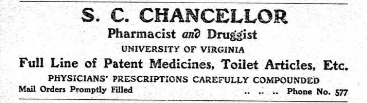
     Sam Chancellor graduated from the Pharmaceutical College in Baltimore, Maryland with the intention of becoming a medical doctor, but impaired eyesight obliged him to pursue a career as a pharmacist instead. He spent years honing his skills at drug stores in Baltimore, Richmond and Charlottesville. In 1890 he bought out the drug store of R. C. A. Seiburg in Charlottesville and established his long standing pharmacy there.

Charlottesville directory, 1902 (Ancestry)

Chancellor's Drug Store (UVA Library Special Collections)

Chancellor's Drug Store (UVA Library Special Collections)


     In 1905 Sam married Clarissa Lynn Rodes, who died after a failed appendectomy a year later. Sam Chancellor died in 1922.


Notes

[1] Dr. Carmichael (1806-1882) served as surgeon in charge of the General Hospital in Danville during the Civil War.

[2] Samuel Alsop, Jr. built houses for two of Dorry's sisters as wedding gifts. "Kenmore Woods" was given to Ann Eliza Alsop and her husband, John M. Anderson.  "Oakley" was built for Clementine Alsop and her husband, Thomas Coleman Chandler. I wrote this article about Oakley several years ago.

[3] In future years, this house would be occupied by Spotsylvania County Sheriff Thomas Addison Harris and Commonwealth's Attorney Samuel Peter Powell.


Sources

Makers of America: Biographies of Leading Men of Thought and Action, volume 1. B. F. Johnson, Washington, D. C.: 1901.

Virginia: Its History, Influence, Equipment and Characteristics, volume 2. Lewis Publishing Company, New York: 1904.

Kelly, Howard A. and Burrage, Walter L. American Medical Biographies. The Norman, Remington Company, Baltimore, MD: 1920.

Henry, William Wirt and Spofford, Ainsworth R. Eminent and Representative Men of Virginia and the District of Columbia of the Nineteenth Century. Brant and Fuller, Madison, WI: 1893.

The George Harrison Sanford King archive at the Central Rappahannock Heritage Center: