Search This Blog

Saturday, December 21, 2013

"This day ran away from my premises, servants..."

Nancy Estes Row's list of runaway slaves, 1862

This is the story of Bettie and Robert Upshur.

     Greenfield, a large plantation in western Spotsylvania, was home to Absalom Row and his family and dozens of other inhabitants. At any given time there would be at least thirty permanent residents at Greenfield, not including kinfolk and other guests who would come to stay for extended visits.

Absalom Row

     When he died in 1855, Absalom left behind an estate valued at $25,443. His property included 889 acres of land, cash and bank stock, furniture and other household effects, and the tools, livestock and other impedimenta necessary for running a large farm.

Inventory and appraisement of Abalom Rows estate

     However, more than half of Absalom Row's wealth was tied to the value of the twenty five slaves he owned at the time of his death. The inventory and appraisement of his estate, completed in May 1856, show these slaves to be valued at $14,375. Listed in the right column of the page shown above are the names of three of those individuals: Molly (the nickname for Mary), and her two children, Betsy and Isabelle, valued together at $1,000.

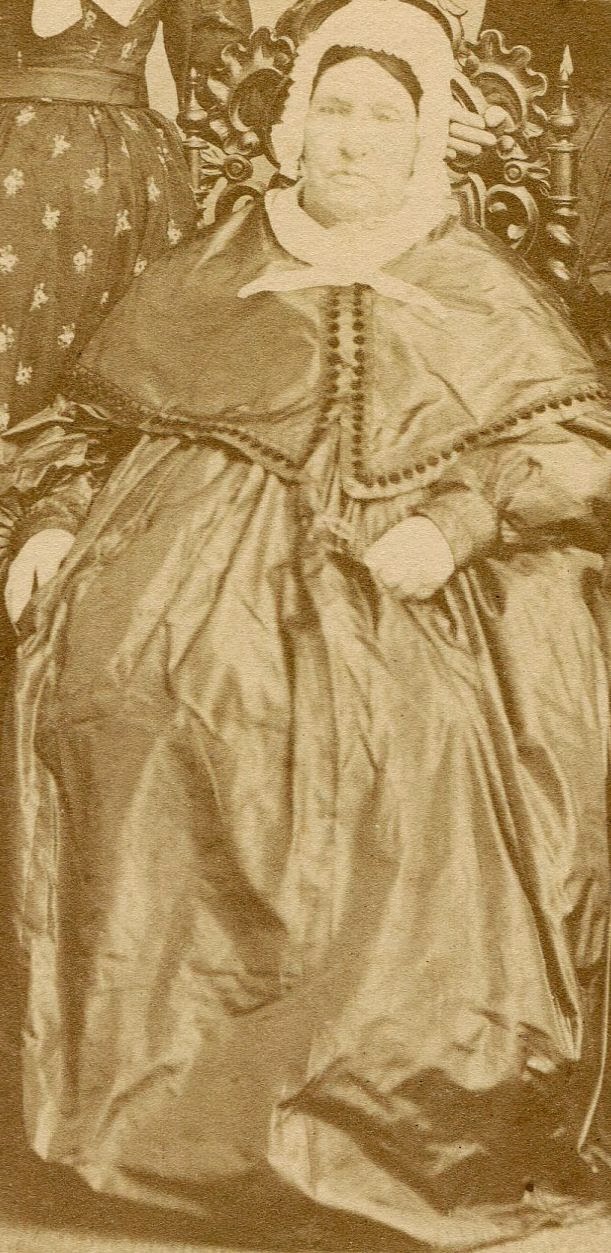
Nancy Estes Row (Courtesy of Ellen Apperson Brown)


     In his will, Absalom named his wife, Nancy Estes Row, as the executrix of his estate. In the eighteen years she was to manage Greenfield, Nancy handled her affairs ably and with a business-like competence traditionally associated with men in the South of the mid-nineteenth century. She exercised sole discretion in all monetary matters including, of course, that discretion pertaining to the lives and well being of those black servants held in bondage at Greenfield.
     In 1857 Nancy gave to Martha and James T. Williams, her daughter and son in law then living in Richmond, three expensive presents. These included 11 year old Ellen Upshur, 12 year old John and 9 year old Patsy. John and Patsy were very likely Ellen's brother and sister. Some time ago I discovered the fate of Ellen Upshur and you can read her story here. To another daughter, Bettie, and her husband Zachary Rawlings, Nancy Row gave two children for Christmas in 1860: Adaline, 16, and 14 year old David.
     Whether or not we choose to give Nancy the benefit of the doubt regarding the possibility of her being a willfully cruel mistress to her slaves, there is no denying that - no matter how gently it could be administered - slavery was an inherently harsh business. On very short notice, persons could be sold off and carted away like so much livestock or furniture. This practice inevitably broke up families, and even in otherwise benevolent households,  most slaves opted for freedom when the opportunity presented itself.
     In the spring of 1862 Federal troops set up camp in Stafford and for a few months occupied the town of Fredericksburg. Their presence became widely known throughout the region, to masters and slaves alike. It would not be long before the enslaved, as many as 10,000 of them, disappeared from local plantations and made a bid for freedom within Union lines.
     Among those who fled were most of the slaves of Nancy Row. Written in her own hand, the list of runaways appearing at the beginning of today's post includes the name of three who left on June 26, 1862 and never came back: Mary Agnace Upsher, 28 (listed as "Molly" on Absalom Row's estate inventory), Betsy and Robert. Betsy's sister Isabella died at Greenfield in 1857.
     Bettie Upshur was born at Greenfield in January 1855. Her brother Robert arrived in May 1860. At the time of their escape from Greenfield, their mother was the head cook of the plantation. That meant that she and her children lived in the room over the kitchen, which stood just south east of the house.
     In January 1863, Nancy Row - with the assistance of her son in law Zachary Rawlings - filed an affidavit with the Corporation Court of Fredericksburg, documenting the loss of her slave property. Slave owners throughout the south routinely filed such paperwork in the hope of some day being compensated for their loss. In her affidavit, Nancy listed the names, ages and values of those who ran away and did not come back. Included are the names of Molly, "No. 1 cook," Betty and Robert.
     By 1864 these Upshurs were living in Washington, D.C. Mary became the wife of a man named Mundy and had two daughters with him, Anna and Frances.
     The name of Robert Upshur next appears in the written record in 1886. He is listed in the city directory of Washington, D.C. as a "laborer." When his name next appears in the directory in 1894, he is living with Bettie at 1345 27th Street NW.

Detail of 1900 census, Washington, D.C.


     By the turn of the century, Betty Upshur is shown to be the head of the household that includes her brother Robert and their two half sisters. The 1910 census shows the same family together, less Anna.

Detail of 1910 census, Washington, D.C.

     In 1915 Bettie and Robert Upsher are still living together, now at 2728 P Street NW.

Detail of 1915 Washington, D.C. city directory

     But the city directory and the census do not tell the entire story.
     Since 1864 Bettie Upshur had been working in the household of one of Georgetown's most socially prominent families. Robert next became employed there in 1871 and their sister Frances Mundy in 1881.
     John D. Patten (1843-1927), an 1861 graduate of Georgetown College, was a partner in the firm of Patchin & Patten, listed variously as "attorneys for national banks," "agents for national banks," or "bank examiners." Patten and his wife dwelt among the city's elite. They were members of a number of civic and philanthropic organizations, including the Columbia Historical Society of Washington. John D. Patten was a member of Washington's exclusive Cosmos Club, where he served on the membership committee.

From the 1899 Cosmos Club members and officers

     In 1916 the society matrons of Washington held a well publicized contest, which would feature the names of those household employees who had been in service the longest. The results were published in the November 3, 1916 edition of the Washington Times. Three employees of Mrs. John D. Patten were certainly among the head of the class: Bettie Upshur - 52 years, Robert Upshur - 45 years, Frances Mundy - 35 years.

Washington Times 3 November 1916

     From their beginnings as slave children in the attic of a plantation kitchen in Spotsylvania, Robert and Bettie Upshur spent their lifetimes in the service of others and made the best of what life had to offer them during that period. They spent their lives together, ending their days working in an architect designed mansion in Washington listed in the Register of Historic Homes.
    

Tuesday, December 10, 2013

George Row's horse

George Washington Estes Row (right)

     When historical fact collides with family legend, the results can be unsettling. But the truth that emerges from that impact is always welcomed here in this space. We are all about telling these stories as honestly as we can. [All images in my blog may be clicked on for enlarged viewing]
     One of the hoary legends in my family concerns the time that 17 year old George Washington Estes Row enlisted in the Ninth Virginia Cavalry. Once Virginia seceded from the Union, George abandoned his studies at the Locust Grove Academy in Albemarle County and returned to Spotsylvania to sign up for anticipated martial glory on April 25, 1861. Like many young southern firebrands, George was likely worried that the war would be over before he could see it.
     In any event, the legend handed down by his daughter, Mabel Row Wakeman, told us that George's mother provided him a slave about his age from Greenfield, and gave them the two best horses from the plantation to go off to slay Yankees. For now, I feel pretty confident about the part about the body servant sent with George, and Nancy Estes Row would have been obliged to provide him with a mount. But George Row had to make other arrangements for his own horse.

GWE Row's note to Nathan Johnson, 26 April 1861

     In 1856 George Row's uncle, Richard Estes of Boone County, Missouri, died and left to George a tidy sum in his will. Jonathan "Nathan" Johnson of Walnut Grove, who was married to Richard's sister Francis Estes Johnson, was appointed by the court to act as George Row's legal guardian, protecting his rights in the Estes legacy (George Row's father died in 1855). Settling estates in the nineteenth century often took years, if not decades. In this case, the fact that Missouri is a long way from Virginia complicated matters. And then there was that little thing called the Civil War, which made transacting business at Spotsylvania Court House all but impossible.
     Just recently Ginger Chadduck, owner of Walnut Grove, sent me the note shown above. In it, George Row is asking his uncle and guardian, Nathan Johnson, to pay from his "interest money" for a horse he had to buy:

Dear Uncle,
      When this acct. is brought forth, pay it from my interest money. I had to get me a horse to go into service as I am called out tomorrow. By so doing you will much oblige your

                                                                                      Nephew G.W.E. Row
                              April 26, 1861

     The day before George wrote this note he was enlisted into Company E, Ninth Virginia Cavalry by Francis C. Beverly, owner of Whig Hill.
     For several years, I had the key to this horse conundrum in my hand, thanks to the Central Rappahannock Heritage Society, where I scanned the legal papers regarding George Row's legacy from Richard Estes. A page from that file is shown below. I needed George's note to Uncle Nathan to understand what I had.

Account of George Row's inheritance

     About the middle of the page, you will see an entry for $100, dated April 26, 1861, payable to William Massie Simms.  This is the horse on which George Row rode off to war.
     Nancy Estes Row provided her son neither a horse nor the money to buy one. I suspect that she had great misgivings about her 17 year old son going off to war, and may even had found out about his enlistment after the fact.
     And what of the servant who accompanied him to the Ninth Cavalry? His name is lost to history, but many years later his grandmother told Mabel Wakeman what he had told her: "Master George said if had had known as much about war as he learned, he would have stayed at the Academy, for he never slept well except one night, when he awoke head to heels in snow, and as for food he lived on parched corn, and life was not pleasant."


Wednesday, October 30, 2013

Greenfield

Mabel Row, about 1899

     "A tiny principality, far away from everywhere, but sufficient unto itself."
     This was how Greenfield was remembered by Mabel Row Wakeman (1879-1974) when she shared her recollections of our ancestral home with Spotsylvania historian Roger Mansfield sixty years ago. For 110 years it was home to four generations of the Estes and Row families. [Please note that all images in my blog may be clicked on for enlarged viewing]
     In 1795 the property that is known to history as Greenfield was owned by Edward Herndon, Jr. and his wife Elizabeth. On February 7 of that year the Herndons sold Greenfield to Richard Estes (1758-1832), my third great grandfather, for 200 pounds. At that time Greenfield consisted of 337 acres and included "all houses, buildings, fences, woods, ways, waters, watercourses, profits and commodities."

From the Herndon-Estes deed 1795


     Richard Estes and his wife Catherine Carlton (1759-1822) raised a family of ten children, the youngest five of whom were born at Greenfield, including my great great grandmother Nancy Estes (1798-1873).
     In July 1820 Richard Estes wrote his will, naming as executors his four sons: Ambrose, Richard, Berkley and George Washington. In the years that followed all four moved west. George Washington Estes went to Owen County, Kentucky and his brothers settled in Boone County, Missouri.
     Richard's daughter Nancy married her second cousin, Absalom Row (1796-1855) of Orange County in December 1825. By 1830 Absalom and Nancy and their two oldest daughters were living in Spotsylvania. With the departure of the Estes brothers, Absalom's place in the family assumed increased significance.
     In June 1832 Absalom Row penned a letter to his nephew Thomas Berry of Illinois, discussing his own health and that of his father in law: This leaves me in tolerable health. I have been able to do my business since about Christmas. I began to get the better of my disease about the time that James [Thomas's brother] was last to see me and you must tell him that my leg, that had no calf to it when he saw it, is now nearly as large as it ever was; Nancy and the children are at her father's house and have been for a week. The old man is almost off with the dropsy. Five weeks later Richard Estes was dead at the age of 74.

From the inventory & appraisal of Richard Estes's estate

     Greenfield, as noted in the inventory and appraisement of the estate of Richard Estes, consisted of three tracts of land: 350 acres, 313 acres (which had been purchased from Sarah Alexander) and 85 acres. Absalom Row bought the two larger parcels at public auction on September 26, 1832. On November 23 Richard and George Washington Estes signed a deed conveying Greenfield to their brother in law.

From the Estes-Row deed 1832

     During the 23 years that he owned it, Greenfield continued to flourish with Absalom Row as its master. He continued to buy land, including 75 acres bought from neighbor Bernhard Kube in 1844. By 1850 Greenfield was home to 30 persons: Absalom and his wife Nancy, their four children, Nancy's sister Mary Estes Carter, overseer James H. Brock and 22 slaves. In addition, relatives would come and visit for weeks at a time, as was the custom at the time.

Absalom Row

     Absalom Row died in 1855 at the age of 59. Eight years earlier he had written his will, in which he provided for the education of his daughter Bettie and his son George. The bulk of his estate he "loaned" to "my beloved wife Nancy Rowe...so long as she lives...and after her death I wish an equal division to be made among my children." He also named Nancy as his executrix. The inventory and appraisal of his estate made in May 1856 listed the names of 25 slaves and showed that Greenfield had grown to its maximum size of 889 acres.

From the inventory and appraisal of Absalom Row's estate

     Nancy Estes Row proved herself to be a competent and conscientious custodian of her husband's estate, which included the home in which she was born.

Nancy Estes Row

     On the eve of the Civil War life at Greenfield continued much as it had for the preceding decades. Except for the absence of Absalom and his daughter Martha, who was now married and living in Richmond, the same number of persons lived at Greenfield in the summer of 1860 as had 10 years previously.

Western Spotsylvania in 1863

     This detail of J.F. Gilmer's map shows the location of Greenfield (indicated as "Mrs. Rowe") and its closest neighbors. Beginning clockwise just north of Greenfield they were:

- William A. Stephens, whose grandson would one day own Greenfield
- Joseph Trigg, whose granddaughter Josephine married Day Stephens, a grandson of W.A. Stephens and also future owner of Greenfield.
- Johnson Fitzhugh, who moved to Spotsylvania from King George in the mid 1850s.
- Charles Bradshaw, who was postmaster at Todd's Tavern.
- Bernhard Kube, a German immigrant who traveled extensively working in the gold mining business. He brought Nannie Row a parrot from one of these trips. He sold his property to another German immigrant, Fredericksburg tanner John Hurkamp, for whom the park is named.
- Leroy Dobyns, who owned Oakley and whose daughter Maria wrote a well known letter describing the dramatic events there during the battle of the Wilderness.
- Richard Pulliam, whose son Dr. John Duerson Pulliam fought with the 9th Virginia Cavalry.

So what did Greenfield look like?

Drawing by George W.E. Row

     Unfortunately, no photographs of the old place are known to exist. We do know that the property extended along modern Jackson Trail West from Brock Road to Orange Plank Road. The sketch above, drawn by 16 year old George Washington Estes Row in his "Mitchell's School Geography" book shows a house which could have been his family's home. After reading the description below, you can decide for yourself.

Greenfield

     We can thank my great aunt Mabel Row Wakeman for leaving us detailed descriptions of what Greenfield looked like. She was the informant who provided WPA researcher Mildred Barnum with the basis of her report on Greenfield in January 1937. In addition, Mabel also shared a great deal of information with Roger Mansfield in her correspondence with him during the 1950s and 1960s. Her efforts enabled Roger to sketch the view of Greenfield seen above and also to write a short history of the place (virtually all my cousins have a copy of this).
     The house was of frame construction, a two story affair with a basement and a shed room on the west end. The house, which faced north, was said to be inconveniently laid out, a fact which did not seem to bother its owners until after Emancipation.
     The road into Greenfield arrived at the well yard, where a beautiful flower garden had been planted. Three large blocks of locust wood served as carriage steps. On the east side stood a log weaving house with two porches. The kitchen had a dirt floor and had two stories - the cook lived upstairs. There was an ice house on Panther Run, which had been dammed to create an artificial pond. South of the main house were the shops and the slave quarters. The cabins where the slaves lived were screened from view by a stand of trees. All of the provisions and the outbuildings were kept under lock and key. A former slave remembered how Nancy Estes Row used to bustle about the plantation with her keys jingling.

Nannie Row

     After the death of Nancy Estes Row in January 1873, the real estate of Greenfield was divided among her three daughters (her son, George W.E. Row, had already been given 166 acres in 1869). Nannie Row, who never married, received the Greenfield home site and 244 acres.
     With the help of her brother George, who also farmed his own place adjacent to Greenfield (Sunshine farm), Nannie was able to profitably manage Greenfield during her lifetime. Produce and livestock were sold at wholesale to merchants in Fredericksburg. The completion of the Potomac, Fredericksburg and Piedmont Railroad made this a much more convenient enterprise.
     In her will Nannie Row left Greenfield to her nephew Absalom "Abbie" Row. When she died in June 1889, 20 year old Abbie was living far from Spotsylvania, working as a stoker on a merchant ship. Two years later he was in the dairy business with a Mr. Charles in Fort Worth, Texas. In 1893 he married Annie Rosser and settled in West Virginia, where his first two children were born. By now Abbie was working as a conductor on the Southern Railroad. Soon after the birth of his son Thomas in January 1898, Abbie decided to move home to Greenfield.
     And what had been the fate of Greenfield since the death of his Aunt Nan nine years earlier? Someone must have acting as caretaker of the place, but I do not know who. Abbie's brothers, Houston and Horace, were too young. In any event, Abbie Row and his family settled at Greenfield in 1898. Abbie kept his job as a conductor, and worked on the farm on his days off. His dream was to buy new tools and equipment and modernize Greenfield.
     In January 1899 Abbie's sister in law Clementina Rosser Carter was visiting with the Rows. She died on the 11th, and so earned the unhappy distinction of being the last person to die at Greenfield. She is buried in an unmarked grave in the family cemetery there.
     On a happier note, Abbie's third child, Maxine, arrived in 1902, and so earned the distinction of being the last person born at Greenfield. Many years later Maxine's daughter Marie Clark wrote a monumental genealogical history of the Rows of Virginia. Her work is something I refer to often.
     Try as he might, Abbie was unable to realize his ambition to modernize Greenfield. By the early 1900s his indebtedness had reached a point where he was forced to concede defeat. In 1905 he sold Greenfield to friend and neighbor Scott Todd Stephens for $500 and assumption of the property's debt. Scott Stephens is seen below sitting with his wife Lillie Jennings. Friends Julia Mann and George King stand behind them.

Scott T. Stephens, seated at right

     And so Greenfield passed out of my family's possession forever. During the 8 years he owned Greenfield, Scott Stephens demolished the house and its dependencies. Only the basement of the house and the outlines of the buildings remained, still visible decades later.
     Scott Stephens died of tuberculosis in 1913 and the following year Greenfield passed to his son Robert Benjamin Stephens, shown below sitting with Fred Parker.

Robert B. Stephens (right)

     In 1918 Robert Stephens sold Greenfield to his uncle and aunt, George Day Stephens and Josephine Trigg, seen here with their daughter Sue.

Josephine, Sue and Day Stephens

     Day Stephens sold Greenfield in 1923 to J. S. Barnes and after his death in 1928 it passed to his brother William. Ironically, the property had gone into foreclosure due to $1000 owed to Horace Row.

Barnes debt to Horace Row

     From William Barnes Greenfield passed to Melzi Wolfrey.
     In 1932 Noah and Minnie Houck left Depression-stricken Wilkes County, North Carolina and came to Spotsylvania in search of new opportunities. Noah bought Greenfield, and the Houcks would own the place for the next 38 years.
     Rolf, a son of Noah, married Margaret Row of Sunshine farm in 1934. His brother Onard bought Greenfield in 1949 and he and his wife built a small house there, which still stands on the back side of the Oakley property. Onard farmed Greenville until 1970.
     Onard Houck sold Greenville to Charles Miller, who in turn sold it to the American Central Corporation in 1972. The cemeteries of the family and the slaves were spared, but in a pattern that would become all to familiar in Spotsylvania in the coming years, earth moving equipment was brought in and a great upheaval ensued with the intention of subdividing the property into campsites and for recreational purposes. As was Greenfield's fate for most of the 20th century, this ambition, too, fell by the wayside.
     Ultimately this mess was sorted out and the result was Fawn Lake, a development consisting of high end homes, a golf course and a man made lake. The Fawn Lake community built a fence around my family's cemetery. The slave cemetery remains neglected, the stones that once marked the graves strewn about.
      This is all that is left of the old homestead. (Photo by Mary Edith Arnold).

Greenfield


Monday, October 28, 2013

Captain John Row

John Sanders Row, at right

     Earlier this year I submitted an article to the Orange County Historical Society about my cousin John Row. I have always been fond of old John and I included in my piece everything I could find about him, including the proverbial kitchen sink. I was politely informed that my piece was a trifle too long for publication and as the months passed I had almost forgotten about it. You can understand my surprise when in today's post there came to hand the current number of The Record, which included my story of John's life.
     In the photograph above, John is sitting next to his brother, Dr. Elhanon Winchester Row, who would become regimental surgeon for the 14th Virginia Cavalry. At far left is James Roach, who was quite an interesting fellow in his own right. This photograph was made in 1862 when they all served in Company I of the Sixth Virginia Cavalry.
     Here is the article in its entirety [All images in my blog may be clicked on for enlarged viewing]:


Sunday, October 13, 2013

Thomas Addison Harris

Thomas Addison Harris*

     Soldier, farmer, public servant, twice a husband and eight times a father, Thomas A. Harris was a resourceful man of many dimensions and I take pride in presenting his life's story today. [Original photographs which include asterisks in their captions appear courtesy of my friend and fellow researcher Rich Morrison.]
     Thomas Harris was the fifth child of of Robert McCracken Harris and his wife Mary Kishpaugh, who came from Warren County, New Jersey and settled in Virginia in the early 1840s. Thomas was the first of their family to be born in Spotsylvania, arriving on August 29, 1844. The 1850 census shows that the Harrises lived next door to Robert's father William Harris. I presume they all came south at the same time.
     Robert McCracken Harris and his family lived near Shady Grove Church. He does not seem to have taken to the slave system in his adopted state. At least his name does not appear on any slave census that I can find. The 1860 census shows that two free black women, Bettie and Mary Curtis, were living on the Harris farm as laborers. They were still there ten years later.
     When the Civil War began Robert Harris had four sons of military age. The two oldest, who were born in New Jersey, had divided loyalties. William left Virginia to serve in the Union army. John Alfred Harris joined the 30th Virginia Infantry. They both survived the war. William returned to Virginia and for many years he and John ran a grocery in Fredericksburg named Harris & Brother.
     The other two sons who were Virginia born also cast their lot with the Confederacy. Charles Montreville Harris served with the Fredericksburg Light Artillery. Thomas, still three months shy of his seventeenth birthday, enlisted for one year's service in Company D of the 30th Virginia Infantry. This same company was later commanded by another rambunctious teenager, the colorful Benjamin Cason Rawlings. Rawlings was the first Virginian to join the Confederate army.
     In March 1862 Thomas submitted a request to transfer to a new battery being organized by Lieutenant J.F. Alexander. For whatever reason this did not come to pass and he remained with the 30th until he was mustered out on July 23, 1862.
     But his stint as a Confederate soldier was far from over. A month later he enlisted in Company E of the 9th Virginia Cavalry, in which he served until April 1865. Thomas Harris served as a scout for General Jeb Stuart and accompanied him during both of his raids into Pennsylvania. It was at the outset of the second of these adventures when he encountered some difficulty.

Payment for loss of T.A. Harris's horse

     On June 21, 1863 Thomas's horse was killed in action during the fight with Pleasonton's cavalry in Upperville in Loudon County. This was an occupational hazard for all troopers north and south, and doubly so for Confederate cavalrymen, who furnished their own mounts. Appraisals for these horses were kept on file so that compensation for their loss in battle could be expedited. In Thomas's case, however, the bureaucratic wheels turned slowly and it was not until February 18, 1864 that he received the $650 due him.
     The exploit for which Thomas was best remembered took place during the battle of Five Forks in April 1865. Much of the fighting took place at "Burnt Quarter," the home of the late John W. Gilliam in Dinwiddie County.  His widow Mary, who was then nursing a sick servant, and three of her daughters were trapped in their house by the fighting that raged about them, and indeed their lives were in great peril. General Fitzhugh Lee asked for five volunteers to escort them to safety. Corporal Thomas A. Harris was one of those five. Mary Harris refused to leave her ailing slave, but her daughters were successfully brought out of harm's way. During the ensuing battle Thomas was severely wounded, and his career as a Confederate trooper came to a close.
     Thomas returned to Spotsylvania and resumed his life as a farmer. On April 14, 1867 he married Mary Elizabeth Poole, who bore him eight children over the next sixteen years. Two of them, Eustace and Rupert, died in their teens.
     Thomas Addison Harris had ambitions beyond those of being a farmer. In 1870 he dipped his toe into politics and was elected as superintendent of the poor. This position he held until 1879, when he was elected commissioner of revenue for the St. George's district. And four years later he was elected sheriff of Spotsylvania County, in which capacity he served for the next twenty years.

Gathering at Spotsylvania Court House, about 1890

     In the photograph above, Sheriff Harris (13) is seen standing near the center of the image. His son, William Aquilla Harris (5) stands at left, dressed in white.

Spotsylvania Court House (on right), late 1800s

     In 1885 Thomas bought a 259 acre farm from the estate of Phillip Anns. This property included the modern sites of R.E. Lee School and the Spotsylvania Courthouse Village. The photograph above appeared in "A Life of Public Service," an excellent article written by Ted Kamieniak for the Free Lance Star on October 9, 1999. The camera is looking north up Court House Road at its intersection with Brock Road. The Harris farm was located behind the buildings on the left.
     One of Thomas's brothers, James Alfred Harris, was a partner in the saw mill business of my great grandfather, George Washington Estes Row. Their advertisement appeared in the March 23, 1881 edition of the Virginia Star:

Row & Harris

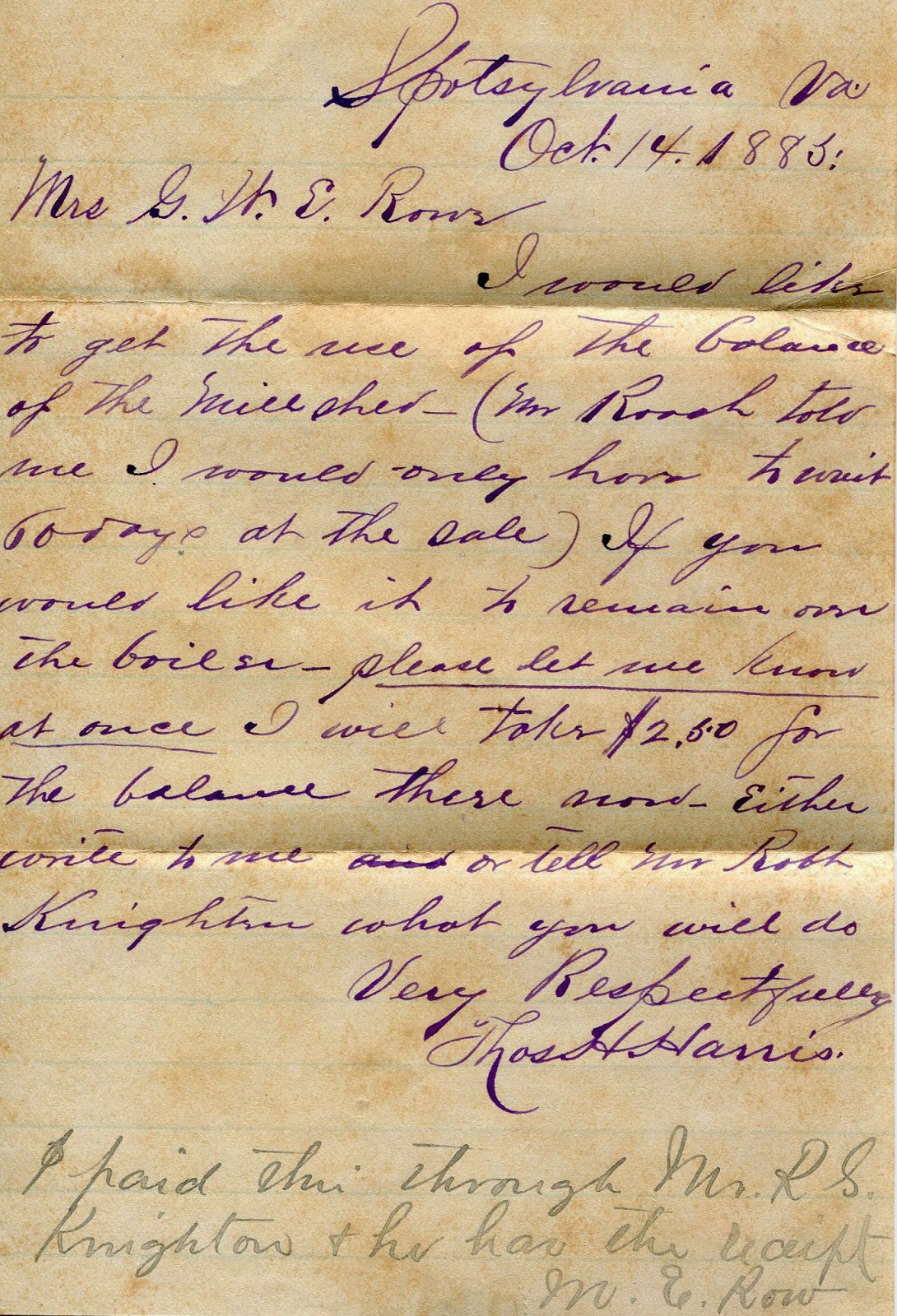
     After George W.E. Row's death in 1883, Thomas attended his estate sale and made arrangements to carry away the shed that covered the steam boiler for the mill. This letter was written by him to my great grandmother on October 14, 1883:

Thomas Harris letter to Lizzie Row

     Thomas's wife Mary died in 1888 and he remained a widower for three years. On September 3, 1891 he married thirty nine year old Elizabeth J. "Lizzie" Easturn.

Lizzie Eastburn*


     In 1903 Spotsylvania clerk of court Joseph Patrick Henry Crismond was forced to resign in the wake of a long running scandal. Judge R.E. Waller appointed Thomas A. Harris to fill the remaining two years of Crismond's term. In the photo below, Harris stands third from left. Judge Waller is the hatless fellow seated in the middle of the picture:

Spotsylvania Court House, 1890s

     In 1905 Thomas Harris was elected, without opposition, to an eight year term as clerk of court in his own right.

Thomas Harris, 1905

     Harris also helped usher Spotsylvania into the new century by becoming a member of the Spotsylvania Telephone Company, which ran a line from Fredericksburg to the court house area.

Thomas A. Harris*

     In January 1912, sixty seven year old Thomas fell on an icy patch and suffered debilitating injuries. He lay in bed for several weeks before succumbing to a heart attack brought on by "acute indigestion" on January 25. He is buried at Zion Methodist Church in Spotsylvania. His wife Lizzie followed him to the grave just four months later.

Headstone of Thomas Harris


     During his final illness, Thomas would have been cared for by his son, Dr. William A. Harris, who had married JPH Crismond's daughter Dora.

Dr. William A. Harris*

     Dr. Harris practiced medicine in Spotsylvania for decades and served three terms in the House of Delegates in the 1930s. He was my family's physician for many years.

Dr. Harris letter to Lizzie Row

     In early 1917 Dr. Harris treated my great grandmother for a persistent cough and what he characterized as a liver complaint. He wrote a prescription for Keracol and gave her advice on taking care of herself. He concluded his letter on a warm and personal note, telling her that she should go on a trip she planned and he also referred to my grandfather's recent marriage:

     I believe the trip will do you good and would certainly advise you to take it, especially as Horace has provided himself with a fine little woman, who will look after him in your absence.
                                                                                      With best wishes to all
                                                                                      I am sincerely your friend
                                                                                                    W.A. Harris             

How many of us have ever received a letter from our doctor like this one?

Tuesday, October 8, 2013

The mystery house


This photograph taken in 1966 in (I assume) Spotsylvania was recently discovered in my family's archive. If any of my readers recognizes this place and who may have owned it, please write and let me know. [You can click on the image to get an enlarged view]

Monday, October 7, 2013

Of squirrels slain, and a brother lost

Sunshine, as it looked in the 1950s

     Most of us who are parents have had the experience of teaching our children to write notes to relatives, thanking them for a gift received or to share some important event. Young boys do not take naturally to this social nicety and often require a little prodding and coaxing to get the words on paper. [Please note that all images in my blog may be clicked on for enlarged viewing]
     George Washington Estes Row and his young family moved to Sunshine, the house he built, soon after election day in 1879. Sunshine farm, as it existed then, was a 166 acre tract carved out of Greenfield,  the family's plantation in western Spotsylvania,  given to George by his mother in February 1869. At that time George Row was married to Annie Daniel of Culpeper and their son Absalom, called "Abbie," had been born three months before.

George Washington Estes Row

Annie Daniel Row

     George and Annie Row had a second child, Virginia Isabella, born in March 1871. At that time they were living at Greenfield with George's mother and sister. Annie died at Greenfield in November 1871 and little Virginia died at her grandmother's home in Culpeper the following year.
     George married a second time in 1875 to Lizzie Houston of Rockbridge and they built Sunshine to accommodate their growing family, which by 1879 included Houston and Mabel. Robert Alexander Row was born in February 1881. I do not know whether he never thrived or if he was taken by a sudden illness, but little Robert departed this life in October 1881 and was buried in an unmarked grave in the family cemetery at Greenfield. His mother kept a lock of his blond hair.

Robert's hair

Lock of Robert Alexander Row's hair
     And so, the unwelcome task of writing to his grandmother about the loss of his brother fell to thirteen year old Abbie. His note, as well as a carefully copied poem, survive. Abbie Row was not an enthusiastic student and he never finished his schooling, a fact which is made evident by his less than stellar spelling and grammar. For clarity's sake, I have tidied up his letter in my transcription. He did a somewhat better job of copying the poem, which is at least legible.

Abbie Row's letter to Sarah Jane Daniel

3th 1881
               Dear Grannie
I wish I could see you all very much. I suppose you heard that my younger brother was dead. I am going to school. We have only 2 enrolled. The superintendent says if  it doesn't make any better showing the school will not go on about a month. I have killed 35 squirrels this year and 1 partridge with that gun that I brought from there. Father 50 squirrels. He has a new gun, a breach loader. It shoots a cartridge 7 or ten times. I am going to get a gun like his.

Poem copied by Abbie Row


The fields and woods of old Sunshine, where Abbie hunted with his father, have changed very little in the past 200 years. Here are a couple of views of the old place taken in the autumn of 2012:

Road leading from Sunshine to Jackson Trail West

Sunshine

Sunshine

     Abbie Row's inattentiveness to his schooling narrowed his career choices, but it did not deter him from living a colorful life whose cinematic events would easily lend themselves to a miniseries on television. This is Abbie Row with his brother Horace and my mother at Sunshine in 1929:

Horace, Judy and Absalom Row