Search This Blog

Sunday, March 20, 2016

Dr. James Edgar Chancellor

James Edgar Chancellor (UVA Library Special Collections)

     He was the youngest child born to George and Ann Chancellor of Chancellorsville, arriving on January 26, 1826. He received every benefit a loving and well-to-do family could provide, and he made the most of those advantages.
     James attended the "classical academy" in Fredericksburg and studied medicine under Dr. George French Carmichael [1]. He then enrolled at the University of Virginia and took classes in medicine, anatomy and surgery, and chemistry and earned his degree in 1847. He then spent a year in Philadelphia, where he attended the Jefferson Medical College. He received his medical degree in 1848 and returned to Spotsylvania, where he began a successful private practice.
     Until about 1853, James lived with his half-sister, Mary Pound, and her husband, Jacob E. Appler, on their farm near Chancellorsville. In 1853, James was appointed to a one-year term as postmaster at Chancellorsville, a sinecure held by a number of his relatives over the years. That same year, on November 18, James married his sweetheart, Dorothea "Dorry" Josephine Anderson.
     Born on February 3, 1828, Dorry was the daughter of Thomas W. Anderson and Jane Porter Alsop. In 1834, Jane's father, Samuel Alsop, Jr., gave to Thomas and Jane a house and large farm in Spotsylvania called "Coventry" [2].

James E. Chancellor house (Library of Congress)

     James and Dorry Chancellor made their home at the house shown above. It was located across the road from Spotsylvania Court House [3]. The wall in the foreground enclosed the lawn of the court house at that time. The triangular wooden frame in front of the barn at left was a well built in the road. An earlier granary and stable belonging to Dr. Chancellor burned in 1857.
     Six children were born to James and Dorry: Eustathius (1854), Euodia Livingston (1855), Alexander Clarendon (1857), Thomas Sebastian (1858), Samuel Cleveland (1859) and Josephine "Josie" Anderson (1862). Euodia died in 1857. James and Dorry published the poem below dedicated to her memory. This clipping is part of the George Harrison Sanford King collection at the Central Rappahannock Heritage Center in Fredericksburg. Euodia lies buried in the gated portion of the Berea Christian Church cemetery belonging to J. E. Chancellor (his name is on the gate) at Spotsylvania Court House. Berea Church was built in 1856 under the supervision of Dorry's grandfather, Samuel Alsop, Jr.


     Soon after the Civil War began, Dr. Chancellor made his services available to the Confederacy. On September 4, 1861, James was commissioned assistant surgeon for the General Hospital at Charlottesville. The following year he was named chief surgeon of the hospital complex in Charlottesville, and remained at that post for almost the entire war.
     Since there was no such thing as a "general hospital" in Charlottesville in 1861, the wounded and sick Confederate soldiers who were brought here via the Virginia Central Railroad were quartered in the town's stores, hotels, private homes, the town hall and court house and even the Rotunda at the University of Virginia. During the Civil War, more than 22,000 men were treated at this place. Over 1,100 died there and are buried in umarked graves near the University.
     On February 23, 1862, James and Dorry Chancellor celebrated the birth of their second daughter, "Josie." Their happiness would be short lived, however. Dorry became sick just five months later and she died of "typhoid fever with pulmonary congestion." Her body was transported back to Spotsylvania, and she was buried next to Euodia at Berea Christian Church.

Richmond Times Dispatch, August 21, 1862

     After Dorry's death, James' two youngest children, Sam and Josie, were brought to the widowed Jane Alsop Anderson to care for. While it is not known how long Sam lived with his grandmother, it appears that Josie lived with her for most of her life.
     In addition to his responsibilities for thousands of patients and caretakers, James also did what he could for his extended family. After the destruction of Chancellorsville in May 1863, James made arrangements for his aunt Fannie Chancellor and her children to come to Charlottesville. He obtained for Fannie a position as matron at Midway and Delevan hospitals. Fannie, with the help of her daughters Frances and Penelope, brought fresh eggs and vegetables to the patients and provided whatever other small comforts they could. Unfortunately, James' skills as a doctor could not save Fannie's daughters once they contracted typhoid fever in August 1864. They died within days of each other.
     The year 1864 also saw Dr. Chancellor detailed on temporary duty when he was ordered to report to the Reserve Medical Corps of the Army of Northern Virginia. These surgeons assisted in the care of thousands of Confederate soldiers wounded during the battles of the Wilderness and Spotsylvania Court House. He returned to Charlottesville after the completion of this tour of duty.
     In early March 1865, Union cavalry commanded by General Philip Sheridan occupied Charlottesville for three days. Although there was a moderate amount of looting and burning, the town and outlying farms were spared the wholesale destruction these same troopers meted out in the Shenandoah Valley.
     A month later, after the capture of Richmond by Federal forces, Dr. Chancellor loaded medical supplies into an ambulance with the intention of making his way to General Joseph Johnston's army in North Carolina. However, when news of General Lee's surrender at Appomattox reached him, James returned to Charlottesville and acknowledged that the struggle for southern independence had come to an end.

Dr. James Edgar Chancellor (UVA Library Special Collections)

     James did not return to Spotsylvania after the war. Instead, he elected to remain in Charlottesville. In October 1865 he was named demonstrator of anatomy by the medical school at the University of Virginia. He also met someone who would become part of his life for the next 30 years.

Birdwood (Virginia Department of Historic Resources)

     Gabriella Garth was born about 1828 at "Birdwood" in Albemarle County, the impressive home of her wealthy and socially prominent parents, William Durrett Garth and Elizabeth Woods Martin. The beautiful young Gabriella enjoyed all the benefits of a storybook upbringing, including an education received at Mrs. Mead's School in Charlottesville. In the map detail below, I believe Birdwood is indicated as "Garth" in the left center of the image, just south of the road and east of "Randolph."

Map detail of Albemarle County, 1860s (National Archives)

     In November 1851, Gabriella married Dr. James Kirk of Hilton Head, South Carolina, in a ceremony held at Birdwood. The bride and groom then returned to Rose Hill, the Kirk home in Bluffton. A portrait of Gabriella hangs in the house today, and can be viewed by clicking on this link. Dr. Kirk and Gabriella had three children together. Dr. Kirk and their oldest child died in 1858. She remained at Rose Hill with her surviving children, Woods and Lilla, until 1861. With the threat of a Union invasion of Hilton Head now imminent, Gabriella took her children and a small contingent of slaves to the train depot in nearby Hardeeville. From there they headed west to Alabama, presumably to refugee with her uncle, Jesse Garth.
     While living in Alabama, she met Dr. John Summerfield Mayes. They were married in Lawrence County in March 1862. Dr. Mayes and their son died there in 1865. Gabriella then took Woods, Lilla and her youngest child, Martha Mayes, home to Birdwood and soon thereafter met Dr. Chancellor. They were married in her parents' home on November 14, 1867. Reverend J. S. Lindsay, chaplain at the University, officiated.

School of Medicine, 1867. Chancellor seated at far right (UVA Library Special Collections)

     James and Gabriella Chancellor lived at University Place in a large house. Over the years, in order to help make ends meet, Gabriella took in boarders, mostly young male students at the University. In 1880 there were 34 people boarding in the Chancellor household.
     Dr. Chancellor also sought ways to supplement his meager income. The most successful of his ventures was to become resident physician at various mineral springs which featured hotels and other amenities to attract those who sought to "take the waters." Testimonials by James appeared in newspapers over the years, attesting to the efficacy of the waters at such places as Jordan Alum Springs and Rockbridge Alum Springs in Rockbridge County, Virginia and at the Salt, Sulphur and Iodine Springs in Monroe County, West Virginia.
     Beginning in 1872, this would be virtually his sole source of income. That year he suffered a nasty wound while dissecting a cadaver. His health became so compromised that he was obliged to resign his position at the University of Virginia.

Faculty in 1868. Chancellor at lower left (UVA Library Special Collections)

UVA faculty. Chancellor in front, 2nd from left (UVA Library Special Collections)

     Despite this serious setback, James E. Chancellor's reputation and stature as a physician continued to grow. He published a number of professional papers that were presented at various conferences. He became a member of the Medical Society of Virginia in 1871, serving as its vice president in 1874 and 1880 and as president in 1883. He also was appointed to the Virginia State Board of Medical Examiners. Chancellor was made a permanent member of the American Medical Association in 1875 and the American Public Health Association in 1878.
     In 1885 he was elected and served one term as professor to the chair of diseases of women and children at the University of Florida in Tallahassee. He also filled the chair of anatomy during his stay there.
     That same year, on May 6, James's youngest child, Josie, died at "Coventry," her grandmother's house in Spotsylvania. She is buried with her mother and sister at the Berea Christian Church cemetery. Her obituary is part of the George Harrison Sanford King collection at the Central Rappahannock Heritage Center:


     On Monday, December 9, 1895, The Alexandria Gazette reported that "The dwelling house of Dr. J. E. Chancellor was destroyed by fire at the University of Virginia at 7 o'clock Saturday evening. Loss about $2,000."
     James and Gabriella moved to 110 13th Street in Charlottesville. Dr. Chancellor died there one year later, on September 11, 1896. He is buried at the University of Virginia Cemetery and Columbarium.

James E. Chancellor standing with his brothers (Ancestry)

     After his death, Gabriella was joined in her house by her divorced daughter, Martha Mayes Shuey and her two children. Ten years after the burning of the house she shared with James, this house also burned:

Richmond Times Dispatch, November 23, 1905

     Gabriella Garth Kirk Mayes Chancellor died in Louisa County, where she had gone to spend the summer, on August 10, 1909. She is buried at Maplewood Cemetery in Charlottesville.


Postscript 

All four of James Edgar Chancellor's sons lived well into the 20th century and prospered.

Dr. Eustathius Chancellor (Nationial Institutes of Health)

     Eustathius Chancellor earned his medical degree at the University of Maryland in 1877. He moved to St. Louis, where he completed his classical education by earning a Master of Arts degree at St. Louis University, while establishing a successful private practice. The governor of Missouri appointed him as Medical Director of the Missouri State National Guard. He never married. Eustathius died in 1931.

Alexander Clarendon Chancellor

     A. C. Alexander married and raised a family in Columbus, Georgia, where he owned a successful store specializing in men's high-end clothing and accessories. He was named president of the Georgia Retailers Association in 1909. A photograph of his palatial home appears in Kenneth H. Thomas' book, Columbus, Georgia in Vintage Postcards. Arcadia Publishing, Charleston, SC: 1901. He died in 1933.

Home of Alexander Clarendon Chancellor

     Thomas Sebastian Chancellor and his wife lived in Alabama and Florida, where he worked in retail and as a commercial traveler.

Samuel Cleveland Chancellor

     Sam Chancellor graduated from the Pharmaceutical College in Baltimore, Maryland with the intention of becoming a medical doctor, but impaired eyesight obliged him to pursue a career as a pharmacist instead. He spent years honing his skills at drug stores in Baltimore, Richmond and Charlottesville. In 1890 he bought out the drug store of R. C. A. Seiburg in Charlottesville and established his long standing pharmacy there.
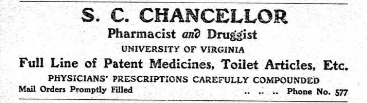
Charlottesville directory, 1902 (Ancestry)

Chancellor's Drug Store (UVA Library Special Collections)

Chancellor's Drug Store (UVA Library Special Collections)


     In 1905 Sam married Clarissa Lynn Rodes, who died after a failed appendectomy a year later. Sam Chancellor died in 1922.


Notes

[1] Dr. Carmichael (1806-1882) served as surgeon in charge of the General Hospital in Danville during the Civil War.

[2] Samuel Alsop, Jr. built houses for two of Dorry's sisters as wedding gifts. "Kenmore Woods" was given to Ann Eliza Alsop and her husband, John M. Anderson.  "Oakley" was built for Clementine Alsop and her husband, Thomas Coleman Chandler. I wrote this article about Oakley several years ago.

[3] In future years, this house would be occupied by Spotsylvania County Sheriff Thomas Addison Harris and Commonwealth's Attorney Samuel Peter Powell.


Sources

Makers of America: Biographies of Leading Men of Thought and Action, volume 1. B. F. Johnson, Washington, D. C.: 1901.

Virginia: Its History, Influence, Equipment and Characteristics, volume 2. Lewis Publishing Company, New York: 1904.

Kelly, Howard A. and Burrage, Walter L. American Medical Biographies. The Norman, Remington Company, Baltimore, MD: 1920.

Henry, William Wirt and Spofford, Ainsworth R. Eminent and Representative Men of Virginia and the District of Columbia of the Nineteenth Century. Brant and Fuller, Madison, WI: 1893.

The George Harrison Sanford King archive at the Central Rappahannock Heritage Center:


Sunday, March 13, 2016

"O the horror of that day!"

Susan Margaret Chancellor (Rich Morrison)

     When she was 16 years old, she witnessed the destruction of Chancellorsville,  the former home of her grandparents, during the epic battle that took place there in May 1863. Almost 60 years later, she shared her recollection of those times with a local historian [1], which was then published in The Confederate Veteran in 1921.
     Susan Margaret Chancellor was the youngest of 11 children who were raised at "Forest Hall," a large farm on the Rappahannock River near the United States Ford, arriving on February 19, 1847. The two maps below show the location of that farm. In the second map, the Chancellor farm is shown as "Major Fitzhugh."

Northwestern Spotsylvania County, 1863 (National Archives)

Site of Forest Hall, 1863 (National Archives)

     Sue Chancellor's parents were Sanford Chancellor (1791-1860) and Frances "Fannie" Longwill Pound (1803-1892). Fannie's mother, Ann Lyon Pound Chancellor, was married to Sanford's brother, George Chancellor, for whom Chancellorsville was named. This connection made Ann Chancellor both his sister-in-law and mother-in-law.
     A remarkable photograph of the Chancellors taken at "Forest Hall" about 1858 shows Fannie and Sanford Chancellor standing in the doorway of their house. The little girl sitting at the bottom of the steps is Sue Chancellor. Sue gave the original of this photograph to her nephew, Fredericksburg genealogist George Harrison Sanford King. The version shown here is part of the archive of the National Park Service, which generously shared it with me.

The Chancellors of "Forest Hall," about 1858. (National Park Service)

     During the War of 1812, Sanford Chancellor served on the staff of General William Madison, brother of the president of the United States. For the remainder of his life, Sanford was often referred to as "Major Chancellor."
     Sanford Chancellor served his community as a school commissioner, justice of the peace, sheriff of Spotsylvania County, and postmaster at Chancellorsville during the last year of his brother George's life, 1835-1836.
     Sanford and Fannie Pound were married in Spotsylvania on January 7, 1823. Their first two sons,  William Cooper (on March 9) and John Andrew (on September 28), died in 1838. Their obituaries are part of the George Harrison Sanford King archive at the Central Rappahannock Heritage Center:

William Cooper Chancellor (CRHC)

John Andrew Chancellor (CRHC)

     In the early years of their marriage, Sanford and Fannie lived at New Store, located in Spotsylvania County southeast of Chancellorsville. They built "Forest Hall" about 1840, where their youngest four children were born.
     In addition to his work in the public sphere, Sanford was also a man of enterprise. His farm employed the labor of 29 slaves (according to the 1850 census) and included a bark mill, which ground up sumac and other plant material and was shipped down the Rappahannock to the tannery in Fredericksburg. Sanford was an investor in the Rappahannock Canal, which extended up the Rapphannock from Fredericksburg to his property. Once that project was complete, the engineers who built the dam presented this tea service as a gift to Sanford and Fannie Chancellor:

Chancellor tea service (Ancestry)

The canal remained in active use until the 1850s. Sanford was also an officer in the United States Gold Mining Company, located just west of his home and for which the United States Ford was named.
     In February 1854, a slave belonging to Sanford was murdered by a slave belonging to William T. J. Richards. An inquest was held, and a vivid account of that tragic incident, based on the coroner's report, can be read here.
      Sanford Chancellor died of pulmonary disease at his home on February 25, 1860. Fannie sold "Forest Hall" to Norman Richard Fitzhugh [2]. Together with her 7 unmarried children--Mary Edwards, Ann Elizabeth, Jane Hall, Frances "Fannie" Douglas, Penelope "Abbie" Abbett, George Sanford and Sue--Fannie moved to Chancellorsville, her mother's house. When Ann Chancellor died in December 1860, Fannie became the mistress of Chancellorsville.


Chancellorsville (Virginia Historical Society)
     The following spring brought with it Virginia's secession from the United States and the onset of hostilities between north and south. Fannie's oldest surviving son, Dr. Charles William Chancellor, joined the Confederate cause and served in several positions during the Civil War. These included regimental surgeon of the 19th Virginia Infantry, surgeon at Division No. 2 of the Charlottesville General Hospital (where his cousin, Dr. James Edgar Chancellor, was chief surgeon) and as chief medical officer in General George Pickett's brigade [3].
     After the battle of Fredericksburg, Sue Chancellor remembered that Confederate troops under the command of Generals Carnot Posey and William Mahone were encamped near Chancellorsville to guard the vulnerable fords across the Rappahannock. Fannie Chancellor cooked meals for the private soldiers, who enjoyed the company of Sue and her sisters, who played the piano and sang songs for these young men. In return, they taught Sue's sisters to play cards, which met with Fannie's disapproval. A South Carolina trooper in Hampton's Legion, Thomas Lamar Stark, took a fancy to Sue and gave to her as a present a white lamb. Sue named her new pet "Lamar." [4]
     In addition to the kindnesses she showed to the enlisted men, Fannie Chancellor entertained Generals Posey and Mahone, as well as Lafayette McLaws, Richard Anderson and J. E. B. Stuart, a personal favorite of the Chancellor family ("He was so nice and had always a pleasant word for everyone").
     During the winter of 1862-1863, Fannie took in several refugees after the battle of Fredericksburg: Murray and Sally Ennis Thornton Forbes and their married daughter, the wife of Dr. John R. Taylor of "Fall Hill," their younger daughter Kate, Kate's enslaved "mammy" Aunt Nancy, and a driver who saw to their horse and carriage. [5]
       Mr. and Mrs. Forbes and their daughter Mrs. Taylor left Chancellorsville on April 29 to attend to business in Fredericksburg, leaving behind their young daughter Kate and their slave Aunt Nancy. In their attempt to return to Chancellorsville, they were caught up in the chaos of the second Battle of Fredericksburg. It would be another two years before they saw Kate again. 
      That evening, Generals Anderson, Posey and Stuart, together with their aides, were enjoying dinner at Chancellorsville when a courier galloped into the yard. He brought word that the Union army, commanded by General Joseph Hooker, was crossing the Rappahannock River at United States Ford. "Immediately all was confusion. Hastily the generals bade us goodbye, but General Stuart, always so charming, took time to say to my sister: 'Thank you, Miss Fannie, for the good supper; and as it is always my custom to fee the waitress, take this from me as a little remembrance.' And he gave her a tiny gold dollar. I have it yet, one of my most cherished possessions."
     The Chancellor women put on all the clothes they could. Some of Fannie's daughters secured items from the treasured tea service in their hoop skirts. Meat was hidden beneath one of the front steps of the house. Union troops arrived shortly thereafter and informed the Chancellors that their house was to become the headquarters for General Hooker. The Chancellors and their guests were herded into one room, where they slept on pallets. Union staff officers comfortably occupied the rest of the house.
     "General Hooker did not come until the next day. He paid no attention to my mother, but walked in and gave his orders...We were joined by our neighbors, who fled or were brought to Chancellorsville house for refuge, until their were sixteen women and children in that room. From the windows we could see couriers coming and going and knew that the troops were cutting down trees and throwing up breastworks. I know that they were pretty well satisfied with their position and were confident of victory."

Chancellorsville, May 2, 1863 (Virginia Historical Society)

     By Saturday, May 2, 1863, the frightened civilians trapped inside the Chancellorsville house could hear the sound of gunfire growing nearer. Hooker ordered that these unfortunate people be taken to the basement. By now the house was filled with wounded men, and the doctors began their grisly work. The sitting room was set up as an operating room and the piano was used as an "amputating table." Union surgeons allowed Fannie to care for two wounded Confederates who had been brought to the house.
     The 16 civilians at the Chancellor house were brought out of the basement and placed back into the room they had occupied earlier. "It was late in the day when the awful time began. Cannonading on all sides and such shrieks and groans, such commotion of all kinds! We thought we were frightened before, but this was beyond everything and kept up until after dark."
     The following morning, May 3, the women and children were taken back to the basement. "Passing through the upper porch I saw how the chairs were riddled with bullets and the shattered columns which had fallen and injured General Hooker. O the horror of that day! The piles of legs and arms outside the sitting room window and the rows and rows of dead bodies covered with canvas!"

General Joseph Dickinson (Library of Congress)


     The Chancellors and their companions were in the the basement for a short time when General Joseph Dickinson, assistant adjutant general to General Hooker, came downstairs and ordered everyone out. "'The house is on fire, but I will see that you are protected and carried to a place of safety.' Cannons were booming in every direction and missiles of death were flying as this terrified band of women and children came stumbling out of the cellar."

Chancellorsville as it looked in 1865 (Library of Congress)

     "The woods around the house were a sheet of fire--the air was filled with shot and shell, horses were running, rearing, screaming, the men a mass of confusion, moaning, cursing and praying... Slowly we picked our way over the bleeding bodies of the dead and wounded, Gen. Dickinson riding ahead, my mother with her hand on his knee, I clinging close to her and the others following behind..."
     This little band of sufferers made its way up to the United States Ford. One of Sue's sisters, who had been ill, had a hemorrhage from her lungs. General Dickinson ordered a Union trooper to dismount and put her on the horse and then walked behind her to hold her on. They encountered one of General Dickinson's superiors, who admonished him about not being at his post: "[Dickinson] drew himself up proudly and said, 'If here is not the post of duty, looking after the safety of these helpless women and children, then I don't know what you call duty.'"
     Once at the ford, they crossed over the pontoon bridge assembled several days earlier and stepped on the Stafford side of the bank. Here Sue's ailing sister fainted and was laid out on the grass. A Union drummer boy named Thacker brought her a lemon and some ice, and bound her head with a clean bandanna. An ambulance was found, and in it were placed Sue, her sister, Fannie Chancellor, her brother George and Kate Forbes. The rest of the refugees had to walk.
     They finally reached the home of John Hunt at the Eagle Gold Mine in Stafford County, which was within the Federal lines. Here the Chancellors and their companions remained under guard for 10 days. Sue's sisters were very cool to their guards at first, "but after a while they relaxed and relieved the irksomeness of our confinement by talking, playing cards, music, etc., and I even think there were some flirtations going on."
     General Dickinson managed to get a message to Sue's brother, Dr. Charles W. Chancellor, and inform him of his family's safety. In turn, Dickinson was able to bring to Fannie her son's grateful reply. At last, Fannie and her children were granted their freedom. There were placed in ambulances and taken to the United States Ford, where they were met by Sue's sister Julia, the widow of Thomas Rogers Chartters, who had died in August 1862. The Chancellors were taken to the Chartter's farm in Stafford, "Cherry Grove."
     That autumn, Fannie Chancellor took her children to Charlottesville, where Sanford's cousin, Dr. James Edgar Chancellor, worked as chief surgeon of the general hospital. James had gotten Fannie a job as matron at the Midway and Delevan hospitals there. She brought fresh food and other comforts to the sick and wounded, and was assisted by her daughters Frances "Fannie" Douglas and Penelope "Abbie" Abbett. Sue attended school in Charlottesville, and two of her sisters obtained teaching positions in the Shenandoah Valley.
     Work in the hospitals was a ghastly experience for all concerned, and was fraught with many dangers in an era when the acceptance of the germ theory of disease was many years in the future. Fannie and Abbie Chancellor died of typhoid fever within days of each other in August 1864. They are buried in the University of Virginia Cemetery and Columbarium.

Obituary of Penelope Abbett Chancellor (CRHC)

     Fannie and Sue Chancellor remained in Charlottesville for the remainder of the war, when they returned to Spotsylvania. In 1870 they were living at "Clifton" in the household of James Petigrew Chartters, brother of Julia's late husband Thomas. James' wife, Susan Philips Chancellor, was a cousin of Sanford.
     In 1872, Fannie's wealthy uncle, Andrew Lorman of Baltimore, died and left his Chancellor relations a sizable inheritance. With her share of that money, Fannie was able to buy "Oak Grove," a Spotsylvania farm just west of Fredericksburg. Here she lived out her remaining years.
     In 1876, Sue Chancellor and some friends and relatives boarded the train in Fredericksburg to make the trip to Philadelphia to attend the Centennial Exposition. "The name Chancellor caught the ear of a distinguished looking gentleman seated near and presently he came up, asking if we were the Chancellors of Chancellorsville. When he found out that we were, he said..."and I am General Hooker." [6] Of course we were surprised, but we invited him to join our party. He shared our bountiful luncheon and we had a very pleasant day--a contrast to the three days we spent in the same house with him thirteen years before. We never saw him again, but for years we had visits from soldiers north and south, who remembered "the ladies of Chancellorsville."
     Most notable among these visitors was Joseph Dickinson, who corresponded with Fannie Chancellor in the years since their first encounter, and he made a point to visit her whenever he was in the area. In fact, Dickinson served on the Chancellorsville Battlefield Commission with Sue's cousin, Vespasian Chancellor. When Francis Longwill Pound Chancellor died at "Oak Grove" on July 9, 1892, Joseph Dickinson attended her funeral.

Vespasian Chancellor (National Park Service)

     The following year, on March 9, 1893, Susan Margaret Chancellor married her cousin, Vespasian Chancellor, at the 5th Baptist Church in Washington, DC.

Marriage license of Sue and Vespasian Chancellor (Ancestry)

Fifth Baptist Church, Washington, DC (Library of Congress)

     Sue and Vespasian made their home at 300 Main (modern Caroline) Street in Fredericksburg. Vespasian died April 28, 1908. Sue continued to live there until near the very end of her life.

Sue Chancellor (Ancestry)

     By 1935, Sue was living in the household of Fredericksburg grocer Pelham Gray Finney. On December 17, 1935, she "stumped her toe," fell and broke her hip. She was taken to Mary Washington Hospital, where attending physician Dr. Earle R. Ware ordered x-rays. Sue never recovered and died in the hospital on December 28, 1935. Her funeral was held at Fredericksburg Baptist Church. Dr. Ware was one of her honorary pallbearers. She is buried in the Chancellor family cemetery in Spotsylvania.

Notes:


[1] Vivian Minor Fleming (1844-1930) served in the 2nd Virginia Artillery during the Civil War, was injured in an accident and after his recovery served in the 1st Engineer Battalion. He was known for writing a number of books about the war. He was also one of the original owners of the Eagle Shoe Company in Fredericksburg. His wife was an organizer of the Kenmore Association, which in 1925 raised money to purchase Kenmore from its owner, E. G. "Peck" Heflin, who had plans to develop the property. Kenmore was thereby saved for future generations.

[2] Norman Richard Fitzhugh (1831-1915) served as assistant adjutant general to General J. E. B. Stuart during the Civil War.

[3] Dr. Charles William Chancellor (1832-1915) was a man of high accomplishment. He was educated at Georgetown College, the University of Virginia Medical School and the Jefferson Medical College in Philadelphia. After the war he served as dean of the Medical School of Washington University until 1875. He then became secretary of the Maryland State Board of Health, In 1893, he was appointed by President Grover Cleveland to serve as U. S. Consul at Havre, France, where he stayed for four years.

[4] Thomas Lamar Stark (1843-1883) served in Company I, 2nd South Carolina Cavalry. He was captured on May 4, 1863 and imprisoned at the Old Capitol Prison and then Fort Delaware. He returned to his regiment after his parole. He was wounded on July 7, 1864. He survived the war and died in Columbia, South Carolina.

[5] A son of Murray and Sally Forbes, Lieutenant James Fitzgerald Forbes, was mortally wounded by the same volley that cost Stonewall Jackson his left arm on May 2, 1863.

[6] In October 1876, Joseph Hooker and his literary executor, Samuel P. Bates, visited the battlefields of Fredericksburg and Chancellorsville. On their ride out to Chancellorsville, they were accompanied by Sue's cousin, Fredericksburg merchant George Edward Chancellor.


Sources:

Chancellor, Sue, "Recollections of Chancellorsville," The Confederate Veteran, vol. XXIX, No. 6., Nashville, Tennessee, June 1921.

Happel, Ralph, "The Chancellors of Chancellorsville," The Virginia Magazine of History and Biography, vol. 71, no. 3 (July 1963)

King, George Harrison Sanford, "The Chancellor Family," Genealogies of Virginia Families. William and Mary Quarterly Magazine, vol. 1, Adams-Clopton. Genealogical Publishing Company, Inc.: Baltimore, MD, 1982.


Wednesday, March 9, 2016

Reverend Melzi Sanford Chancellor

Melzi Chancellor, at left, with his brothers

     Although I can no longer remember the source, I once read that his unusual first name was the idea of his mother. Shortly before his birth, she read a book whose main character was named "Melzi." There was something euphoniously exotic about that name to her, and she gave it to her first child by her second husband.
     Melzi Sanford Chancellor was born at Fairview farm in western Spotsylvania County on June 29, 1815. At that time, a grand house was being built on the Orange Turnpike (modern Route 3) at its intersection with Old Plank and River Roads. This house, built on an 854-acre tract owned by Melzi's wealthy step-uncle, William Lorman of Baltimore, was a wedding gift for his parents, George and Ann Lyon Pound Chancellor. (For a brief history of the Lorman-Chancellor connection, click here). This place is known to history as Chancellorsville, and it served for many years as a tavern, inn and post office as well as home to the Chancellors.

Chancellorsville (Library of Congress)

     By the time he was 19 years old, Melzi was working for William Lorman in Baltimore.  While there, young Melzi made a profession of his religion and was soon thereafter ordained as a minister at Wilderness Baptist Church. During his long career, Reverend Chancellor served at a number of area churches, including Wilderness, Piney Branch, Mine Road, Salem, Goshen, Craig's, Ely's Ford and New Hope.
     In addition to his work as a Baptist minister, Melzi was also the first postmaster appointed for Chancellorsville after his father's death in 1836. He was elected to several terms as a deputy commissioner of revenue in Spotsylvania. In a political advertisement written in 1852, Melzi subtly reminded voters that he had a large family to care for and needed the money:

Fredericksburg News, March 12, 1852

Reverend Chancellor was also a farmer and the owner of 7 slaves, according to the 1860 census.
     On November 24, 1837, 22-year-old Melzi Chancellor married his first wife, Lucy Fox Frazer, in Baltimore. [1] They had 10 children together, born over a period of 21 years, 1838-1859.
     In 1857, Melzi bought Dowdall's Tavern, located on the Orange Turnpike opposite Wilderness Church, as a home for his family.

Dowdall's Tavern (Library of Congress)

     Former Union soldier Robert Knox Sneden created hundreds of maps and other images from the Civil War, most of which are now at the Virginia Historical Society. Included is this depiction of Dowdall's Tavern:

Dowdall's Tavern (Virginia Historical Society)

     Like all the Chancellors of Spotsylvania County, Melzi was a southern patriot and a devoted adherent to the Confederacy. Three of his sons enlisted in the Confederate service during the Civil War. Vespasian, the oldest, served for a time in the 30th Virginia Infantry, and later fought with the 9th Virginia Cavalry. His brothers, George Edward and Thomas Frazer, also rode with the 9th cavalry.

Western Spotsylvania County, 1863

     The map detail above shows the locations of Fairview, Chancellorsville, Melzi's house at Dowdall's Tavern and Wilderness Church just west across the Orange Turnpike.
  
Wilderness Church (Library of Congress)

     By April 30, 1863, a large Federal army commanded by General Joseph Hooker had concentrated at Chancellorsville. The Union line extended west toward Wilderness Church. This sector was occupied by the XI Corps, commanded by Major General Oliver O. Howard. Howard established his headquarters at Melzi's home. Unfortunately for him and his men, no provision was made to protect his exposed right flank.
     One of Howard's division commanders, General John White Geary (who was elected governor of Pennsylvania after the war), had a confrontation with Reverend Chancellor "for a supposed indignity offered him." Geary ordered Melzi's arrest. Union General Henry Slocum interceded on Melzi's behalf and effected his release. In 1862, Melzi's brother Lorman had his own encounter with then Colonel Geary, which can be read here.
     On May 2, troops commanded by General Thomas "Stonewall" Jackson executed a long march to reach Howard's vulnerable right flank. Late that afternoon, they fell upon these unsuspecting soldiers, who were too shocked to offer much resistance and they began retreating east toward Hooker's defenses at Chancellorsville. Some came running up to Melzi's house, and they pleaded with him to give them a place to hide. "He directed them to a cellar, over which was a trap door. When they were all in, he shut the door down, and the Confederate troops came up in a short time and captured thirty of them." (The Free Lance, February 22, 1895)
     Late that night, General Jackson was accidentally shot by his own men while reconnoitering the area in preparation for a renewed attack. He was carried out of the woods and placed in an ambulance and taken first to Dowdall's Tavern, where he was met by his surgeon, Dr. McGuire. From there he was taken to the hospital set up near Wilderness Run, where his left arm was amputated.
     The following year, Melzi was arrested by Federal authorities again. This time he spent six months imprisoned as a citizen-hostage at Fort Delaware.

Fort Delaware (Library of Congress)

     After his release, Melzi resumed his ministerial duties. Dowdall's Tavern burned in 1869. Melzi built another home for his family behind Wilderness Church. This place was called Chancellor's Retreat and can be seen in the two photographs below:

Wilderness Church and Chancellor's Retreat, 1882 (CRHC)

Chancellor's Retreat at right, Orange Turnpike in foreground, 1884 (National Park Service)

     Alexander Lorman, for whose father Melzi worked as a young man, died in 1872. The wealthy Mr. Lorman left a generous legacy for his Chancellor kinsman, and Melzi was among those who benefited. He received a life estate in an inheritance of $50,000, a portion of which he shared with the churches in his charge.


Obituary of Lucy Chancellor (CRHC)

     By the early 1880s, Melzi retired from the ministry, and he and Lucy moved to Fredericksburg, where they lived at 406 George Street. Lucy died there on September 3, 1884. Her obituary from The Fredericksburg Star, above, comes from the collection of George Harrison Sanford King's papers at the Central Rappahannock Heritage Center.
     On October 19, 1886, Melzi married Bettie W. Caldwell in a ceremony held at the E Street Baptist Church in Washington, DC. Bettie had been born and raised in Fredericksburg, where she taught school for many years. She later taught some of Melzi and Lucy's children. Bettie's sister, Mary, kept a diary of events in Fredericksburg during the Civil War. National Park Service historian John Hennessy wrote an interesting article about Mary which can be read here.

Chancellor-Caldwell marriage license (Ancestry)

     Reverend Melzi Chancellor died at home on February 20, 1895. He is buried with his family at the Chancellorsville cemetery.


The Free Lance, February 22, 1895

     Bettie Chancellor outlived her husband by 16 years. She is buried in the Fredericksburg Cemetery.

The Daily Star, March 30, 1911


[1] Lucy Frazer's brother and sister are worth noting here. John Thomas Frazer married Melzi's cousin, Mary Elizabeth Chancellor. Lucy's sister, Mary Elizabeth Frazer, was the second wife of Thomas Coleman Chandler. Thomas and Mary owned a large farm in Caroline County where, in May 1863, General Stonewall Jackson was brought after the amputation of his arm. He died in a building used as the Chandler's office on May 10. Thomas Chandler's first wife, Clementina Alsop, was fortunate to be the daughter of Samuel Alsop, Jr., who built Oakley for them as a wedding present in 1826.

Postscript:

Reverend Melzi Chancellor and family, April 1866 (American Antiquarian Society)

     Since I originally published this article, I have come across two photographs in the collection of the American Antiquarian Society. I have written a subsequent piece on my analysis of those two photogaphs, which can be read at :The Chancellors Revealed


Saturday, March 5, 2016

Lorman Chancellor

Lorman Chancellor, seated at right, with brothers Melzi and James

     Andrew Lorman married Mary Longwill of Cecil County, Maryland, about 1763. Their son, William, was born in 1764. The Lorman family settled in Falmouth, Virginia, where Andrew worked as an artisan at Hunter's Forge, which produced everyday iron implements as well as weapons and other supplies for the Continental Army during the American Revolution. Andrew died in Falmouth in 1773.
     Five years later, in 1778, the widowed Mary Lorman married James Lyon of Falmouth. Young William Lorman did not get along with his father-in-law, and in due course he left Virginia and moved to Baltimore, Maryland. One wonders if James Lyon ever had occasion to regret the rift with his stepson, given that William became one of Baltimore's leading citizens and amassed a considerable fortune.
     Among William Lorman's many achievements was his election to the original board of directors of the Baltimore & Ohio Railroad. He also became president of the Bank of Baltimore. William married Mary Fulford and they had one son, Andrew, born in 1795.
     Meanwhile, James and Mary Lyon had one daughter, Ann, born in Falmouth in 1783. Ann married Richard Pound, formerly of Culpeper County, and they lived at Fairview in western Spotsylvania County. Richard and Ann Pound had four daughters: Francis Longwill, Margaret Lyon, Elizabeth Richard and Mary Ann.
     After Richard Pound's death in 1812, Ann Lyon Pound's half-brother, William Lorman, acquired Fairview and what would later become Chancellorsville through the satisfaction of a deed of trust in 1813. He retained ownership of this 854-acre tract until he transferred title to Ann and her children by pocket deed in 1839, which was not recorded until 1842.
     Ann Lyon Pound married George Edward Chancellor in 1814. As a wedding present, William Lorman built for them the commodious house known to history as Chancellorsville. Located on the Orange Turnpike just east of Fairview, Chancellorsville was home to the extended Chancellor family, their white employees and their slaves. It's location on the Turnpike at the hub of Old Plank Road, the road to Ely's ford and the River Road to Fredericksburg gave it strategic importance during the battle fought there in 1863.

Chancellorsville (Library of Congress)

     This depiction of Chancellorsville was made from memory in the mid-1870s by Fredericksburg photographer Frederick Theodore Miller, the son of German immigrants who were crucial in the development of Tabernacle Methodist Church.
     Lorman Chancellor was born in this house in January 1817. After the death of his father, he served as postmaster at Chancellorsville 1837-1843, and as assistant marshal was the U. S. census taker for the eastern district of Spotsylvania in 1850. Lorman studied law and was a practicing attorney in Spotsylvania by the time he married Margaret Elizabeth Smith, of Middleburg, Virginia, on September 6, 1847. They made their home at Woodlawn, the large farm located near Chancellorsville.
     Lorman and Margaret had nine children together, only three of whom survived until adulthood. The deaths of some of these unfortunate children were reported in local newspapers, and it is instructive to read these accounts here, if only to remind ourselves that in the mid-nineteenth century being educated, wealthy and socially prominent--as the Chancellors certainly were--provided no protection from illnesses that today would be either treatable or preventable. Their very first child died the year after she was born:

Fredericksburg News, 26 October 1849

     The next two Chancellor children, Clarence Smith and Hugh Mercer, shared a fate similar to that of little Florence, when they died within days of each other in early spring of 1853. This undated newspaper clipping comes from the archive of Chancellor descendant George Harrison Sanford King and can be found at the Central Rappahannock Heritage Center. The horrifying complication of "cancrum oris," suffered by Hugh, is Latin for "cancer of the mouth" and refers to what I believe we know today as flesh-eating bacteria:


          Elizabeth Pembroke, the fourth child of Lorman and Margaret, was likely their only living child when they moved from from Spotsylvania to Middleburg by the late 1850s. Lorman placed this advertisement in the January 11, 1858 edition of the Alexandria Gazette:


     It did not take Lorman long to establish himself as a man of prominence in Middleburg. He set up his law practice there and was elected mayor, a position he held throughout the Civil War. The 1860 census indicates that he was quite well to do for that time, enjoying an aggregate wealth of $43,300. The Chancellors lived in this house, which still stands at the corner of South Jay and Washington Streets. Here were born Lorman and Margaret's only two sons who survived childhood: Sanford Carroll (1860-1905) and Arthur Bernard (1864-1931). Both became successful attorneys.

Lorman Chancellor house (Google)

     On August 3, 1858, the Alexandria Gazette reported that Lorman had been elected captain of the local militia unit, the 132nd Virginia. Lorman was still captain of the 132nd when the Civil War began in April 1861. In July, Governor John Letcher made him colonel and ordered Lorman's men and other militia units "of all counties north of the James River and east of the Blue Ridge",  to march to Manassass and rendezvous with General Bearegard. The 132nd Virginia did as instructed, but arrived too late to see action during the Battle of Manassas.
     On February 27, 1862, Union Colonel John W. Geary (later General Geary, who at some time during the war arrested Lorman's brother, Reverend Melzi Sanford Chancellor of Spotsylvania) invaded Loudoun County. A week later, Confederate General D. H. Hill was ordered to abandon Loudoun and transfer his troops to Richmond to help fight off General George McClellan, who had landed a massive army in the Virginia Peninsula with the intention of taking the Confederate capital, Richmond. The remaining Confederates in Loudoun County retreated southward to escape Geary's advance.
     Among those in a column south of Middleburg fleeing toward White Plains was James E. McCabe, who was acting as overseer of a group of slaves who had been building fortifications near Middleburg. McCabe's responsibility was to move these slaves far enough away so that they could not be liberated by the approaching Federals. Also in retreat with this column was Colonel Lorman Chancellor and his 132nd Militia, as well as a group of men who had been conscripted and were none too happy to be in their situation. McCabe reached White Plains first, and locked up the laborers in his charge in a building that could be easily guarded. When Colonel Chancellor arrived, he demanded that McCabe remove the slaves in order that Chancellor could lock up his untrustworthy draftees instead. McCabe refused, and Lorman hit him with the hilt of his sword. McCabe thereupon drew his pistol and fired at Lorman and inflicted a slight flesh wound. The surlier elements under Lorman's command refused to help him and in fact were cheering for McCabe.
     Lorman returned to Middleburg to recover, and he was arrested by Federal authorities on March 28, 1862. On that date he signed a parole as a prisoner of war, in which he agreed "not to bear arms against the United States or to assist its enemies...until regularly exchanged."

Parole of Lorman Chancellor, March 1862

     On March 9, 1863, Colonel John Mosby had dinner at Lorman's house just prior to embarking on a lightning raid on a Federal encampment at Fairfax Court House. Mosby and his partisans managed to slip past the large numbers of Union troops there and Mosby himself found young Union General Edwin Stoughton asleep in his bed. He awoke Stoughton with a slap on his rump with the flat of his sword and placed him under arrest. In addition to the hapless general, Mosby's men also captured a number of Union soldiers and horses.
     A month later, on April 4, Lorman Chancellor was identified as a member of Mosby's Rangers and was arrested at his home and taken to the Old Capitol Prison in Washington, DC. He was paroled several days later, and on April 17 was among a group of prisoners taken by Captain R. W. Healy of the 58th Illinois Volunteers to City Point, Virginia, where they were released.
     Some of Middleburg's residents pleaded with Mayor Chancellor to disassociate himself from John Mosby, fearing that by assisting the partisans the town faced the possibility of being burned by the Federal army in retribution. Lorman refused to disavow General Mosby and Middleburg survived the war.
     After the Civil War, Lorman resumed his law practice, but like many in those early post-war years he was financially embarrassed and was obliged to declare bankruptcy. He and Margaret took in her mother and several other Smith relatives as boarders to make ends meet. Fortunately for Lorman, his wealthy Baltimore cousin, Andrew Lorman, died and left him the tidy sum of $72,000, according to the January 22, 1872 edition of the Alexandria Gazette.
     Margaret Smith Chancellor died on November 8, 1883. In his later years, Lorman spent time in Baltimore where he lived with his daughter, Elizabeth Pembroke Annan. Despite his advancing years, he still had enough energy to take long trips by carriage. On July 21, 1893, the Roanoke Times reported that Lorman and two of his nephews drove a horse-drawn phaeton from Baltimore to Fredericksburg, stopping at his old house in Middleburg along the way.
     Lorman Chancellor died February 9, 1894 at his daughter's house in Baltimore. His obituary, which appeared four days later in The Free Lance, is part of the George Harrison Sanford Collection at the Central Rappahannock Heritage Center in Fredericksburg.

Obituary of Lorman Chancellor


Among the sources for this article are:

Happel, Ralph. The Chancellors of Chancellorsville, published in The Virginia Magazine of History and Biography, vol. 71, no. 3 (July 1963).

Chamberlain, Taylor M. and Souders, John M. Between Reb and Yank: A Civil War History of Northern Loudoun County, Virginia. McFarland & Company, Inc., Publishers. Jefferson, NC: 2011.


Tuesday, December 8, 2015

No Matter What Befalls Me


     This month, the Orange County Historical Society is publishing my new book,  No Matter What Befalls Me: Virginia Families at War and Peace.
 
     The book is a compilation of 25 historical essays and includes dozens of rare photos and other images, two maps, a foreword, an introduction and a comprehensive index.

     A press release was recently distributed by the Society, which provides important information about me and the book:


For information about how to order the book, please visit the Orange County Historical Society's website

Please check out the book's Facebook page for news and updates.