Search This Blog

Monday, April 30, 2012

Colonel Elhanon Row

Appointment of Elhanon Row to colonel of militia, 1862

     Elhanon Row (1798-1874) of Orange County was the youngest child of my great great great grandparents, Thomas Row and Rachel Keeling Row. Among his more notable achievements, Elhanon was the first elected sheriff of Orange County, winning that seat in 1852. Previously the office of high sheriff was an appointed position, one to which Thomas Row had been twice named before his death in 1840. Elhanon's son John Sanders Row was the second elected sheriff of the county (1854).
     Last week while noodling around the Orange County Historical Society's reading room I happened upon the document shown above. I had no previous inkling that this artifact existed, so when I found it I was happily surprised. In May 1862 Lieutenant Governor Daniel A. Wilson appointed Elhanon Row colonel of the third regiment of the first brigade of the second division of Virginia militia.
     The following day I found this entry in the minute book at Orange Court House: [1803] "Thomas Row qualified Lieutenant Colonel of the third regiment in the first brigade and second division of the militia of Virginia taking the several oaths required by law."
     Of course, by the time Thomas Row's son assumed the colonelcy of his old regiment, it was part of the Confederate militia. Had he still been alive, I wonder what would have been the opinion of Thomas regarding that change of allegiance. Thomas had served in the 5th Virginia Infantry during the Revolution to help secure the nation that his son and many like him willingly rent asunder.

Saturday, April 14, 2012

The Prayer Book of Rachel Keeling Row


     Recently my cousin and fellow researcher, Deborah Humphries, had occasion to visit Charlottesville, Virginia. While she was there she made good use of her time by stopping in at the Special Collections Department at the UVA Library to do some research. What Deborah found there is perhaps the most significant document regarding the history of my Row ancestors we have found to date.
     What Deborah uncovered were pages from The Book of  Common Prayer once owned by Rachel Keeling Row (1754-c.1829), wife of Thomas Row (1754-1840). They were my great great great grandparents. Deborah reports that the pages themselves are quite small, measuring about three inches by six inches. At some point one of the original pages went missing and a photocopy was substituted. The entries are apparently written by the hands of at least three persons--Rachel and Thomas Row and an unidentified relative who added information after 1840.
     The pages from this book are a record of the births of Thomas and Rachel Row's thirteen children, who came into this world over a span of twenty three years, 1775-1798. If this family record were all that existed in the archive this would be a very exciting and historically significant artifact. But what makes these pages from the prayer book special indeed are the entries documenting the births of the slaves at Row's Mill, the ancestral family farm in Orange County, for a period of forty six years, 1793-1839.
     Below are the high resolution images of these tiny pages taken by Deborah while at the University's library. I have presented them in their entirety followed by a transcription that Deborah and I worked on together. I have made no attempt to correct spelling or punctuation. Anything in the transcription that is unclear to me is contained within brackets with a question mark. The citation for the originals is: Keeling, Rowe and Farish Family Papers, 1765-1877, Accession #11144, Special Collections Department, University of Virginia Library. The library generously gave me permission to present the scanned images of the originals for today's post.
     Any errors in the transcription are mine alone. If any of my sharp eyed readers can offer suggestions on some of the more difficult entries I would be glad to hear from you.


Rachel Keeling
Rachel Keeling
his prayer
Book
Rachel Keeling
her hand and
pas she will
writ good
But I can't
tel [when?]

1 William Row son of
   Thomas & Rachel was
   Born November 7th 1775

2 Edmund Row was
   Born October 1st 1777

3 Milley Row was born
   August 26 day 1779

4 Thomas Row was
   born 4th day of October
   in the year of our Lord
   1781

5 Rachel Row was
   Born March the 1
   1783

6 Keeling Row
   February 25th day 1785

7 Jincey Row born
   November 1 day 1786

8 Elizabeth Row
   was born February
   the 15 day 1789

9 Carlton Row was
   June the 12 day 1790

10 Hettie Row Born
     February 25th day 1792

11 John Row was born
     April 9th Day 1794
     and Departed this
     life August 24th 1795

Absolum Row was
born Decr 13th 1796

Elhanon Row Born
August the 23rd 1798

Rachel Keeling
daughter of Carlton
Row was born
May the 4th 1819

Edmund Row son of Thos
& Rachel Row born the
1st day of October 1777
and died the 14th of May
in the year 1797

Carlton Row died
on the 6th day of March
in the year 1820

Jincy Roach Daughter
of Thos & Rachel Row
died on the 26 day of
February 1843

Milley Gaines Daughter
of Thos & Rachel Row died
31st May 1848

Negroe Amey was
born March 12th Day 1793

Negro Sylva was born
February 1st day 1795

Priman born Feby 3 1806

Negroe Sharlot was
Born May 21st day 179[6?]

Negroe Roose Born
January 19th 1798

Negro Dauphney Born
September 18th 1799

Negroe Ben Born
October 19th 1801

Negro Edey born Sept
the 7th 1803

Moriah daughter
of Amey born June
the 2nd 1815

Ned son of Amey
born June 22 1817

Catey daughter of
Jude born Nov 7 1817

Jesse son of Amey
Born May 11th 1819

Simon son of Rose
 born August 20th 1819

Charles son of Amey
born May the 1st day 1821

Peter Born the
9th of June 1823
                      II

Zoe Born March
the 22 1825
              1

Robert Born Feby
[?]  1827
              7

John Born Decr 27
    1827
             7

Henrietta Born Jany
the 13th 1828
             6

Roger Born Feby
the 9th 1829

Betsey Daughter of
Rose born July 26 1829

Anne Daughter of
Rose born July 7th 1831

Siller Daughter of
Eadey born Decr 15th 1831

Sawney son of
Aggy Born June 21st
1832

Edmund Son of
Edey born June
the 29th 1833


Hannah Daughter
of Rose born 16th July
1834
Lucy born the same
day of Rose-1834

Mary daughter
 of Eadey born Nov
the 22nd 1834

Sarah daughter
of Aggy born Decr 25th
1834

Charles son of
Moriah born Sept
the 10th 1835

Peter son of Eadey
born April 20 1836

Frank & Feby son
& daughter of Rose
born March the 24 1837

Amey daughter of
Moriah born May the
14 1837

Rebeccah daughter of
Eadey born Feby the
29th in the year 1838

George son of Aggy
born October the 1st
1838

Matilda Daughter of
Moriah Born Feby
the 25th 1839

Bette daughter of
Eadey born
October the 10 1839

     I hope to learn more about all these people, both slave and free, during my upcoming trip to Virginia. For now I will leave you with a transcription of Thomas Row's will done many years ago by distant cousin Marie Clark. By comparing the names of the slaves above with some shown below we get a sense of their fates after the death of Thomas Row in March 1840.


Tuesday, April 10, 2012

The Chancellors, Part 3

Store of Melzi Chancellor, Jr. 1920s

     The year after George Edwards Chancellor died and his business on Commerce Street was liquidated, the store was once again open for business. This time the owners were George's brother Melzi Sanford Chancellor, Jr. and Melzi's brother in law, James Richard Rawlings, husband of Leona Chancellor (1857-1900). James Rawlings and Melzi Jr. remained business partners at this location for close to seventeen years.

The Free Lance 13 July 1888

     James Rawlings was born in Spotsylvania County near Shady Grove Church on May 6, 1852. He was the youngest son of James Boswell and Ann Cason Rawlings. James' oldest brother, Zachary Herndon Rawlings was married to my great great aunt, Bettie Row of Greenfield plantation in Spotsylvania. James' other brother, Benjamin Cason Rawlings, led a life of high adventure and was instrumental for the meeting of my great grandparents, George Washington Estes Row and Mary Elizabeth Houston. Like George W.E. Row, Ben Rawlings escaped the encirclement at Appomattox and remained at large for several weeks before surrendering to Federal authorities in Richmond on May 2, 1865. George and Ben then rode to Hadensville in Goochland County, where their families were living as refugees to escape the fighting in Spotsylvania. By then Ben was so gaunt, tattered and disheveled that young James did not recognize him and hid behind his mother's skirts.
     James Rawlings married Leona Chancellor in 1878. The 1880 census shows that twenty eight year old James and Leona, together with their infant son James Boswell Rawlings, were living with James' parents in Spotsylvania. Between 1886 and 1897 James and Leona had another son and three daughters.
     I do not know exactly when James Rawlings made the transition from farmer to merchant, but by 1888 he was in partnership with his brother in law Melzi. Over the years they ran dozens of large, expensive ads in The Free Lance.

The Free Lance 10 July 1894

The Free Lance 27 April 1899

     In 1900 a prosperous James and Leona Rawlings, together with their five children and servant Cora Jefferson, were living in the upper ward of Fredericksburg.
     Despite all this prosperity and family togetherness, there seems to have been some troubles brewing behind the scenes. By the spring of 1905 Melzi and James had parted company as business associates. On the first of May 1905 James opened his own store, styled as "James R. Rawlings & Son" and was clearly a direct competitor with Melzi's establishment.

The Free Lance 25 April 1905

     In addition to his career as a merchant, James Rawlings was active in Democratic politics. This was true also for his grandson, George Chancellor Rawlings, Jr. (1921-2009) who served in the House of Delegates in the 1960s. James Rawlings was postmaster of Fredericksburg during both terms of the Wilson administration.
      James Richard Rawlings died on January 17, 1925 and is buried with Leona in the Confederate Cemetery in Fredericksburg.


     Lucy Monroe Chancellor (1852-1889) was an older sister of Leona Chancellor Rawlings. On November 24, 1869 she became the first wife of John James Stephens (1847-1929) of Rosemont farm in Spotsylvania. The Stephens family had been friends of the Rows of neighboring Greenfield for decades.
     The now long forgotten narrow gauge Potomac, Fredericksburg and Piedmont Railroad, which extended from Fredericksburg to Orange, ran by the Stephens farm. The saw mill of my great grandfather, George W.E. Row, was one of the contractors that provided railroad ties and fencing stock to the PF&P (locally known as the "Poor Folks and Preachers" railroad). Located at Rosemont was Stephens Station, a small white building with a platform in front situated on the north side of the track. Here a person was allowed to get off if he wished and had to flag the train if he wished to get on.
     James and Lucy Stephens had nine children together. In the late 1880s and early 1890's my great grandmother took turns with the Stephens teaching each other's children. As she recalled seventy years later, my great aunt Mabel Row Wakeman wrote: "My mother taught Cora, Willie and Sanford, my brother Houston and me one session in our home. The next session Mr. James Stephens employed Miss Nannie King, step daughter of his wife's sister Mrs. Anna King, to teach in the office building in his yard. My brother Houston and I went to school with Cora, Willie, Sanford, Day, Fannie Hawkins (afterwards Mrs. Curtis Wright) and Sheffie Booking, granddaughter of Mr. Hugh Stephens, who was then keeping store on Brock Road...My mother employed Miss Maria Marshall of Orange C.H., a great granddaughter of Chief Justice Marshall, to teach in our family and Mrs. Eleanor Scott Stephens [James' mother and sister of Robert Scott] now very old and a widow living with her daughter Sudie Todd would walk over with her little granddaughter to school at our home."
     When Lucy Chancellor Stephens died in 1889, her father Reverend Melzi Chancellor came to Rosemont to conduct her funeral. Mabel Row, then 10 years old, remembered him as "a tall man with white side whiskers."
Scott Stephens receipt to Horace Row 1906
    

     Scott Todd Stephens, born 1870, was the oldest child of James and Lucy Stephens. By 1900 he was working both as farmer and merchant, presumably at the store previously run by his grandfather Hugh. In some respects Scott Stephens was considered an up and comer. He was active in local Democratic politics and was appointed notary public for Spotsylvania County and was clerk of the school board.
     As you might expect, my grandfather Horace and my great grandmother of nearby Sunshine farm patronized Scott's store on Brock Road and otherwise did business with him.

Receipt for threshing 1901

Lizzie Row's check to Scott Stephens 1902


Receipt to Horace Row 1910

      Horace's brother Abbie Row inherited Greenfield from his aunt Nannie Row upon her death in 1889. By the late 1890s he was living there with his wife and children and had visions of improving Greenfield and making it more of a modern farming operation. Abbie worked full time as a railroad conductor. However, it proved to be too much for him to successfully farm Greenfield during his time off from the railroad. Debts began to pile up. Finally there was no alternative but to sell old Greenfield. On June 28, 1905 Abbie Row sold Greenfield to Scott Stephens for $500 and his assumption of the loan owed by Abbie to Scott's sister Sudie Todd.
     And so, after remaining in the Estes-Row family since 1795, Greenfield passed forever into the hands of others, beginning with a grandson of the storied Chancellors.

Sunday, April 1, 2012

The Chancellors, Part 2

G.E. Chancellor's receipt to George W.E. Row, April 1882

     At the relatively tender age of seventeen George Washington Estes Row, my great grandfather, signed up as a private in Company E of the Ninth Virginia Cavalry. During the course of the Civil War three of Reverend Melzi Chancellor's sons--George, Thomas and Vespasian--would serve in the same regiment. Only two would come home alive.
     George Edwards Chancellor was born in Spotsylvania sometime between 1842 and 1845. Different ages are indicated in each of the censuses taken 1850-1880 as well as the Virginia Death Index, so his exact birthday has been difficult for me to pin down. However, there is no doubt that he was but a teenager when he and George W.E. Row rode into Fredericksburg on April 25, 1861 and were enlisted in the Ninth Cavalry by Francis C. Beverly.

Receipt for G.E. Chancellor's horse, 1863

     Demonstrating an intelligence and ability that also characterized his post-war life George Chancellor rose in the ranks, attaining the rank of second lieutenant. After the war he was referred to as "Major" Chancellor, which I assume was the rank to which he was brevetted, since the available archives do not show that he advanced beyond lieutenant. George had a brush with death on October 19, 1863 during the fight near Buckland Mills in Fauquier County. Chancellor's horse was killed in action that day. Like most Southern troopers, George had furnished his own mount and the following month he was duly compensated eleven hundred (Confederate) dollars.
     In the spring of 1864 Captain Robert K. Smith, commanding officer of Company E, was furloughed on sick leave. Lieutenant Chancellor got the nod to take Smith's place during his absence. While acting as commanding officer, Chancellor signed a number of routine requisitions. It is said that George Chancellor was wounded late in the war during the fighting around Petersburg. That may be so, but there is no mention of this in the archives that I can find. The only hint of this possibility appears on an Inspection Report which states that Chancellor was granted a furlough on the authority of General Robert E. Lee on December 16, 1864. The last official mention of him on January 31, 1865 shows that George Chancellor was absent without leave.
     Bringing home with him his bullet torn coat worn during many campaigns, George returned to Spotsylvania after the war. At some point he made the decision to give up farming as an avocation and moved to Fredericksburg to make his way as a merchant. The 1870 census shows that George, now a store clerk, was living in the household of Irish immigrant and dry goods merchant Patrick McCracken.

Chancellorsville, late 1800s. Courtesy of the Colvin Collection

     In 1876 Joseph Hooker came to Spotsylvania to visit the Chancellorsville battlefield. As described by one with him that day: "We were accompanied on our ride to the Chancellorsville field, some ten or twelve miles above Fredericksburg, by Major George E. Chancellor, a son of Melzi Chancellor, whose home at the time was Dowdall's Tavern, where General Howard had his headquarters. On setting out, General Hooker suggested that we should take some lunch with us, as when he was there last there was very little to eat in all that region. Major Chancellor thought it unnecessary, and in fact we feasted most sumptuously at his father's house." (Battles and Leaders of the Civil War, Vol. 3, p. 217)

Advertisement of G.E. Chancellor, 1884

     George Chancellor appears to have opened his store on Commerce (now William) street in Fredericksburg in late 1873. Based on the flyer above, it is clear that he catered to the needs of area farmers, including George W. E. Row.

Chancellor invoice to G.W.E. Row, October 1882

G.W.E. Row check to George E. Chancellor, May 1882

     Likewise, G.E. Chancellor was a customer of my great grandfather's saw mill in Spotsylvania. Below is an entry from one of George W.E. Row's ledgers, showing a purchase made by Chancellor.

Ledger of G.W.E. Row

     After Row's death in April 1883, my great grandmother had the responsibilty for settling her late husband's debts as the administratrix of his estate. Shown below is a receipt to M.E. Row by G.E. Chancellor.

Chancellor's receipt to Lizzie Row, June 1884

     George Chancellor never married. He died in Fredericksburg on November 12, 1887. The cause of his death as stated in his death notice is uncomfortably vivid: "a lingering disease of the stomach and other secretive organs, the trying ordeals of which he bore with soldierly manhood." He is buried in the Chancellor family cemetery.

The Free Lance 15 November 1887

The Free Lance 15 November 1887

At rest at Chancellorsville

     George's father and brothers Vespasian and Melzi, Jr. were named as executors of his estate. They wound down his business and sold off the inventory. Within a year Melzi, Jr. would reopen the store.

The Free Lance 13 December 1887


Thomas Frazer Chancellor

     George's younger brother, Thomas Frazer Chancellor, was born about 1845 in Spotsylvania. He enlisted in Company E of the Ninth Virginia Cavalry on March 1, 1862 and served with my great grandfather for two months before George Row transferred to the Sixth Cavalry. Thomas was captured near Gettysburg in October 1862 during Jeb Stuart's ride around McClellan's army to steal horses and provisions. Young Thomas was imprisoned at Fort Delaware before being exchanged in December.
     Like George W.E. Row, Thomas Chancellor was a courier for Jeb Stuart. A charming and amusingly written incident which took place in December 1862 is described in The Perfect Lion: The Life and Death of Confederate Artillerist John Pelham by Jerry H. Maxwell:
     "On a cold and windy December 10, Private Thomas Frazer Chancellor, a courier for Stuart, arrived at Camp No-Camp with exciting news. A country ball would be held that evening at the the crossroads known as Chancellorsville, barely ten miles away and the general and his staff were cordially invited to attend the festivities. Stuart declined the invitation, but he allowed a handful to show up, provided they return to camp the following morning. The select group included Pelham, von Borcke, Blackford, Major Lewis Terrell, Lieutenant Chiswell Dabney and Captain Phillips. Banjoist Sam Sweeney, "Mulatto Bob" and two fiddlers were conscripted to provide the musical entertainment." This improbable group of men commandeered an ambulance that fell apart soon after hitting a tree stump covered in snow. Blackford was thrown from the ambulance and knocked unconscious. They managed to patch up the remnants of their conveyance and "After an hour of torture...we reached the scene of the evening's festivities. Private Thomas Chancellor greeted the beleaguered travelers and proceeded to introduce them all around." Dinner was served at midnight and they danced until three a.m.
     It may be true that lightning does not strike twice in the same place, but for the doomed Thomas Chancellor this sadly proved to be the case when his regiment visited Gettysburg a second time. Thomas was wounded during the fighting on July 1. After lingering for two weeks he died on July 15, 1863. He is buried in the Chancellor family cemetery.


Vespasian Chancellor

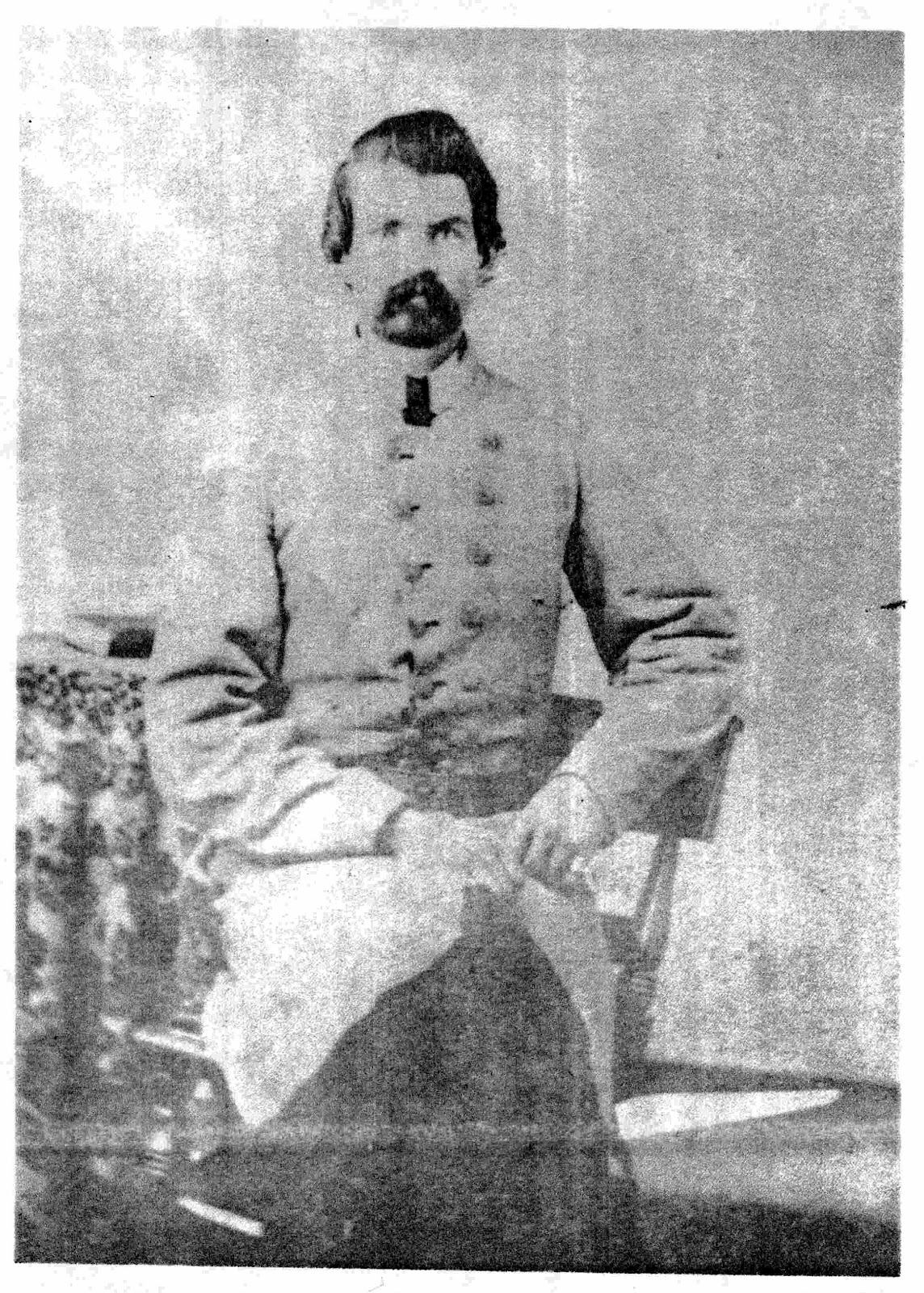
     Vespasian Chancellor, the oldest son of Reverend Melzi and Lucy Chancellor, was born on November 22, 1838. The year before the start of the Civil War twenty one year old Vespasian was working as a farmer on his father's home at Dowdall's Tavern. Vespasian rode with the Ninth Cavalry, like my great grandfather, but not at the same time and not under the same circumstances.

Vespasian Chancellor in uniform

     Vespasian enlisted in Company C of the Virginia Thirtieth Infantry on July 3, 1861. His career in the Confederate infantry consisted of driving wagons for the quartermaster corps. This phase of his military service came to an end in May 1862 when he was admitted to the Confederate Army's General Hospital in Charlottesville where his uncle, Dr. James E. Chancellor, worked as a surgeon. Private Chancellor suffered from "functional disease of the heart and anemia." He was furloughed in October 1862 and remained on the war's sidelines, as far as I know, until he enlisted in Company E of his brother George's regiment, the Ninth Cavalry, on February 1, 1864. Trooper Vespasian Chancellor was detached to Jeb Stuart's headquarters. His activities are described as those of a scout and spy.
     After the war Vespasian returned home to his father's house, where he once again worked as a farmer. In 1877 he was, I believe, postmaster at Chancellorsville.
From the estate sale of Nancy Estes Row

     In January 1873 Vespasian rode out to Greenfield to see what might be available at the estate sale of my great grandmother, Nancy Estes Row. He spent $5.30 and came home with a lot of carpet, a bed cord and a lot of books. Ten years later Vespasian attended the estate sale of George W.E. Row, who had died of pneumonia at age 39 on April 18, 1883. The estate sale was held at  the site of my great grandfather's saw mill, located on Joseph Talley's farm near Finchville, on September 25. The sale was conducted by Fredericksburg auctioneer James Roach, a friend of George Row who rode with him in the Sixth Cavalry. That day Vespasian bought three log chains, spending $13.25.

Broadside for Row estate sale

From the estate sale of G.W.E. Row

     In 1884 Vespasian Chancellor visited the Chancellorsville battlefield with two hundred other veterans from both North and South. In the photograph below Vespasian is seated at the far right. Standing to the left behind him are Union General Rosecrans and the extravagantly bewhiskered General James Longstreet.

Chancellorsville, 1884. Courtesy of the National Park Service

     Vespasian Chancellor married his first cousin, Sanford's Chancellor's daughter Susan Margaret, on March 8, 1893. They lived in town at 300 Caroline Street. The 1900 census shows that his occupation remained farming. Vespasian and Sue Chancellor's household also included two servants. Amanda Henderson was the cook and Robert Henderson was the "driver."
     Vespasian died at home in Fredericksburg on April 28, 1908. He and Sue, who outlived him by 27 years, are buried in the Chancellor family cemetery.

The Free Lance 30 April 1908


Sunday, March 25, 2012

The Chancellors, Part 1

Chancellorsville

     For much of the nineteenth century my Row ancestors enjoyed many connections with the Chancellors of Spotsylvania. These were ties of friendship, public service, commerce and war. The Chancellors' place in history is forever fixed because of the unfortunate location of George Chancellor's house on the Orange Turnpike in May 1863. But it is the back story of these people's lives that adds to our appreciation of what is an already remarkable narrative.

Forest Hall, courtesy of the National Park Service


Location of Forest Hall (sold to N.R. Fitzhugh 1860)

     Major Sanford Chancellor was born in Orange County on January 8, 1791 to John and Elizabeth Edwards Chancellor. He was the younger brother of George Chancellor (1785-1836), who married the widow Ann Lyon Pound Ann's half-brother, Baltimore merchant William Lorman, built Chancellorsville as a wedding present for them. Sanford's wife Frances ("Fannie") Longwill Pound, was a daughter of Ann Lyon Pound's first marriage. In the photograph above, we see several children in the front yard. Standing in the doorway are, very likely, Sanford and Fannie Chancellor (many thanks to Park historians Noel Harrison and Don Pfanz for kindly providing me a scan of this rare photograph).
     Forest Hall was a plantation of 650 acres on the Rappahannock River near United States Ford. To the best of my knowledge Sanford built the house in about 1840. He is known to history as Major Sanford Chancellor because during the War of 1812 he served on the staff of General William Madison, brother of President James Madison. Sanford was a friend and colleague of my great great grandfather, Absalom Row.
     Sanford and Fannie had, I believe, eleven children born between 1823 and 1847. Two sons died in 1838. Two daughters, Penelope and Frances, died of typhoid in 1864 within days of each other while staying with their uncle Dr. James E. Chancellor in Charlottesville. In addition to the large Chancellor family there also lived at Forest Hall black slaves, nineteen of them (mostly children) according to the 1850 slave census.
     Sanford Chancellor had responsibilities and ambitions beyond those of husband, father and farmer. He twice served as High Sheriff of Spotsylvania County. In 1836 he was postmaster at Chancellorsville. Like Absalom Row, Sanford served as justice of the peace. He was also one of the county school commissioners, as shown on the lists below (originals at the Central Rappahannock Heritage Center).

School commissioner, 1848

School commissioners, undated and 1850

     In the 1800s, long before there was anything resembling the Virginia Department of Transportation, the individual counties were responsible for the building and maintenance of roads and bridges within their boundaries. Able bodied men in the various magisterial districts were put on schedules to perform the work. For this they received a small daily compensation--or a commensurate fine if they failed to show up (my great grandfather George W.E. Row was once such a miscreant). One of Absalom Row's duties was to approve payment for this work. In the archives at CRHC are many such vouchers signed by Absalom Row, including this one dated July 3, 1843. Absalom approved payment of $2.50 to Sanford Chancellor for two days' service "as surveyor of the road from the United States mills to Elley's Road."
    
Voucher for road work, July 1843

     Without question the most interesting item I have found at CRHC is the record of an inquest held in Spotsylvania on February 5, 1854. On that day a jury, which included Sanford's nephew Reverend Melzi Chancellor, was empaneled to investigate the murder of Jacob, a slave belonging to Sanford Chancellor. On February 4 Jacob had been stabbed to death by Beverley, a slave belonging to William T. J. Richards. My great great grandfather Absalom Row, acting as coroner, conducted the inquest. Last June I wrote about this episode in detail, and you can read that here. Shown below is the first page of the official record followed by my transcription of Sanford Chancellor's testimony. 

From the inquest regarding Jacob's murder

Testimony given by Sanford Chancellor, February 1854

     Absalom Row wrote his will in January 1847. It was a good will, specific in its intentions, unambiguous, dated and signed. Unfortunately Absalom neglected to have his will witnessed. In April 1856, four months after his death, a proceeding took place in court to ascertain whether it was indeed the handwriting of my great great grandfather. Absalom's brother in law, Jonathan Johnson of Walnut Grove plantation, and Sanford Chancellor "were called and sworn in open court and severally deposed that they are well acquainted with the handwriting of the testator...and verily believe [it was] wholly written by the said Absalom Row deceased..."

From the will of Absalom Row

     Sanford Chancellor died of "pulmonary disease" on February 25, 1860. He lies buried in the Chancellor family cemetery.

Headstone of Sanford Chancellor

     After Sanford's death Forest Hall was sold and his widow Fannie and seven of their children moved to Chancellorsville. They were living there in May 1863 when the house was taken over by General Hooker for his headquarters. The Chancellors' youngest daughter, Susan Margaret, kept a journal of the time leading up to and including the battle of Chancellorsville. It is a most remarkable account  of those days, made all the more so by the fact that Sue Chancellor was just 16 years old. Some of her story can be read here.
     Chancellorsville was partially destroyed by fire during the battle and Fannie Chancellor never lived there afterwards. She moved to Oak Grove, where she lived until her death in 1892. In September 1878 she was a customer of the saw mill of my great grandfather, George Washington Estes Row. In one of his account books is this entry for the purchase of 1000 feet of second class fencing.

From a ledger of G.W.E. Row


Melzi Sanford Chancellor

     Melzi S. Chancellor was born in Spotsylvania at Fairview on June 29, 1815, the oldest son of George and Ann Lyon Pound Chancellor. It is said that his mother decided on this decidedly distinctive first name while reading a book during her pregnancy when she was struck by the name of one of the characters. Like most well-to-do boys of the time Melzi was educated in private schools. He professed his religion in 1834 while working in Baltimore as a clerk for his uncle, Alexander Lorman (46 years later Lorman left Melzi a handsome inheritance). Melzi was ordained as a minister the following year. During his long career as a Baptist minister he served as pastor at these churches in the Goshen Association: Wilderness, Piney Branch, Mine Road, Salem, Goshen, Craig's, Eley's Ford and New Hope. Craig's burned during the Civil War and was rebuilt with the aid of Reverend Chancellor.

Fredericksburg Ledger, 24 August 1866

     In addition to his ministry, Melzi also seemed to have modest political aspirations. His name appears as justice of the peace and he was also a Commissioner of Revenue for St. George's Parish.

Fredericksburg News, 12 March 1852

     Melzi married Lucy Fox Frazer in Baltimore on November 23, 1837. They had eleven children, all but one of whom would live to adulthood.

Marriage register (Chancellor is at bottom)

     By the time of the Civil War the Reverend Chancellor and his family, together with seven slaves, were living in a house built by James Dowdall in 1745 and had formerly been used as a tavern and post office. Located near Wilderness Church, this place would become the focus of one of the most dramatic events of the Civil War.

Dowdall's Tavern

Map detail of battle of Chancellorsville

     Melzi Chancellor's house was within the Union lines and was utilized as headquarters for General O.O. Howard. On May 2, 1863 Confederate forces led by Stonewall Jackson worked their way to the western flank of the Union army. Their circuitous route took them through Greenfield, the Row plantation, via a road now called Jackson Trail West. When the Rebel troops crashed into the utterly surprised Yankees this part of the Union army fled east in panic. A mob of them rushed to Melzi's house and "appealed to him for a place to hide. He directed a number of them to a cellar, over which was a trap door. When they were all in he shut the door down, and the Confederate troops came up in a short time and captured thirty of them." According to his obituary, Reverend Melzi Chancellor was arrested during the war and spent six months in Fort Delaware as a citizen hostage.
     In 1878 Melzi, like his aunt Fannie Chancellor, was a customer of my great grandfather's saw mill business, buying two lots of oak shingles.

Business envelope of George W. E. Row

Row ledger 1878

Row ledger 1878

     On December 5 of that same year Reverend Chancellor officiated at the wedding of my great grandparents at the home of William Stapleton Hicks.

Kent-Conley wedding, 5 December 1878

     In 1884 Melzi's wife Lucy died. Two years later he married Bettie Caldwell of Washington, D.C.

Marriage license of Melzi and Bettie

     In October 1889 Melzi's daughter Lucie, wife of John J. Stephens, died. My great aunt Mabel Row, then ten years old attended the funeral with her mother. In a letter written seventy years later to Spotsylvania historian Roger Mansfield, Mabel still vividly recalled him as "a tall man with white side whiskers."
     Melzi Chancellor died on February 20, 1895. He is buried in the Chancellor family cemetery.

Free Lance, 22 February 1895

Free Lance, 22 February 1895

Free Lance, 22 February 1895