Search This Blog

Tuesday, August 16, 2022

Two Families, One Story


William A. Jackson, 1850 

     In the early 1800s, there were three William Jacksons living in Fredericksburg--grandfather, father and son.

     In 1770, William Jackson an eighteen-year-old stone mason from Bath, England, arrived in Fredericksburg. He lived in a house near the town wharf, and over the years earned a reputation as a reliable builder and respected citizen. He married his second wife, Frances Ellen Snelling, in 1783 and their only son, William, Jr, was born shortly thereafter.

     William Jackson, Jr., married Elizabeth Minor about 1805. She was a daughter of Colonel Thomas Minor of Spotsylvania, who had served in the American Revolution and had been present at Yorktown during the surrender of Lord Cornwallis's army. William, Jr., and Elizabeth had six children together, including four daughters. Their firstborn was William A. Jackson, born in Fredericksburg about 1806.


Mary Cassandra Riely Jackson, 1850

     William A. Jackson was married twice. His first marriage, to his cousin Emmeline Jackson, took place in 1831. Emmeline died three years later, after the birth of their second child, Mary. In May 1837, William married Mary Cassandra Riely of Winchester. They settled in Fredericksburg in a house he built at the intersection of Princess Ann and Lewis streets. They had six children together, the oldest of whom was Emma Catherine, born April 10, 1838.

     Jackson was a man of prodigious energy who made full use of his many talents in a variety of enterprises. For a number of years he commanded the town's militia, the Fredericksburg Guards, and was often referred to as Captain Jackson. He was active in the local politics of the Whig party. Years later, his daughter Emma still remembered the Whig songs he enthusiastically sang at home, such as "Rally, Whigs! Rally, Whigs!"

     Jackson and his father, William, Jr., worked together or singly in a number of businesses. They partnered in a dry goods store Fredericksburg in the early 1830s. Jackson had a financial interest in the town's woolen factory as well as the Hope Foundry. He was also president of the Fredericksburg Union Manufacturing Company, which bought pig iron from the Catharine Furnace in Spotsylvania. 

     But the most significant investments by father and son lay in the gold mining business. In 1836, William, Jr., bought a 1600-acre tract in northwestern Spotsylvania County called "Greenwood." He built a summer home there, but his primary reason for this land purchase was because of the presence of gold in the area. In 1836, he sold 1,030 acres to what was called the Greenwood Mining Company. He and his son were also heavy investors in the nearby United States Gold Mine on the Rappahannock River (Previously, Greenwood had been the home of John Strother Green and his wife, the former Lucinda Jones. Lucinda was the mother of Bettie Churchill Jones, who inherited Ellwood). 

     The Jacksons lost a great deal of money in their gold mining schemes, and by the 1840s they were experiencing serious financial difficulties. Their solution to their money problems was to double down and invest in another gold mining enterprise, this time in California. 

     When a major gold discovery was made in 1849 at John Sutter's mill near Sacramento, California, Jackson and his father saw what they believed to be the ideal opportunity to reverse their financial fortunes. They sold all their real estate in Fredericksburg (at least fourteen properties, by my count) in order to raise capital for an ambitious but highly risky plan. 

     William A. Jackson's mechanical skills and map-making abilities were now employed to the fullest. He invented an improved gold-washing machine and partnered with a General Walbridge of New York to manufacture these devices and ship them to California. Jackson accompanied this ship on its voyage around the southern tip of South America to California. During his eighteen-month-long stay there, he produced this well-known map of the gold fields near Sacramento:

William A. Jackson's map

     At the same time that Jackson was making arrangements for his westward journey, his parents and unmarried sisters moved to Lexington, Kentucky. A Virginia-born Episcopalian minister named Edward Berkley was in the process of establishing a church and school there. The Jackson sisters were contacted by Reverend Berkley to teach in the new Episcopal school there. The school was a success and they remained there for a number of years.

     In the meantime, Jackson's wife Mary and their children moved to her hometown of Winchester, where they lived briefly with her brother (he and his wife had twelve children of their own). They later divided their time between the town's two hotels and at Jordan's White Sulphur Springs.

     Jackson returned briefly to Virginia after his stay in California. He then sailed to England to negotiate the sale of land bought by his company in the gold fields. This effort did not realize the financial gain that Jackson had hoped for. However, while he was in London he visited The Great Exhibition and brought home picture books from the exposition for his family's enjoyment. 

     Jackson reunited with his family in Winchester in 1852. Soon after his arrival, his sisters in Kentucky urged him to bring his daughters Emma and Anna to their school. The girls spent four years there, and Emma later recalled that "we had every care and every instruction of education by the finest teachers, both in English and French and music and drawing...We owe a debt of gratitude to those dear aunts for the care and advantages we could otherwise never have obtained." While in Kentucky, Emma's grandparents, William, Jr., and Elizabeth Minor Jackson, died.

     During his years in Winchester, William A. Jackson's interest in all things military remained strong. Just as he had in Fredericksburg, he served as captain of the local militia, the Continental Morgan Guards, whose uniforms were made to resemble the sort worn by the Continental Army during the American Revolution. These uniforms included ruffled shirt fronts, and Emma Jackson was given the responsibility of properly maintaining the ruffles of Matthew Burrell "Byrd" Washington, a descendant of a relative of George Washington. 

     In 1858, Jackson was hired to manage one of the coal mining operations on The Kanawha River in what is now West Virginia. His wife Mary and their children accompanied him there. The Jacksons socialized with other families who were involved in running the mines. It was during one of these gatherings that Emma met Legh Wilber Reid, a civil engineer who was the superintendent of the Great Kanawha Coal and Oil Company. They two fell in love and became engaged. They could not then foresee that events would conspire to make that engagement last five years.


Map showing the Orange & Alexandria Railroad, 1860

     James Henry Reid was born in Prince William County on December 18, 1804. He married Amy Ann Tolson of Stafford County in 1832. They raised their two sons--Legh Wilber and James Henry, Jr.-- on their farm near Brentsville. Attorney Eppa Hunton, a future brigadier general, congressman and senator, was a friend and neighbor of the Reids.

     Reid was educated in the law, and during the 1830s and 1840s he made the most of his training. A partial list of his positions and appointments during these years included: clerk of the circuit court of law and chancery; chancery commissioner in that same court; justice of the peace; jail inspector for the state of Virginia; coroner for Prince William County; deputy sheriff of Prince William County. He was very well connected and was acquainted with some of Virginia's leading citizens.

     In May 1848, the Virginia Assembly chartered the Orange and Alexandria Railroad to construct a road from Alexandria to Gordonsville. It's president was James Strode Barbour, Jr., whose family owned "Fleetwood Hill" in Culpeper. Reid was named the treasurer and secretary of the company. The office for the soon-to-be-built railroad was established in Alexandria, and the Reid family moved there in 1849.

     The O & R completed the track to Gordonsville in 1854. That same year, the General Assembly gave permission to the company to extend the line to Lynchburg. The Virginia Central Railroad already owned the road from Gordonsville to Charlottesville, so it was only necessary to build a new road from that point to Lynchburg. The O &A was required to pay a trackage fee to the Virginia Central. Once the road was completed to Lynchburg in 1860, it could connect with the Virginia & Tennessee and Southside railroads. 

     During the years leading up to the Civil War, Reid was very active active in the civic life of Alexandria. He was an alderman from the Third Ward and served as chairman of the Alexandria committee on streets and was a member of the committee on improvements. In 1855, Reid ran (unsuccessfully) for a seat in the House of Delegates on the American Party (also known as the "Know-Nothings") ticket.

Legh Wilber Reid, 1858 (VMI Archives)

     In 1854, Reid's older son Legh began his studies at the Virginia Military Institute. In that era, most of the courses offered by the institute prepared its cadets for a career in engineering, either in the military or in civilian life. One of Legh's professors, Thomas Jonathan "Stonewall" Jackson, made an impression on him that inspired the writing of this short poem:

     The stamp of genius on his brow, and he

     with his wild glance and keen but quiet eye

     Draws forth from secret sources where they lie.

     Legh graduated in 1858, ranking second among a class of 47 cadets. Soon after graduation, he was named superintendent of the Great Kanawha Coal and Oil Company. And there he met Miss Emma Jackson, and so began a courtship that lasted until the end of the Civil War. 

William A. Jackson in his Confederate uniform

     Once the Civil War began, William A. Jackson was appointed lieutenant colonel of the Fourth Regiment, Virginia State Line. He later was named 22nd Virginia Infantry (also known as 1st Kanawha Regiment). Also serving in the 22nd was Colonel George S. Patton, grandfather of the famed World War II general (Colonel Patton died of wounds received at the Third Battle of Winchester, September 25, 1864). Perhaps because of his age or prior experience in the mining business, in January 1862 Jackson was transferred to the Confederate Nitre and Mining Bureau, in which he would serve for the duration of the war. 

     At the beginning of the war, Jackson's family was living in Charleston (West), Virginia. Two of his daughters, Emma and Anna, were teaching school there. A flood rendered the Jackson house uninhabitable, and for a time they lived in the empty house of Colonel Patton, which stood on higher ground.


     When Virginia seceded from the Union, Legh Wilber Reid went at once to Richmond and was appointed lieutenant. He returned to Kanawha and started work as a drill master for new recruits. On July 15, 1861, Legh was appointed lieutenant colonel of the 36th Virginia Infantry. Later, his regiment was sent to Tennessee to reinforce Fort Donelson. During the unsuccessful defense of this fort on the Cumberland River in February 1862, Legh was wounded in the shoulder and evacuated to Virginia. He was furloughed to recuperate at his family's temporary home in Charlottesville.  During his absence, an election was held by the 36th to select its new commander. Legh lost this election, primarily because many of the new soldiers in the regiment did not know him well, if at all. Having lost his colonelcy, Legh was named adjutant, with rank of lieutenant, in the 27th Virginia Partisan Rangers (which became part of the 25th Virginia Cavalry two years later).

      The Civil War also brought many changes to the lives of Legh's parents and younger brother. When the Union army occupied Alexandria, the Reids retreated to their farm at Brentsville. The headquarters for the O & A Railroad were moved to Lynchburg, and the senior Reid spent much of his time traveling and attending to the company's business. He also sought a position in the Confederate government. In July 1861 he petitioned Christopher Memminger, the Confederate Secretary of the Treasury, for an appointment as Auditor of the Treasury for the Post Office Department. He enlisted the help of his friend, Judge Richard C.L. Moncure of the Virginia Supreme Court, to provide a recommendation for him to Memminger. Judge Moncure's letter of reference to Secretary Memminger is shown below:


     It is not clear if Reid ever got a position in the Confederate government, but his work for the railroad continued. His name appears on a number of documents pertaining to his work on behalf of the O & A. The receipt shown below, signed by Reid was from the Confederate quartermaster to the O & A for transporting troops between Lynchburg and Fairfax Station. Because of the importance of the railroads to the war effort, corporate officers like Reid were  deemed by the Union authorities to be worthy of capture and imprisonment if caught. While that did not happen to James Henry Reid, the U.S. government confiscated his house in Alexandria in June 1864.


     Legh was among the almost 3,000 cavalrymen who accompanied General John McCausland to Pennsylvania during the summer of 1864. Their mission was to exact retribution on the town of Chambersburg for the destruction wrought by Union General David Hunter in Rockbridge County and Lexington. Upon the arrival of the Confederates in Chambersburg on July 30, they demanded that the city fathers hand over $100,000 in gold or $500,000 in greenbacks.When this demand was refused, the Confederates went to work setting the town ablaze. Legh later described the sorrow he felt for the women and children. He helped one elderly woman onto a horse and led her to a place of safety. He said he was able to salvage some of her valuables before her house was reduced to ashes. Legh also described the death of his friend, Calder Bailey of the 8th Virginia Cavalry. As the Confederates were leaving Chambersburg, Legh saw a drunken Bailey "recklessly riding back into the town. I hailed him and begged him not to go to the town, as all the Confederate cavalry had left. Bailey did not heed this warning and was overpowered by some of the townspeople and killed on the spot." Legh later heard that Bailey's body was paraded around the town in a wheelbarrow "as a show."

Chambersburg (National Park Service)


     In the fall of 1863, Emma Jackson was offered a teaching position at Mrs. William Brown's female seminary in Lynchburg. The school was held in the Browns' large house, which was also being used as a boarding house. Among the boarders were James and Amy Reid. Their presence at the house was the deciding factor in Emma's decision to accept the teaching job.

General Eppa Hunton

     Several weeks before Legh rode to Chambersburg, General Eppa Hunton lost his adjutant, Captain Charles Linthicum, who was killed at Cold Harbor. This vacancy on Hunton's staff started a letter writing campaign to have Legh take Linthicum's place as adjutant with the restoration of his previous rank as lieutenant colonel. On July 29, 1864, Hunton wrote to Samuel Cooper, Adjutant General and Inspector General of the Confederate army. By October 1864, no action had been taken regarding the appointment of Legh to Hunton's staff, so General Hunton followed up with a letter to Secretary James A. Seddon asking that Legh be allowed to join his staff. Legh's father also began to pull strings on Legh's behalf. On October 6, 1864 Reid wrote a letter to Walker Peyton Conway, a prominent citizen who was a principal in the Fredericksburg banking house of Conway, Gordon and Garnett. Reid asked Conway to use his influence with Judge R.C.L. Moncure to assist Hunton and, of course, his son.

     Reid's exertions on behalf of his son proved to be unavailing. Just two days after he wrote his letter to Mr. Conway, Fate--in the guise of a Federal artillery shell--changed the course of Legh's life. 

     In the words of Emma Jackson, on October 8, 1864 "in Luray Valley, near Tom's Brook, conspicuously prominent on a hill, [Legh was] a fine mark for a shell, which came home to him, shattering his left leg, and, wonderful to say, not injuring his horse." Several of his comrades accompanied him to search for an ambulance; one of them kept his hand on Legh's leg to keep it from moving too much as he rode. At last, they came upon an ambulance and Legh was taken down from his horse and placed inside. He was driven to Woodstock and placed on the floor of a church, which was filled with other wounded Confederates. Legh still felt little pain, just a blessed kind of numbness, but during the night he became increasingly concerned about the amount of blood pooling around his leg. 

     The next day, Legh was told that his left leg would have to be amputated. There being no anesthetics available, Legh was given raw apple brandy. Several men then firmly held him down and Dr. Malcolm Fleming proceeded to saw off his left leg above the knee. Once he was able to be moved, he was taken to the home of a Mrs. Rinker, who had kindly agreed to take care of him. A telegraph was sent to his parents in Lynchburg, and they came to Woodstock at once. James H. Reid spoke to his son only briefly. Legh begged his father to not stay long in this vicinity, as he could easily be captured by United States troops. 

     Reid returned to Lynchburg, but his wife remained with Legh at Mrs. Rinker's home. A local physician, a Dr. Magruder, oversaw Legh's medical care. Amy Reid was anxious to get Legh back to Lynchburg as soon as possible. Legh had not been able to sleep since his operation, and Dr. Magruder would not allow him to be moved until he could get some rest. Magruder went to the house of a local woman who was known to be a drug addict, and was able to obtain enough morphine from her to give Legh two nights' sleep.

     A local man was found who agreed to convey Legh and his mother in his wagon to Staunton. The wagon was filled with hay, which was then covered with blankets, and Legh was gently placed on top. A few days later they reached a Confederate hospital in Staunton. The surgeons there thought it best that Legh remain in their care for a while before traveling again. At last permission was given for Legh to take a train to Lynchburg. He arrived there shortly before Christmas eve. During this time Emma's mother and her sister Anna had come to Lynchburg to offer whatever help they could. 

     In January 1864, the Confederate Congress passed legislation that created what would be called the Association for the Relief of Maimed Soldiers. Its goal was to "supply artificial limbs to those gallant men who have been maimed in the defense of their country." At some time after he was wounded, Legh's name was placed on the register of this organization. Whether he ever received a prosthetic leg as a result of this is not known.

Association for the Relief of Maimed Soldiers

     Lieutenant Leigh Reid had lost his leg, but he had lost none of his fighting spirit. On January 27, 1865 Legh wrote a letter to Allen Taylor Caperton, a member of the Confederate Senate, asking to be considered for some position in the active service, despite the fact that he was disabled. He requested that he be appointed commander of the 25th Cavalry or, failing that, to be given a position in the engineer corps.

     Other efforts to help Legh regain his colonelcy were also afoot, but the Confederacy was quickly disintegrating and other than a flurry of letters, no progress was made on his behalf. Legh made one more effort to be of use to the Confederacy before it came crashing down. On March 13, 1865 the Confederate Congress passed a law that allowed black men to serve in combat roles. Three days later, Legh wrote a letter to General Samuel Cooper: "I respectfully ask to be appointed Colonel of a Regiment of negro troops and authorized to recruit it in this city..."

Letter of Legh Reid to Samuel Cooper

     But by now it was too late. Two weeks after he wrote this letter, Richmond was abandoned by General Lee's army and the Confederate government was on the run. Word reached Lynchburg that the Army of Northern Virginia had surrendered at Appomattox and Union soldiers were already in the city. Legh and Emma had already obtained their marriage license, and they decided to get married on her birthday, April 10, 1865. That morning, Reverend William Henry Kinkle, rector of St, Paul's Episcopal Church, was summoned to Mrs. Brown's boarding house. Kinkle, whose wife had died in 1862, brought his children with him. The wedding ceremony was held in the parlor of the Brown's house. Legh wore a gray officer's uniform, complete with gold buttons and insignia, that his mother had made for him. He is shown wearing that uniform in the photograph below:

Legh Wilber Reid (Library of Congress)

     It was a lovely spring day, one that Legh and Emma had looked forward to for five years. Unfortunately, their memory of their wedding day was marred by a violent episode. Despite the presence of Union soldiers in the city, Lynchburg resident Stockton Terry defiantly hoisted a Confederate flag at his home. One of the soldiers in blue tore it down, and Terry shot him, and then he was killed moments later.

     Emma continued to teach at Mrs. Brown's until the end of the term. Then she and Legh and his parents moved to the City Hotel, where they stayed until they moved to Alexandria the following year. During their remaining time in Lynchburg, Legh ran the new Southern Express office, and he operated a store on the first floor of the hotel. Neither undertaking was particularly successful.
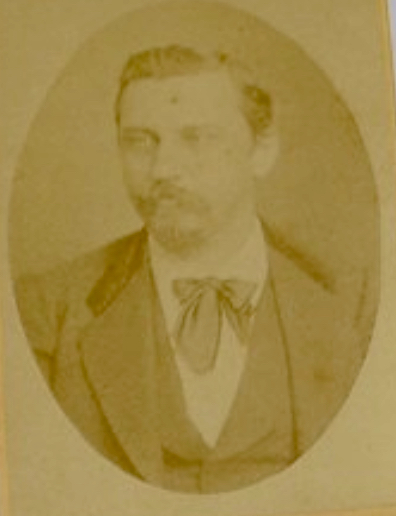
Legh Wilber Reid


     Legh and Emma's first child, a son, died shortly after he was born in Lynchburg in February 1866. They had three more children during their years in Alexandria--Legh Wilber, Jr., James Henry and Mary Cassandra. 

     When they returned to Alexandria in May 1866, Legh and Emma shared a house with his parents. James Henry Reid continued his work as treasurer and secretary of the Orange and Alexandria Railroad. Legh was given the job of the company's paymaster. This required him to travel by a special car attached to a freight train, which stopped at each station and pay the employees in cash. Because Legh had to use crutches, Emma accompanied him on these trips.

     James Henry Reid died of a stroke while conducting the company's business in the Baltimore banking house of Robert Garrett on May 19, 1869. His remains were brought back to Alexandria, where he was buried in Ivy Hill Cemetery. 

     After Reid's death, his widow Amy and Legh's family moved from the large house they had lived in on Fairfax Street to a smaller one on Cameron Street. Legh was offered his father's positions as treasurer and secretary. He met with the company's president, John S. Barbour, Jr., and convinced him that the company would be better served by dividing those two offices between two men. He also told Barbour that the frequent trips to Baltimore to transact the treasurer's business would impose difficulties on him in his crippled condition. Barbour agreed, and Legh became the company's secretary at the same salary his father was paid for both offices. 


     At the end of the Civil War, William A. Jackson reunited with his wife, Mary. They lived with their daughter Lucy and her husband David Kent in Pulaski County. Jackson remained there for the rest of his life, which ended on January 15, 1875. His remains were brought back to Fredericksburg, where he was buried in the Confederate Cemetery. 

     Jackson's unmarried sisters, who had enjoyed a successful teaching career in Kentucky before the Civil War, came to Alexandria in the autumn of 1869. They lived in hotels for a while, but then moved to the home of Legh and Emma, who had bought a house with Amy at 504 Duke Street. Legh enlarged the house to accommodate Emma's aunts. Except for a period in the 1880s when they lived in Northampton County, the Jackson sisters lived with the Reids for the rest of their lives [1]. After the deaths of her daughter Lucy and son-in-law David Kent, Mary Cassandra Riely Jackson moved in with her sisters-in-law in Northampton County, where she died on September 29, 1889. Like William, she was buried in the Confederate Cemetery in Fredericksburg. 

John Strode Barbour, Jr.


     Legh continued his work with the railroad, which was renamed the Virginia Midland in 1873. He was also president of the Charlottesville & Rapidan Railroad, and sat on the board of directors for several other companies. In 1884, the Virginia Midland was bought by northern investors and its headquarters were to be moved to New York. Legh decided to make a career change, with the help of John S. Barbour who by now was serving in the House of Representatives. Grover Cleveland, a Democrat, had just been elected president of the United States, and patronage jobs became available to those with connections. Legh's connection was Mr. Barbour. Legh was given the position of assistant register of the Treasury Department. His boss was former Union General William S. Rosecrans. Legh stayed at the treasury until the Republicans came back into power in 1891.


     By this time, Legh's eyesight had begun to fail. He was diagnosed with cataracts. Dr. Robert Randolph of Johns Hopkins Hospital operated on one eye, and two years later repeated the operation on the other eye. Unfortunately, Legh derived little benefit from these procedures. Unable to work, he spent most of his time at home. By now he no longer used crutches, but was confined to a wheel chair. He and Emma enjoyed visits from from friends and family members, and they spent their summers in Atlantic City. The years quietly passed by. Legh Wilber Reid died at his home on Duke Street on Thanksgiving morning, 1908.

Legh Wilber Reid

Emma Catherine Jackson Reid


     Emma outlived Legh by fifteen years. The family of her daughter Mary moved in with her at Duke Street. She died at home on December 3, 1923. She is buried near Legh in Ivy Hill Cemetery.

The Manassas Journal 7 December 1923


[1] Pattie, the last surviving sister of William A. Jackson, died at the Reid home in Alexandria in January 1901. I have been told that during the Civil War, Pattie made great efforts to ship food and clothing to captured Confederate soldiers confined in northern prisons. A collection of letters written to her by these grateful men are being edited for publication.


My thanks to Marc Storch, who introduced me to the stories of the Jackson and Reid familes. 

Special thanks to Ronald Turner, Morgan Breeden and Dave Cuff of the Prince William County Historical Society for their assistance.


Sources:

- "Reminiscences Dedicated to my Children and Grandchildren," by Emma C. Reid, March 1918.

- Ancestry.com

- Fold3.com: Compiled Service Records of Confederate Soldiers who served in Organization from the State of Virginia, and Confederate Papers Relating to Citizens or Business Firms, 1861-1865.

- Chronicling America


Wednesday, July 13, 2022

"I have arrested Mr. George E. Chancellor"


George E. Chancellor at a breastwork near Ellwood, April 1866

     Born in Spotsylvania County about 1842, George Edwards Chancellor was one of ten children born to Reverend Melzi Sanford Chancellor and the former Lucy Fox Frazer. He spent his first years at Hazel Grove, near Chancellorsville. In 1857, his uncle Lorman Chancellor bought Dowdall's Tavern on the Orange Turnpike (modern Route 3) near Wilderness Baptist Church, and Reverend Chancellor and his family lived there until it was destroyed by a fire in 1869.

Dowdall's Tavern, April 1866

     George Chancellor enlisted in Company E of the 9th Virginia Cavalry in Fredericksburg on April 25, 1861. His compiled service record shows that he was promoted to lieutenant in December 1862. On October 19, 1863, at the Battle of Buckland Mills in Fauquier County, Chancellor's horse was shot from under him. Like most soldiers in the Confederate cavalry, he owned his own horse, for the loss of which he was compensated $1,100 (in Confederate currency).  

     In his obituary published in The Free Lance on November 15, 1887, it was noted that Chancellor was wounded while leading his company on a charge near Petersburg in the waning days of the Civil War. His death notice also reported that: "In his wardrobe may be found a coat he wore in the war, in which are a dozen or more bullet holes, pierced by missiles from the enemy's guns, which he kept as a relic."

Chancellor family, April 1866

     In the Chancellor family portrait shown above, George Chancellor is seated next to his father.

     Although Chancellor continued to farm land he owned in Spotsylvania until 1883, by the late 1860s he realized that his skills and ambition would be better served by joining the merchant class of Fredericksburg. By 1870 he was living in the household of  Patrick McCracken, who owned a grocery and dry goods store on Commerce (William) Street, where Chancellor worked as a clerk. 

     In 1873, Chancellor bought a building at the corner of Commerce and Charles streets, where he opened his own farmer's supply and grocery store, which he successfully ran until his death in 1887. It was then owned by his younger brother Melzi Sanford Chancellor, Jr. (shown in the portrait above seated at his father's knee). After Sanford Chancellor's death in 1925, the store was operated by his nephews until 1954.

Broadside advertising Chancellor's business (Library of Virginia)

     In addition to his success as a merchant, Chancellor was also active in the civic life of Fredericksburg. Among his other endeavors, he served as vice president of the fair association, was a member of the Battlefield Excursion Committee, and played a role in the local politics of the Conservative Party.

     In October 1876, General Joseph Hooker and his literary executor, Samuel P. Bates (who was also the state historian of Pennsylvania) engaged the services of Chancellor to act as their guide to visit the Chancellorsville battlefield. In an article for The Century Illustrated Monthly Magazine, Bates wrote:

"We were accompanied on our ride to the Chancellorsville field some ten or twelve miles above Fredericksburg by Major George E. Chancellor, a son of Melzi Chancellor, whose home at the time of the battle was at Dowdall's Tavern, where General Howard had his headquarters. On setting out, General Hooker suggested that we should take some lunch along with us, as when he was there last, there was very little to eat in all that region. Major Chancellor thought it unnecessary, and in fact, we feasted most sumptuously at his father's house."

Chancellor's Retreat, 1884 (National Park Service)

     Chancellor, Hooker and Bates had their lunch at Chancellor's Retreat, the home that Reverend Melzi Chancellor built behind Wilderness Baptist Church after Dowdall's Tavern burned in 1869.

     At the conclusion of the Civil War, however, George Chancellor's accomplishments and adventures still lay ahead in an uncertain future. In 1865, George and his fellow veterans in the region were obliged to make a new start in a war-ravaged landscape, where money was scarce and prospects were bleak.

     For George Chancellor, a possible solution to this problem might be found by offering his services to a group that had plenty of money--the Northerners who began to surge into the Fredericksburg area after the surrender at Appomattox. Chancellor's intimate knowledge of his home county and the battlefields where he had fought provided him with a unique skill set that could be of use to his former enemies.

    His first step was to make a sales pitch directly to Secretary of War Stanton. In his book Where Valor Proudly Sleeps: A History of Fredericksburg National Cemetery, 1866-1933, author Donald Pfanz mentioned that on December 1, 1865 Chancellor wrote a letter to Stanton in which he offered to act as caretaker for the two federal cemeteries created by volunteers earlier that year (and presumably the cemeteries of the Union hospitals that were set up during the war) and to create another by gathering the remains of U.S. soldiers still unburied. He hinted that there was some urgency involved, as those remains were subject to being disturbed by the natural elements (including wild animals) as well as the hand of man. Quoting from Chancellor's letter, Pfanz writes: "If [the bodies] are not taken up and carried to some burying ground they will soon be plowed over by the farmers as a great many are in the cultivated fields." As it happened, the government gave careful consideration to Chancellor's proposal, but decided it could achieve the same result with less expense by undertaking the work itself. 

     Another idea Chancellor had in this line of work had, perhaps, a greater potential for success. He advertised a list of names of Union soldiers whose graves he could identify. For those who might take him up on that offer, he would (for a fee) take relatives to the grave site of their loved one so that the remains could be taken back to their home states and given a proper burial. As we shall see, Chancellor's experience with one such person seeking the grave of his brother-in-law got him into some trouble with the provost marshal of Fredericksburg. 

Dr. Reed Brockway Bontecou

Harewood Military Hospital, Washington D.C.


      Either by means of this advertised list of names or by some other means of self-promotion, the name of George Chancellor came to the attention of Dr. Reed Brockway Bontecou, the chief surgeon of the Harewood Military Hospital at Washington, D.C. During the years the hospital was in operation, 1863-1866, Bontecou revolutionized war-time medicine by photographing his patients. These photographs were used to document the treatment of the wounds of his patients and to track their progress. A great many of these photographs still exist, including this one of Frederick Pilgrim of the 8th New York Cavalry:

Frederick Pilgrim

     These pictures were taken by, or under the direction of William H. Bell, chief photographer of the U.S. Army Medical Museum. Bontecou's unique access to Bell's skills and equipment allowed him to undertake a historic project quite unrelated to his duties at Harewood Hospital. In the early spring of 1866, Bontecou led three photographic expeditions to the battlefields of Fredericksburg, Chancellorsville, Wilderness and Spotsylvania Courthouse. A total of 121 photographs were taken by Bell and his assistants. (My thanks to historian and author John Cummings, whose research discovered Bontecou's link to these historic images. Mr. Cummings is currently working on a book on this very topic).

George Chancellor and Dr. Bontecou at Confederate works near Spotsylvania Courthouse, April 1866

     During Dr. Bontecou's visits to the area's battlefields, George Chancellor acted as his guide. The two men developed a friendly rapport and Dr. Bontecou was grateful for Chancellor's assistance. George, it can be assumed, was grateful for the business opportunity. 

Prentiss M. Fogler

     About the same time that he was guiding Bontecou and his crew, Chancellor was contacted by Prentiss M. Fogler of Hope, Maine. Fogler had somehow become aware of Chancellor's list of known burials of U.S. soldiers in the Spotsylvania area. He requested Chancellor's help in locating and retrieving the remains of his brother-in-law, Sergeant John D. Leach [2]. Both men served in Company I of the 20th Maine Infantry, which Fogler had commanded. Leach had been killed in action in the Wilderness on May 7, 1864, and was buried in the 5th Corps hospital cemetery there.

     Prior to meeting Fogler, Chancellor removed Leach's head board from his grave and took it to his house for safe keeping. He placed his own marker on the grave so that, it would seem, only he would be able to locate Leach's grave. 

     Fogler and Chancellor met Saturday, April 21, 1866. With them was William H. King [3], who later worked as the porter at the Exchange Hotel. King offered to drive Fogler out to the cemetery in his wagon for $12. At this point, Chancellor spoke up and said that since he had removed Leach's head board, King would not be able to identify his grave. Chancellor said that he was willing to accompany Fogler and King and designate the grave. His fee was $20. Fogler realized that he had no other choice than to accept Chancellor's offer, so the three of them, together with Sanford E. Chaffee [4], went out to the 5th Corps hospital cemetery. On the way there, they stopped by Chancellor's house to retrieve Leach's head board. 

Colonel Henry A. Hambright

     Fogler was decidedly unhappy about the way Chancellor conducted his business with him. As soon as he returned to Fredericksburg, he went to the office of  Colonel Henry A. Hambright [4], the provost marshal, whose office was located at the corner of Princess Anne and George streets. Fogler wrote an affidavit, witnessed by Hambright's adjutant, Richard Robins attesting to his experience that day. Fogler was quite angry about being charged $20 for three hours work, not to mention the fact that Leach's head board had been removed prior to his trip to the cemetery, which forced him to accept Chancellor's terms. 

     On April 27, 1866, Colonel Hambright wrote a letter to General Edward W. Smith, assistant adjutant general in Richmond:

"Sir,

I have the honor to report that I have arrested Mr. George E. Chancellor on the charge of removing the head board from the grave of a Union soldier. The charge was made by Mr. P.M. Fogler of Hope, Maine, a copy of which I herewith enclose, the original being a file in my office.

Mr. Chancellor states that he advertises a list of names of men whose graves he can designate. Mr. Fogler seeing the name of 1st Sergt. John D. Leach Co. I 20th Maine Vols. on the list wrote Mr. Chancellor to find out about said grave. Mr. Chancellor answered his letter when Mr. Fogler wrote that he would send some one for the body who would see Mr. Chancellor about it. Mr. Chancellor immediately removed the head board from the grave, as he says, placing his own mark there to designate the spot then he gave his reason for taking the head board as follows--that he was afraid the head board would be destroyed in some [manner] and then when Mr. Fogler came down he would not be able to designate the grave. Mr. Fogler came down and hired Mr. [William] H. King of Fredericksburg to convey him to the grave of 1st Sergt. John D. Leach Co. I 20th Maine Vols. on the Wilderness Battle field where the 5th Corps hospital had been established, take up the body and return to Fredericksburg with it for the sum of $12. Mr. Chancellor being near said that they would not be able to find the grave as he had removed the head board but would show Mr. Fogler  the grave and take up the body for $20 which bargain Mr. Fogler was obliged to make.

Mr. Chancellor having given the above facts I gave him his liberty upon his signing an agreement to appear upon being sent for. 

I remain, sir, your most obt. servt.

H.A. Hambright"

     Two days after this letter was written to General Smith, William H. King and Samuel E. Chaffee [5] came to Hambright's office, where each submitted his own affidavit. King said that after Fogler learned it would cost him $20 to be shown the grave site of Sergeant Leach, "We then started to the grave, on our way we stopped at Mr. Chancellor's house. There I saw the head board. It was put in my wagon. When we arrived at the grave Mr. Chancellor dug up the body and put it in the coffin."

     Mr. Chaffee, who was also a witness to this affair, stated: "I heard Mr. Fogler ask Mr. Chancellor if he could show him the grave of Sergt. Leach and he replied that he could for he had the head board at his house. And he added that he had taken it up to prevent it from being destroyed. I also saw the head boart at the house of Mr. Chancellor the same afternoon."

     It is not known what consequences George Chancellor may have faced for his actions, but he was sufficiently concerned to get word of his difficulties to Dr. Bontecou, who came to Fredericksburg and wrote a letter on Chancellor's behalf. I am unable to tell for certain whether his letter was intended for Hambright or Smith, but I think that General Smith did at least see this letter:

"Fredericksburgh, Va

Apr 29--1866

Dear Sir

I desire to state what I know of Geo. E. Chancellor who has shown myself and party great attention & friendship on three visits recently made to the battlefields of Chancellorsville, Wilderness & Spotsylvania. He resides near the Wilderness and is engaged with his brother [Vespasian Chancellor] in cultivating a farm, is of excellent character & is respected by all who know him. His thorough knowledge of the country led me to secure his company in showing all the points of interest, and in these rambles I have observed him to replace many head boards of U.S. soldiers that had been disturbed and seemed to manifest and earnest desire to preserve their condition. I have volunteered to make this statement from having heard to day that complaint had been made of his having removed head boards. I do not pretend to know the merits of the case in question other than the grounds about the graves are an open common exposed to fires and depredations by hogs, indeed I saw many not many rods from that house the remains of three soldiers that been rooted up by the hogs and several head boards plainly marked lying about the ground in the vicinity of the graves.

I do not believe that Mr. Chancellor would willfully destroy the identity of any grave, but would rather trouble himself to preserve such. He has been able to give great assistance to parties from the North looking after friends which his intimate knowledge of the Battle grounds renders a good value.

I have recently taken a series of Photographic views of our line of works from the Wilderness to Spotsylvania for the Army Med[ical] Museum and have observed many remains of men that never have been buried, and many quite imperfectly covered, their heads & feet now exposed.

I should judge that on the Chancellorsville fields there are one hundred skulls lying about. Mr. Chancellor would be of great service in pointing out the locations of these to any party the government might send to gather them up.

I have the honor to be very respectfully & truly yours

R.B. Bontecou

Bvt. Lt. Col. & Surgeon Harewood USA Gen' Hospital"

     The influence of Dr. Bontecou seemed to clear this matter up for George Chancellor, who was apparently summoned to the office of General Smith in Richmond. On May 3, 1866, Chancellor wrote a letter to Smith, reminding him that he had promised to compensate Chancellor for the expenses he incurred to make the trip to Richmond and for his absence from his farm. 


[1] Prentiss Mellan Fogler (1838-1897) was born on his family's farm in Hope, Maine. He attended the Westbrook Seminary (now Westbrook College) in Portland, Maine. He commanded Company I of the 20th Maine Volunteers, which achieved a measure of immortality for its heroic defense of Little Round Top during the Battle of Gettysburg. The regiment's commander, Colonel Joshua Chamberlain, won the Congressional Medal of Honor for his actions that day. After the war, Fogler served as secretary to Governor Joshua Chamberlain, was the registrar of deeds for Kennebec County for 20 years and served as assistant secretary of the state senate. In 1897, he died as the result of burns received when a lantern he was carrying shattered after he stumbled and fell, covering his arms with burning oil.

[2] John D. Leach (1839-1864) was born on his family's farm in Hope, Maine. Just prior to his enlistment in the 20th Maine, he married the sister of Prentiss Fogler. Despite the unpleasantness experienced by Fogler in retrieving his body, Leach's remains were successfully transported to Maine and laid to rest in West Rockport Cemetery.


[3] William H. King (1844-1869) was born in Rochester, New York and came to Fredericksburg shortly after the Civil War. He worked as the porter at the Exchange Hotel. He married Fredericksburg native Margaret Jennings, a seamstress, in 1868. The following year, William King died of tuberculosis, and Margaret returned to the household of her widowed father, a shoemaker. After his death from tuberculosis in 1875, Margaret lived with her brother for a number of years. She spent the last 24 years of her life in the Fredericksburg Alms House, where she did of tuberculosis and syphilis in 1918

[4] Henry Augustus Hambright (1819-1893) was born in Lancaster, Pennsylvania. He was a veteran of the Mexican War, and worked as a public works contractor prior to the Civil War. He commanded the 79th Pennsylvania Volunteers until he was mustered out in June 1865. He then served for 14 years in the 11th United States Infantry. He served in several posts until his retirement in 1879, including duty as provost marshal in Fredericksburg January-June 1866.

[5] Samuel Erasmus Chaffee (1838-1920) was born in East Windsor, Connecticut. Just prior to the Civil War he worked as an axle maker. During the Civil war he served in the 20th Connecticut Infantry. He came to Fredericksburg shortly after the Civil War, and was appointed by the military authority as the city tax collector and as a justice of the peace. In October 1869 he married Fredericksburg native Mary Elizabeth Turner. They had one son, James Sanford. Samuel Chaffee returned to Connecticut sometime during the 1870s, leaving his wife and son behind. Mary and James lived with her parents until their deaths, then she lived with brother, Fredericksburg merchant William G. Turner. Mary died in 1923.


My primary source for the details surrounding George Chancellor's involvement with Prentiss Fogler is at Ancestry.com--U.S., Union Provost Marshal Papers, 1861-1867


Saturday, April 9, 2022

"I may never see you all again"


Salem Baptist Church, 1870s (Confederate Memorial Literary Society)

     John C. Davis was born  in 1837 on a farm in Limestone County, just west of Huntsville, Alabama. He was the oldest of fourteen children born to Elizabeth Covington Davis and James Brown Davis, a farmer, slave owner, constable and justice of the peace. 

James Brown Davis (Ancestry)

Elizabeth Covington Davis (Ancestry)

       John C. Davis married Elizabeth Jane Jackson by the mid-1850s and they had at least three children together--James "Buck" Buchanan, Mary Helen and Elizabeth. By 1860 the Davis family was living on a farm, one they likely rented.         

Muster of new recruits in Company H, 9th Alabama

     John enlisted in Company H of the 9th Alabama Infantry in Athens, Alabama on March 22, 1862. He was soon sent to Virginia to join the rest of his regiment. Like many new recruits, John soon fell ill with one of the many ailments that afflicted soldiers new to camp life. He was twice a patient at Chimborazo Hospital No. 4 in Richmond during the summer of 1862, with a diagnosis of "Debility," meaning general weakness from some undiagnosed illness. He returned to active duty after his second hospital stay on September 28.

First page of John's letter to Betty Jane

     Just three days before the Battle of Chancellorsville, John sat down to write a four-page letter to his wife. My transcription of this letter follows below. To make it easier to read, I have corrected many of his misspellings but have otherwise let his writing speak for itself. 

April the 28th 1863

Camp Near Fredericksburg Virginia

Elizabeth Jane

Dear Miss

After my love and respects to you I will answer your very welcome letter. I received it a few days ago and was mighty glad to hear from you all and you were all well, was very good news. You gave me great satisfaction to hear and see a letter should come from under your loving hand. Betty Jane I can look at it and think that your hand has been the instruction of it & I can bring the very image of your lovely looks. Betty Jane I can see that black spot on your face in my mind as plain as noon day. Betty Jane never cease writing me for I love to hear from you and the little children. Now if I  just could see Buck & Mary's little sharp teeth a-smiling at me once more. Betty, you say that you have a mighty pretty little girl [Elizabeth Jane, their youngest child]. Well Betty I expect she is pretty if she is any kin to Mary. Betty I know Mary is a pretty child. Her eyes will always help her out for beauty. Please give me the Baby's name in full. I thought I never would ask you her name because you would not tell me. But Betty it is no time for curiosity for I may never see you all again. Tell Buck to go to school and you try to encourage him to learn. For if I ever should get home I am determining to educate him if he will partake of it and if I should never get home I will Request you to give him good learning if you have to live on dry Bread never think Poor folks can't send their children to school it is all a mistake. We know that if you could live with his work you could live without it. Betty I reckon it will be a great while before I can see you again but make yourself sure if we can but only live that time will surely slip off after a while and then it will be for life time. I do not intend to ever go into another war. It is a rough one and when I get home again it will take a great deal more than the Yankees ever done to make me mad enough to come away to old Virginia and leave all that is near and dear to and bind myself tighter than any negro you ever saw. I tell you my dear Betty Jane I can never do it again. You say a heap of the Boys have deserted. I can't blame them much for they do not treat the private soldiers right. You written to me that you was glad when the cavalry came in there a-picking up the Conscripts that I was gone. I will join you there. I am glad I was not there but I wish I had a-stayed longer and a-got in Thompson's Cavalry and then I would have a-been so much closer to home. You said that you would not blame me to desert. Betty I would be afraid that you would not give me anything to Eat. Well do not think I shall ever desert if I am treated as well as I have been. We do not get enough to eat. We get a quarter of a pound of Bacon and a heap of time there is half of that dirt and a pound and 2 ounces of flour and then it is all [illegible]. We have got two messes of Irish potatoes this spring. Tell me in your next letter all of the deserters' names and do not let everybody be a-reading your letter. It is not concerning anybody but you. What I write to you I do not care for pap a-reading them. Tell me whether Sam Cot was in the army or not. Tell me whether Pink Davis has ever gone back to the army  and all about the connection. You take good care of all the things. Mind the horses and do not let them be rode to death. I expect my saddle and my fiddle will both be ruined before I ever get home. Well my paper is gone and I must stop for this time.

John C. Davis to Elizabeth Jane Davis

     At the time John wrote this letter, the 9th Infantry was one of five Alabama regiments in the brigade commanded by General Cadmus Wilcox. This brigade would undertake some serious work in the days ahead.

     On the morning of May 3, 1863, Union forces commanded by General John Sedgwick attacked General Jubal Early's Confederates defending Fredericksburg. This was the beginning of an effort to open a second front against General Robert E. Lee's troops at Chancellorsville. The outnumbered Confederates were pushed off Marye's Heights, and the Federals began to march west on the Orange Turnpike (modern Route 3) toward Chancellorsville. Most of Early's troops retreated a couple of miles south to defend the railroad to Richmond. Hearing that Sedgwick had dislodged the defenders at Fredericksburg, Lee sent the divisions of McLaws and Mahone to reinforce Early.

The Battle of Salem Church (Official Military Atlas of the Civil War)

     Wilcox's brigade, which had been guarding Bank's Ford on the Rappahannock, moved to the turnpike and occupied a position across the road at Salem Baptist Church. They were soon joined by McLaw's and Mahone's men. Wilcox set up a skirmish line, which included two pieces of artillery, at the turnpike's toll gate about a mile east of his main line at Salem Church. After exchanging a few shots with these Confederates, the U.S. army then pushed them back and advanced toward the church.

     The men of the 9th Alabama, together with those of the 10th Alabama, stopped the advance of the 121st New York, which suffered fifty percent casualties. Then the 9th, 10th and 14th Alabama, joined by the 51st Georgia, pushed the Union troops back toward the toll gate, where their artillery was placed. The retreating soldiers in blue reformed their line there, and poured withering fire into the charging Confederates. Wilcox called off the attack shortly before dusk.

Salem Baptist Church (Library of Congress)

Salem Baptist Church (National Park Service)

     A makeshift hospital was set up at Salem Church, and hundreds of wounded soldiers were brought there for treatment. Among those men was John C. Davis, who died of his injuries. John and the many others who died there were buried in the church yard. Later, his remains were taken to the Confederate Cemetery in Fredericksburg.

Headstone of John C. Davis (Dan Janzegers)


Sources:

-John C. Davis's letter was shared with one of my readers by one of his descendants, Robin Burchfield

-Ancestry.com

-Fold3.com

-Battle of Salem Church: Final Federal Assault at Chancellorsville


Saturday, March 26, 2022

Reverend Elmer Grant Barnum


Elmer Grant Barnum

     Elmer Grant Barnum was born in New York near Lake Ontario in the farming community of Sanborn, Niagara County, on October 14, 1868. He earned a master of arts degree from the University of Rochester in 1896 and became a member of prestigious Phi Beta Kappa, the oldest academic honor society in the United States. He then attended the Rochester Theological Seminary (forerunner of today's Colgate Rochester Crozer Divinity School) and completed his studies in 1900.

     On November 21, 1900 he married Edna Westfall, who was the librarian at the seminary. Edna was the daughter of Gilbert and Emma Westfall of Rochester, where her father, previously a farmer, was a grocer and milk delivery man. The following year, the American Home Baptist Missionary Society selected Elmer to travel across the country to the little mining town of Republic, Washington to provide religious leadership to its residents. Elmer and Edna spent one year in Republic before returning to New York. 

     In 1902, Edna's father bought a farm in Girdletree, Maryland. Elmer and Edna moved to the farm with her parents, and for a time Elmer managed the farm for the Westfalls. On July 10, 1903 Mildred Edith, who would be the Barnums' only child, was born in Girdletree. 

     Elmer managed the farm for his father-in-law, who bred sheep, cattle and hogs. While Elmer was a stock man himself, his true calling was that of a minister and educator. Soon after his arrival in Girdletree, he became the principal of the local high school and a preacher in the Baptist church.


Democratic Messenger, 27 May 1905


Democratic Messenger, 24 November 1906

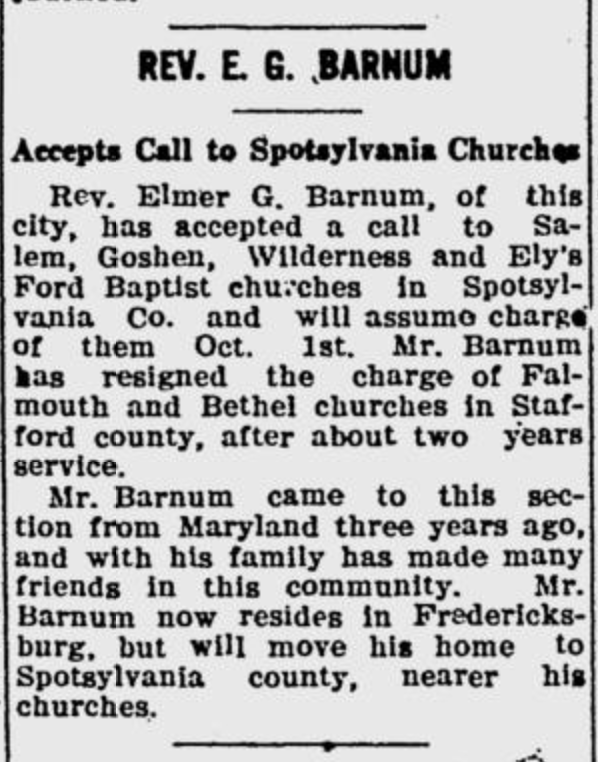
     Although they seemed to be prospering in Maryland, the Barnums and Westfalls made the decision to move to Stafford County, Virginia in 1908. Gilbert bought the 200-acre Riverside Farm on River Road, and he and Elmer resumed their business together as stock breeders. As he had done in Girdletree, Elmer continued his career as a pastor in Stafford County. He served as a minister at both Falmouth and Bethany Baptist churches until 1911. Elmer and his family moved to Fredericksburg that year and he was soon thereafter asked to assume the pastorship of four Baptist churches in Spotsylvania County--Salem, Goshen, Wilderness and Ely's Ford. His congregation at Falmouth Baptist Church was sad to see him go, and published a resolution to that effect in The Free Lance.


The Free Lance, 17 August 1911


The Free Lance, 7 September 1911

     At some time prior to 1920, Elmer moved to Spotsylvania County to be nearer his churches. The Barnums lived at "Pleasant View," which had been the home of the late Absalom McGee, located on the north side of Route 3 near McLaws Drive. Absalom's widow, Cicely Timberlake McGee, sold the house and 30 acres to Elmer in 1921.

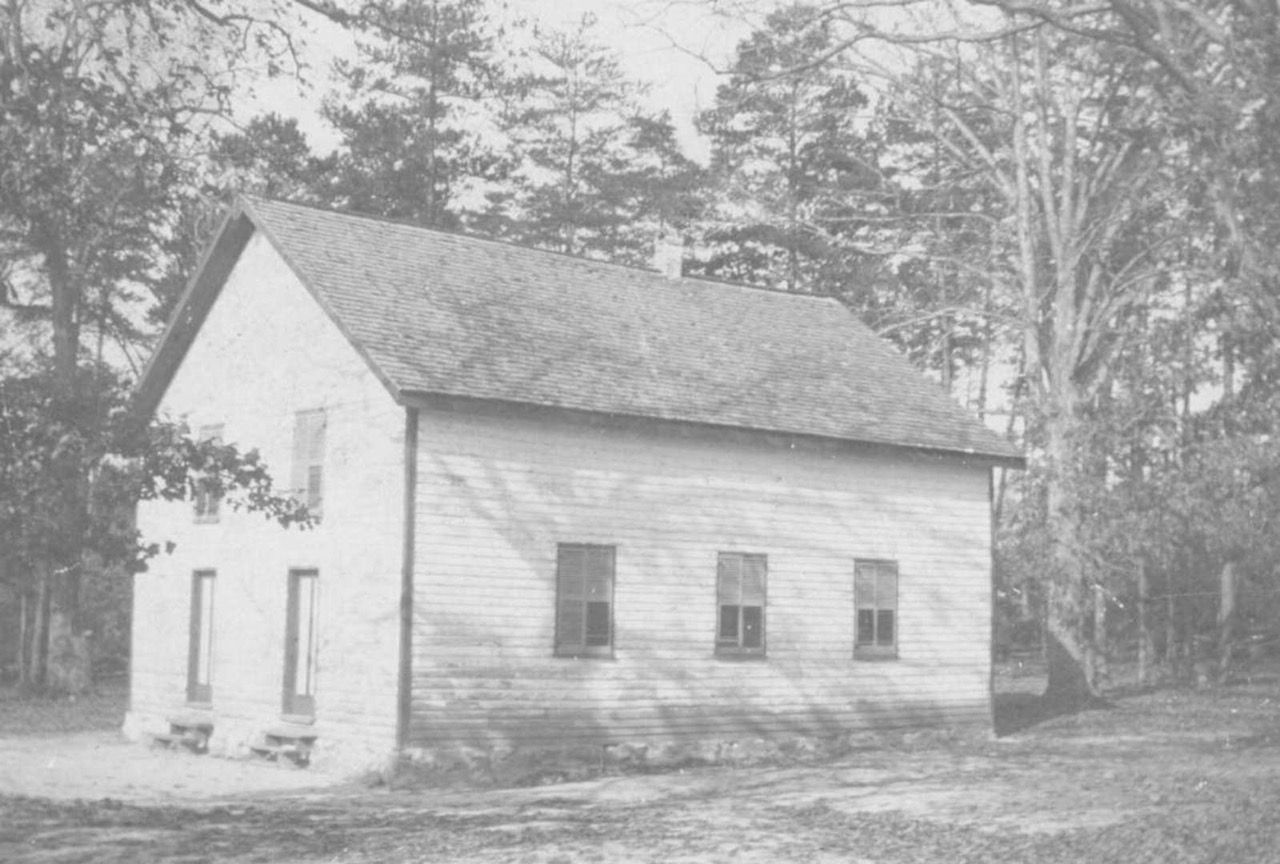
     In addition to the four Baptist Churches mentioned above, Reverend Barnum over time also became the minister at Zoan in Spotsylvania and Flat Run in Orange County. While he undoubtedly left a lasting impression at each church he served, his most enduring legacy was at Goshen Baptist Church. When Elmer became the minister there, the existing church building was still the small structure erected in 1875. In 1912, Goshen's building committee laid plans for the construction of a new sanctuary. Reverend Barnum drew up plans for the new church and made a miniature model of its design. Elmer did much of the actual construction work himself, including making the large wooden columns for the front of the church (during the installation of one of these columns he fell to the ground, but escaped serious injury). The new building was completed in 1913, and remained standing until 1957, when it was replaced by the brick sanctuary that stands today.

Goshen Baptist Church 1875-1913


Goshen Baptist Church 1913-1957

     The newly built Chancellor School on Old Plank Road was dedicated in December 1912. The school offered classes for grades 1-12, and was the first public high school in Spotsylvania County. Mildred Barnum was a student there, as seen in this photograph of the high school students and principal taken about 1920 (she is number 11):


     Following her graduation from Chancellor, Mildred attended the State Normal School in Fredericksburg, the forerunner of today's University of Mary Washington. She graduated in 1923.


Mildred Barnum, 1922 (The Battlefield)

Mildred Barnum, 1923 (The Battlefield)


     When the United States entered the First World War, many of America's ministers did their part for the war effort by volunteering to join the YMCA's venture to sustain the morale of America's fighting men overseas. Hundreds of YMCA facilities behind the lines provided rest-and-recreation opportunities for the soldiers. In June 1918, Reverend Barnum applied for a passport so that he could join this effort. His application was endorsed by the War Department in August 1918, and he left for France shortly thereafter. He remained in Europe until May 1919, when he boarded a ship in Brest bound for the United States.

U.S. Army Transport List (Ancestry.com)

     After the war, Reverend Barnum served two stints as principal of the Chancellor School. The first was 1922-1924. He then served for two years as principal of the Franklin-Sherman High School at McLean in Fairfax County. Mildred taught there during his stay. He then returned to the Chancellor School, where he was principal 1926-1931.

The Free Lance Star, 24 August 1928

     On the evening of August 23, 1928, Elmer and Edna Barnum left their home and drove west on Route 3 in order to attend services at Flat Run Baptist church, where he had previously served as pastor. In an approaching car in the eastbound lane were Mr. and Mrs. Richard Irving Scott and their two daughters, Anna and Evelyn, who were on their way to Wilderness Baptist Church for evening services. Just west of Wilderness Church, one of these two cars inadvertently crossed the center line of the road and sideswiped the other vehicle. Both cars careened off the road and overturned. Young Evelyn Scott fell through an open window and the car rolled over her, killing her. No one was ejected from the Barnums' car, but after the car stopped Edna cried out, "Oh, my chest." Because she had been suffering from heart problems, it was assumed at the time that she may have been having a heart attack (her death certificate indicated that she had suffered internal injuries). Edna Westfall Barnum died shortly after her arrival at Mary Washington Hospital. Her funeral service was conducted by Reverend Edward Voorhees Peyton at Salem Baptist Church, and she was buried at Oak Hill Cemetery.

The Free Lance Star, 25 August 1928

     During the 1930s, Mildred Barnum worked as a writer for the Works Project Administration. She conducted research and wrote brief summaries of many of Spotsylvania's historic properties, including my family's old plantation, Greenfield (part of which now comprises a portion of the Fawn Lake subdivision):


     By the mid-1930s, the energetic and seemingly indefatigable Elmer Barnum began to suffer from rheumatoid arthritis. In the 1940s he also developed significant heart trouble and was bedridden for the last five years of his life. He was cared for by Mildred, who never married and lived with her father until he died on September 5, 1951. Like Edna, his funeral service was conducted by Reverend Edward Voorhees Peyton, and he was buried next to Edna at Oak Hill Cemetery.

Free Lance Star, 6 September 1951

     During the 1940s, Mildred worked as a bookkeeper for Fredericksburg Hardware, and by the 1950s she was keeping the books for Brown Brothers and Company.

   The photo below, which was shared with me by Jim Orrock, shows Mildred Barnum with sisters Mollie and Maggie Orrock during a trip to the Blue Ridge Mountains. Mildred stands at right:


     Late in her life, Mildred suffered from dementia and was placed in the Virginia Baptist Home in Culpeper. She died there on May 28, 1989 and lies buried near her parents at Oak Hill Cemetery.